KCC Institute of Legal and Higher Education, Greater Noida
Law Admissions 2026 Open | Avail Merit-Based Scholarships


The molecular basis of inheritance explains how the genetic information is stored, passed, and expressed in living organisms. It basically focuses on DNA, which is the primary genetic material, and RNA, which plays a role in the expression of genetic information. Understanding these concepts helps explain how traits are inherited from one generation to the next and how genetic variation arises.
This Story also Contains
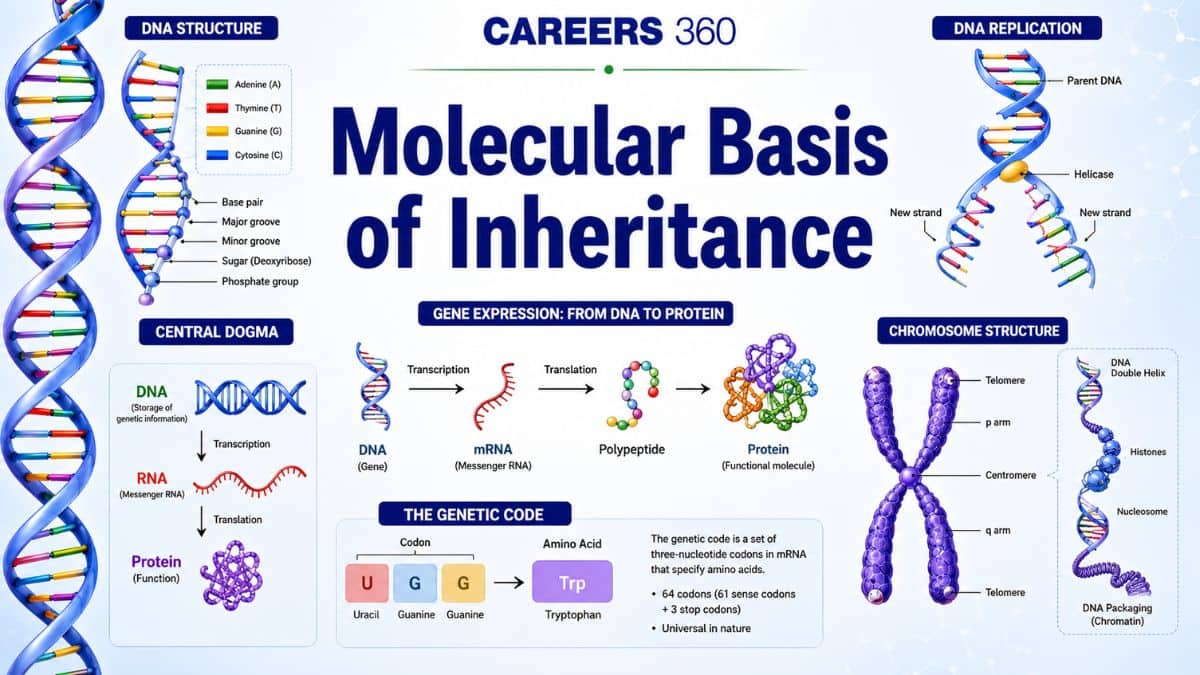
It is important to understand how the characteristics are passed down at the molecular level. Both DNA and RNA work as a blueprint for life. In this article, complete information about what inheritance is, why DNA is important in molecular biology, the structure of both DNA and RNA, the double helix structure of DNA, and the Human Genome Project is given.
Inheritance is the process by which characteristics are passed from parents to their offspring through genes. It explains how children inherit the physical features of their parents, like eye color, hair type, blood group, and certain human genetic disorders. This transfer of genetic information occurs through DNA, which is responsible for carrying the instructions for building and maintaining an organism.
Law Admissions 2026 Open | Avail Merit-Based Scholarships
BBA/MBA/PGDM Early Bird Applications Deadline 19th Oct '26. Apply now using coupon code CAREER250 and get ₹250 off the application fee
Genes are segments of DNA that carry hereditary information and control specific traits. Different parts of DNA are responsible for various factors such as skin colour, hair colour, eye color, etc. This means that DNA is largely responsible for the inheritance of cells. Some of the major reasons why DNA is important to the Molecular Basis of Inheritance are mentioned below:
The nucleus of a cell contains the nucleolus and chromatin. This is the place where all the genes are packed.
Chromatin is condensed into chromosomes, where thousands of genes are responsible for certain traits.
Humans possess 23 pairs of chromosomes (46 chromosomes in total)
Each pair of chromosomes contains thousands of genes that are responsible for deciding certain characteristics of your body as well as your personality.
The number of chromosomes can vary from species to species.
It is important to understand the structure of DNA and RNA to understand how genetic information is stored and transmitted. While both of these molecules are nucleic acids and are made up of long chains of nucleotides, they still differ in structure, function, and chemical composition. Some basic structure of DNA and RNA is discussed below:
Aspects | DNA | RNA |
Structure | Double stranded helix | Single-Stranded |
Monomer Unit | Deoxyribonucleotides | Ribonucleotides |
Pentose Sugar | Deoxyribose | Ribose |
Nitrogenous Base | Adenine(A), Guanine(G), Cytosine ( C ), and Thymine (T) | Adenine(A), Guanine(G), Cytosine ( C ), and Uracil (U) |
Exclusive Base | Thymine (T) | Uracil |
Function | Stores genetic material. | Helps in protein synthesis and regulation of genetic material. |
The N-glycosidic bond binds to the nitrogenous base and pentose sugar, forming a nucleoside. The phosphate group connected to this nucleoside by phosphodiester linking forms the nucleotide. Many nucleotides combine to form polynucleotides using a 3’-5 ’phosphodiester bond. This is how nucleic acid chains form in DNA or RNA. The entire procedure of how polynucleotide is made by joining nucleotide together is discussed below:
Each nucleotide consists of a pentose sugar-phosphate group and a nitrogenous base.
These nucleotides are linked through a phosphodiester bond between the phosphate group of 1 nucleotide and the 3’ group of sugar in another nucleotide.
This bond is formed using a sugar-phosphate backbone which is also supported by a nitrogenous base extending the sugar units.
Repeating the center bonding process creates a long chain of nucleotides which forms a polynucleotide like DNA or RNA.
Watson and Crick proposed the double helix model of DNA in 1953 based on X-ray diffraction data generated by Rosalind Franklin and Maurice Wilkins. It is made up of 2 polynucleotide chains. Sugar and phosphate form the backbone of the helix structure. Nitrogen bases are internal components and are bound by hydrogen bonds. Some more details about the structure of the Double Helix of DNA are discussed below:
DNA consists of two strands of polynucleotides that are coiled with each other in a helical shape.
Adenine is paired with Thymine, and Guanine is paired with Cytosine with hydrogen bonds.
The two DNA strands are running opposite to each other, one from 5’ to 3’ and the other from 3’ to 5’.
The outer structure of the helix is formed by the sugar-phosphate backbone and at the same time the nitrogenous bases are inward.
The strands are twisted to form a right-hand helix.
There are around 10 pairs per turn.
The process by which a DNA molecule produces an identical copy of itself before cell division.
Occurs during the S phase of the cell cycle.
Catalysed by DNA polymerase enzymes.
Follows the semi-conservative model.
Ensures genetic continuity across generations.
It was launched as an international scientific research project for determining the base pairs that make up human DNA. It includes identifying and mapping all the genes of the human genome in terms of physical features and functionalities. It has high importance in the fields of life science, medicine, and biotechnology. Basic facts about the Human Genome Project are mentioned below:
The project was started in 1990 and was completed in 2003, which was ahead of schedule.
It mapped around 3 billion DNA base pairs and has identified around 20,000 to 25,000 human genes.
It was an international research initiative that involved scientists from multiple countries.
The project has advanced an understanding of genetics that has led to the improvement of medicine, biotechnology, and disease research.
Based on their functions, RNA is mainly classified into the following types.
Type of RNA | Function |
mRNA (Messenger RNA) | Carries genetic information from DNA to ribosomes for protein synthesis. |
tRNA (Transfer RNA) | Transfers specific amino acids to ribosomes during protein synthesis. |
rRNA (Ribosomal RNA) | Forms the structural and catalytic components of ribosomes and helps in protein synthesis. |
Gene expression is the process through which the information stored in DNA is converted into proteins. It usually involves two main stages: Transcription and translation. Gene expression and regulation help explain how different cells perform specialised functions despite having the same genetic material.
Transcription:
It is the process by which a segment of DNA is copied into messenger RNA.
Translation:
It is the process where the mRNA sequence is processed by a ribosome to assemble amino acids into a specific protein.
The Central Dogma of Molecular Biology was first proposed by Francis Crick in 1958. He was among the co-discoverers of the structure of DNA. It explains the flow of genetic information and outlines how genes encoded in DNA are expressed through transcription and translation. The central dogma describes the following sequence:
DNA → RNA → Protein
The genetic code is a set of rules by which nucleotide sequences in the mRNA are translated into amino acid sequences in proteins.
Characteristics of Genetic Code:
Triplet code
Degenerate
Unambiguous
Universal
Non-overlapping
Commaless
The Lac Operon is a gene regulatory system in bacteria that controls the breakdown of lactose. It is found in Escherichia coli and other bacteria. It is an example of an inducible operon. This means that it is normally off but can be turned on in the presence of an inducer.
It consists of three structural genes:
lacZ - It codes for β-galactosidase
lacY - encodes for permease
lacA - encodes for transacetylase
The molecular basis of inheritance has important applications in medicine, biotechnology, agriculture, etc. It helps in the following ways:
Genetic Disease Diagnosis
DNA Fingerprinting
Gene Therapy
Biotechnology
Agriculture
Human Genome Research
Personalized Medicine
Evolutionary Studies
Frequently Asked Questions (FAQs)
The formation of protein or protein synthesis begins in DNA. The process of replication helps to make multiple copies of DNA. A single strand of DNA is copied to form mRNA and the process is called transcription. Now, during translation, all kinds of non-genetic RNAs- rRNA, tRNA and mRNA form proteins. This is called the Central dogma theory developed by biologist ‘Francis Harry Compton’ in which he states that biological knowledge flows in a single pattern.
DNA → RNA → Proteins
The molecular basis of genes refers to how genes are made up of DNA and how they store and transmit hereditary information at the molecular level.
James Watson and Francis Crick are often referred to as the "fathers of molecular biology" for their discovery of the double-helix structure of DNA, which laid the foundation for the field.
The Human Genome Project was launched in 1990. Its primary objective was to define the complete sequence of human DNA. To do this, genetic engineering and other advanced techniques are used.
DNA, called the genetic molecule and RNA, are two components that make up the basis. It allows living things to receive genetic information from the parents' genes. The genes are then reproduced and transmitted to the reproductive cell from the parent cell in each cell division.

Law Admissions 2026 Open | Avail Merit-Based Scholarships
BBA/MBA/PGDM Early Bird Applications Deadline 19th Oct '26. Apply now using coupon code CAREER250 and get ₹250 off the application fee
Ranked #36 amongst institutions in Management by NIRF | 100% Placement
Globally Recognized by AACSB (US) & AMBA (UK) | 18 LPA Avg. CTC for PGPM 2026
Leading Design College | 95% Placement Record | Merit-cum-Means Scholarships for Deserving Students
NEET PG All India & State College Predictor with Admission Process Guide