KCC Institute of Legal and Higher Education, Greater Noida
Law Admissions 2026 Open | Avail Merit-Based Scholarships


The alkaline earth metals are a team of six chemicals within the periodic desk made up using beryllium(Be), magnesium(Mg), calcium(Ca), strontium(Sr), barium(Ba), and radium(Ra). All of these elements have various properties that are physical and chemical in nature which ensures they find use across different industries and life forms. Alkaline earth metals are shiny, silvery-white in color, and high density such as alkali metals. As they are more metallic (i.e. the bonding is stronger) their melting points and boiling points tend to be higher than those of alkali metals This is the case for their electronic configuration containing 2 electrons in s-orbitals of the highest energy which they tend to lose forming diatomic cations hence +2 oxidation state.
This Story also Contains
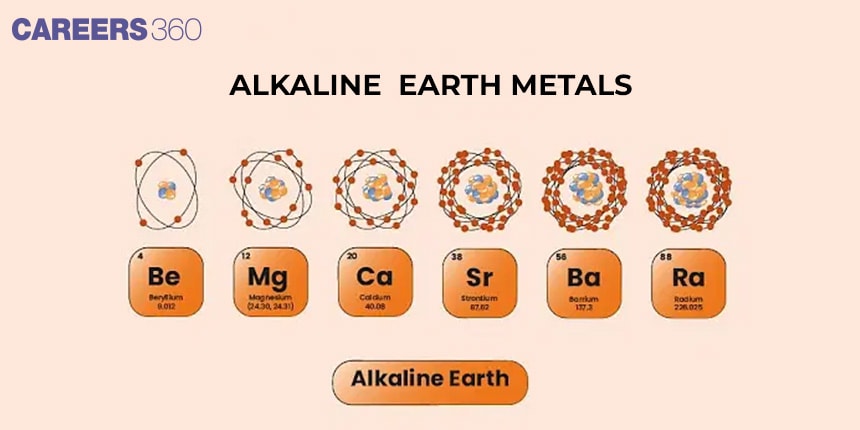
Alkaline Earth Metals: Uses, Safety, and Some Important Points An example is beryllium dust, which is so toxic that it causes chronic lung disease and berylliosis. These barium compounds are useful but they need to be handled with care as all of them contain barium which is one of the toxic elements. Because radium is radioactive, it carries several health hazards and requires regulated management
Also read -
Law Admissions 2026 Open | Avail Merit-Based Scholarships
BBA/MBA/PGDM Early Bird Applications Deadline 19th Oct '26. Apply now using coupon code CAREER250 and get ₹250 off the application fee
Q.1 Which of the following has 2s2 outermost electronic configuration?
1) Mg
2) Li
3) Be
4) B
Solution:
As we learned
Electronic Configuration of beryllium -
4Be→1s22s2 or [He]2s2
Electronic configuration of Be: 1s2 2s2
Hence, the answer is the option (3).
Q 2. Which of the following has the smallest atomic size?
1) Mg
2) Be
3) Sr
4) Ca
Solution:
As we learned
Atomic and Ionic Radii
The atomic and ionic radii of the alkaline earth metals are smaller than those of the corresponding alkali metals in the same periods. This is due to the increased nuclear charge in these elements. Within the group, the atomic and ionic radii increase with the increase in atomic number.
As we move down the group, the atomic size of elements increases, so Be has the smallest size.
Hence, the answer is the option (2).
Also check-
NCERT Chemistry Notes:
These observations led to the conclusion that alkaline earth metals are important both industrially and in biological systems. Many of their unique characteristics make composites vital throughout many industries and sectors, from construction to manufacturing; love them or hate them: composite materials are here to stay!!! The possibilities of these truly amazing substances are likely to become even broader as research and technology continue to evolve. Calcium and magnesium, in particular, are important for maintaining human health by supporting bone formation as well as enzymatic activities. Thus, the broad applicability and biological significance of alkaline earth metals reveal their inescapable impact on new technologies as well as life itself.
Frequently Asked Questions (FAQs)
Radium is radioactive because its nucleus is unstable and decays over time, emitting radiation in the form of alpha particles, beta particles, and gamma rays.
Alkaline earth metals are shiny, silvery-white, and somewhat reactive at standard temperature and pressure. They have two electrons in their outermost shell.
Alkaline earth metals are a group 2 of the periodic table. They include beryllium, magnesium, calcium, strontium, barium, and radium.
They are called alkaline earth metals because their oxides are basic.
Alkaline earth metals react with water to form hydroxides and hydrogen gas. The reactivity increases from beryllium to barium.


Law Admissions 2026 Open | Avail Merit-Based Scholarships
BBA/MBA/PGDM Early Bird Applications Deadline 19th Oct '26. Apply now using coupon code CAREER250 and get ₹250 off the application fee
Ranked #36 amongst institutions in Management by NIRF | 100% Placement
Globally Recognized by AACSB (US) & AMBA (UK) | 18 LPA Avg. CTC for PGPM 2026
Leading Design College | 95% Placement Record | Merit-cum-Means Scholarships for Deserving Students
NEET PG All India & State College Predictor with Admission Process Guide