


Eutrophication - Definition, Classification, Factors, Effects, FAQs
What happens when lakes and rivers receive more nutrients than they can naturally handle? Why do once-clear water bodies turn green with algal blooms, foul odours, and depleted oxygen levels? Eutrophication answers these questions by explaining the process through which excess nutrients, especially nitrogen and phosphorus, trigger uncontrolled plant and algal growth, ultimately threatening water quality, aquatic life, and human health.
This Story also Contains
- Eutrophication
- Classification of Eutrophication
- Factors Causing Eutrophication
- Effects of Eutrophication
- Some Solved Examples
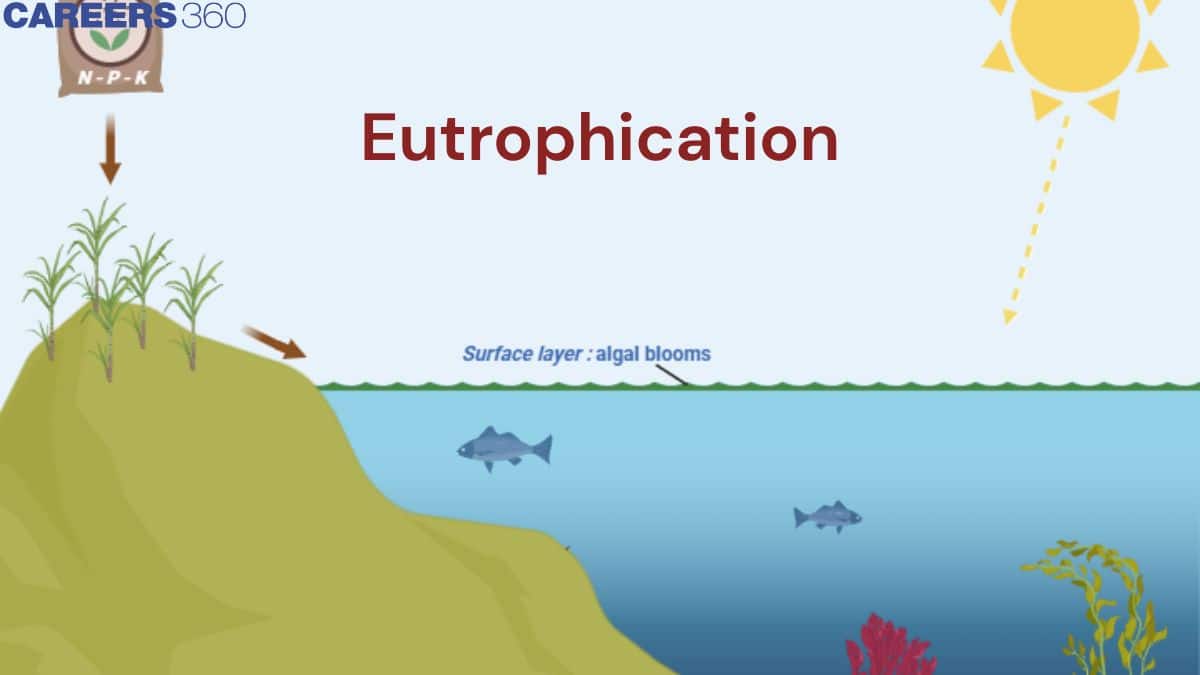
Eutrophication
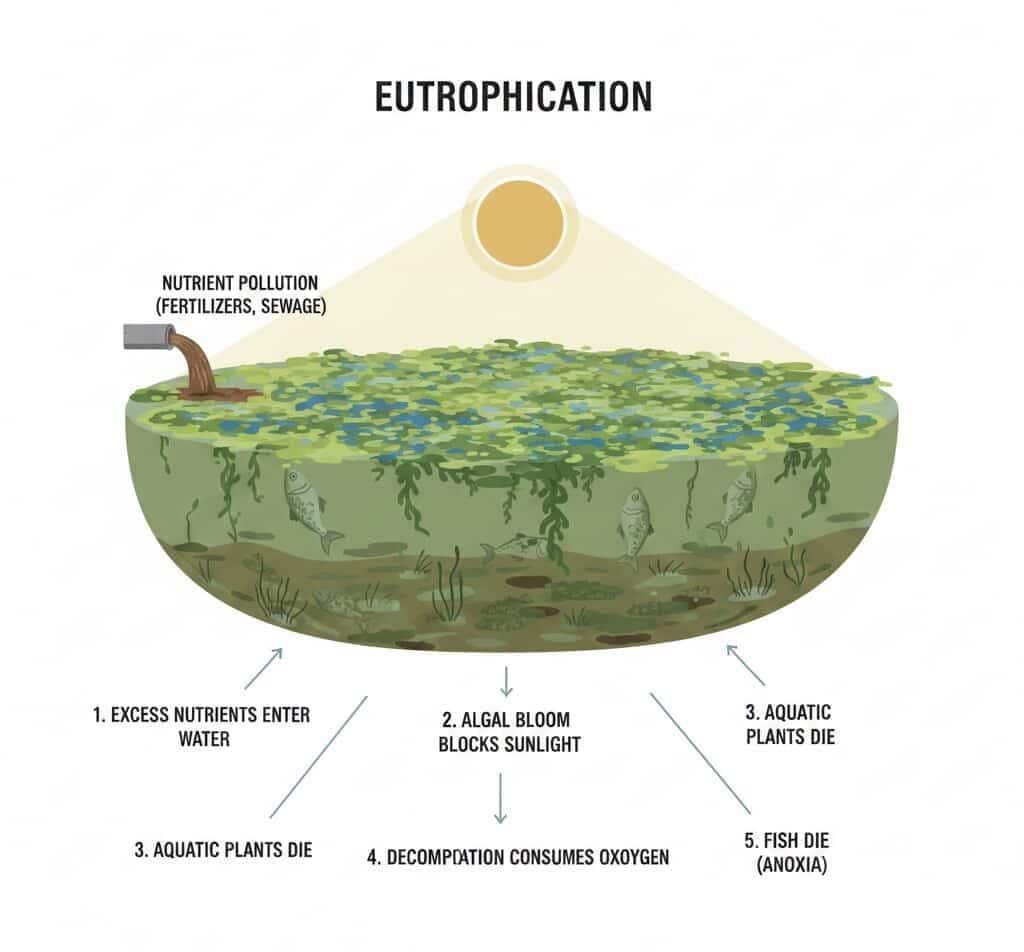
Eutrophication is the process by which a water body becomes excessively enriched with nutrients, especially nitrogen and phosphorus, resulting in rapid growth of algae and aquatic plants. These nutrients mainly enter water bodies through agricultural runoff, sewage, detergents, fertilisers, and animal waste. Excessive algal growth reduces water transparency and, when the algae die and decompose, large amounts of dissolved oxygen are consumed. This leads to oxygen deficiency in water, causing the death of fish and other aquatic organisms. Eutrophication degrades water quality, disturbs aquatic ecosystems, and has become a serious environmental problem affecting lakes, rivers, and coastal regions worldwide.
- Eutrophication is the enrichment of a water body with excess nutrients, mainly nitrogen and phosphorus.
- The term comes from the Greek word eutrophos, meaning well-nourished.
- The major nutrients responsible are nitrates and phosphates.
- Main sources include agricultural runoff, fertilisers, sewage, detergents, cow manure, and human waste.
- Excess nutrients cause the rapid growth of algae called algal blooms.
- Algal blooms reduce light penetration and affect aquatic plant life.
- Decomposition of algae consumes dissolved oxygen in water.
- Oxygen depletion leads to hypoxia (oxygen concentration < 1 mg/L).
- Hypoxia causes fish kills and the death of molluscs and other aquatic organisms.
- Disrupts aquatic food chains and degrades water quality.
- Cultural eutrophication is human-induced and much faster than natural eutrophication.
- Affects both freshwater (lakes, rivers) and marine ecosystems (estuaries, coastal waters).
- Large regions like the Gulf of Mexico and the Mississippi River estuary are severely affected.
- Results in ecological imbalance and economic losses (fisheries).
- Eutrophication can be controlled by reducing nutrient input, proper sewage treatment, and improved agricultural practices.
Classification of Eutrophication
Based on the fundamental cause of eutrophication, there are two forms of eutrophication.
Anthropogenic Eutrophication
Anthropogenic eutrophication is caused by human activity. Humans provide nutrients in the form of fertilisers to agricultural farms, golf courses, and lawns, among other places. Rains wash these fertilisers away, and they eventually end up in bodies of water like lakes and rivers. When fertilisers are introduced to an aquatic ecosystem, they provide abundant nutrients to algae and plankton, causing eutrophication of the water body.
Overpopulation puts considerable pressure on industrial and agricultural expansion, which in turn leads to deforestation. The soil erodes more easily as a result, resulting in greater soil deposits in water bodies. If the soil is high in phosphorus, eutrophication can occur, causing significant harm to the ecosystem surrounding the water body. When sewage pipelines and industrial wastes are discharged into bodies of water, the nutrients in the sewage and other pollutants accelerate eutrophication.
Natural Eutrophication
Natural eutrophication is the overabundance of nutrients in water bodies caused by natural processes. In a flood, nutrients from the land, for example, can be carried away and deposited in a lake or river. These pools of water become extremely nutrient-rich, allowing for the rapid growth of algae and other basic plant life.
When compared to anthropogenic eutrophication, the natural eutrophication process is substantially slower. This process is also influenced by the temperature of the surrounding environment. It could even be aided by the temperature shifts caused by global warming.
Also Read:
- NCERT Solutions for Class 11 Chemistry Chapter 14 Environmental Chemistry
- NCERT Exemplar Class 11 Chemistry Solutions Chapter 14 Environmental Chemistry
- NCERT notes Class 11 Chemistry Chapter 14 Environmental Chemistry
Factors Causing Eutrophication
Eutrophication in water bodies is caused by the following factors.
Use of Fertilisers
Many nutrients are accumulated in the soil as a result of agricultural activities in the field and the use of fertilisers, and they are transported by rain into rivers and groundwater, which ultimately flow into seas or lakes.
Wastewater Discharge into Waterbodies
Wastewater is immediately discharged into water bodies such as lakes, seas, and rivers all throughout the world, particularly in emerging economies. As a result, the maximum amount of nutrients discharged causes disproportionate algal development. At the same time, wastewater can be illegally yet directly disposed of in water bodies in most developed countries. Water is handled in water treatment plants before being discharged into the environment. As an alternative, the treatments used are not always similar to organic load reduction. As a result, there is an overabundance of nutrients in the ecosystem.
Ability to Lose Self-purification
Maximum amounts of solid materials or sediments have been found in recent years. These sediments, in particular, can absorb enormous amounts of nutrients as well as contaminants. The sediments build up in the basin, lowering the water quality. This observable fact could result in a further decrease in water value, amplifying the eutrophication processes. Due to the maximal availability of numerous growth components required for photosynthesis, such as sunlight, nutrients (phosphorus and nitrogen), and carbon dioxide, eutrophication is defined by a considerable increase in algae (microscopic animals that look like plants).
A high amount of organic substance accumulates in murky water, as evidenced by algae that have reached the end of their life cycle. To consume all of the lifeless algae, microbes must consume a large amount of oxygen in some cases, nearly all of it. At the bottom of the lake, an oxygen-free (anoxic) environment develops, resulting in the formation of organisms capable of living in anaerobic (oxygen-depleted) conditions and contributing to the degradation of the biomass.
While decomposing organic matter in the absence of oxygen (anaerobic), these microbes emit hazardous chemicals such as hydrogen sulphide $\left(\mathrm{H}_2 \mathrm{~S}\right)$ and ammonia $\left(\mathrm{NH}_3\right)$.In some circumstances, the lack of oxygen causes biodiversity to be disrupted, resulting in the loss of living organisms. When algal breakdown exceeds oxygen generation, especially during the summer, several changes occur.
Related Topics Link
Effects of Eutrophication
The negative effects of eutrophication on aquatic bodies include a reduction in biodiversity, a rise in water toxicity, and a shift in species dominance. This technique has a number of other important side effects, which are detailed below.
-
In these conditions, phytoplankton grow much faster. These phytoplankton species are poisonous and cannot be eaten.
-
In these waters, gelatinous zooplankton blooms quickly.
-
In eutrophic environments, there is an increase in the biomass of epiphytic and benthic algae, as well as significant changes in macrophyte species composition and biomass.
-
The water loses its transparency and takes on an unpleasant odour and colour. It becomes tough to treat this water.
-
Dissolved oxygen depletion in the water body.
-
Many attractive fish species are removed from the water body due to frequent fish kill incidences.
-
Shellfish and harvestable fish populations are reduced.
Also check-
Some Solved Examples
Question 1: What is the main cause of eutrophication in freshwater bodies?
1) Oil spills
2) (correct) Excessive nutrient inputs
3) Acid rain
4) Industrial discharge
Solution :
Eutrophication is a process in which excessive nutrient inputs (primarily nitrogen and phosphorus) in water bodies lead to an overgrowth of algae and other aquatic plants. This overgrowth can reduce oxygen levels in the water, leading to the death of fish and other aquatic organisms. Oil spills, acid rain, and industrial discharge can also contribute to water pollution, but they are not the primary cause of eutrophication.
Hence, the answer is option (2).
Question 2: The condition that indicates a polluted environment is :
1) (correct) eutrophication
2) $0.03 %$ of $\mathrm{CO}_2$ in the atmosphere
3) BOD value of 5 ppm
4) pH of rainwater to be 5.6
Solution:
In Eutrophication nutrient-enriched water bodies support a dense plant population, which kills animal life by depriving it of oxygen and results in the subsequent loss of biodiversity. It indicates a polluted environment.
Hence, the answer is option (1).
Question 3: The eutrophication of water bodies results in :
1) (correct) loss of Biodiversity.
2) breakdown of organic matter.
3) increase in biodiversity.
4) decrease in BOD.
Solution:
Eutrophication refers to the overpopulation of water bodies by aquatic plants, which deprives animal life of oxygen and thereby kills animal life.
Thus, eutrophication leads to a loss of biodiversity.
Hence, the answer is option (1).
Question 4: Which one of the following statements is NOT correct?
1) Eutrophication indicates that a water body is polluted
2)The dissolved oxygen concentration below 6 ppm inhibits fish growth
3) (correct) Eutrophication leads to an increase in the oxygen level in water
4) Eutrophication leads to anaerobic conditions
Solution:
Eutrophication refers to a condition in which there is a dense plant population on the surface of water.
This leads to a lessening of the oxygen concentration in water and a subsequent anaerobic concentration.
Hence, the answer is option (3).
Question 5: Which of the following pollutants is responsible for eutrophication?
1) Nitrogen
2) (correct) Phosphorus
3) Sulfur
4) Carbon
Solution:
Eutrophication is the process by which a body of water becomes overly enriched with nutrients, causing excessive growth of algae and other aquatic plants. Phosphorus is a primary nutrient responsible for eutrophication, along with nitrogen. Sulfur and carbon are not primary nutrients responsible for eutrophication.
Hence, the answer is option (2).
Practice more questions with the link given below
Frequently Asked Questions (FAQs)
Algal blooms in the water body can prevent sunlight from reaching the lower depths. Many plants and animals may face extinction as a result of this. The local biosphere suffers because of the reduction of oxygen levels in the water body caused by this event.
It's a sort of eutrophication brought on by human activity, and it's usually produced by the introduction of potassium-rich fertilizers into the aquatic body. Deforestation, which causes erosion and transfer of nutrient-rich soil into water bodies, is another fundamental cause.
Many natural events, such as lake or river flooding, can sweep nutrient-rich soil away from the area surrounding the water bodies. In the aquatic body, this nutrient-rich soil might encourage the formation of algae. However, this is a slow procedure.
Eutrophication sets off chain reaction in ecosystem, starting with an overabundance of algae as well as plants. The excess algae along withplant matter eventually decompose, producing large amounts of carbon dioxide. This lowers the pH of seawater, this process is called as ocean acidification
This process can be slowed down by avoiding phosphorus-rich compounds from entering water bodies. Eutrophication can also be avoided by avoiding overuse of fertilizers and properly channeling agricultural wastes.

Questions related to
On Question asked by student community
Correct Answer: Nitrogen and phosphorus
Solution : The correct answer is (a) Nitrogen and phosphorus
Eutrophication is a process that occurs in bodies of water, such as lakes, rivers, and coastal areas, where there is an excessive accumulation of nutrients, particularly nitrogen and phosphorus. These nutrients can come from various
Correct Answer: Both (1) and (2)
Solution : The correct answer is Both (1) and (2).
Eutrophication is also known as nutrient enrichment of a water body. It is caused because of the increased supply of nutrients through agricultural runoff and industrial wastes into the water body. It increases the