Evaporation
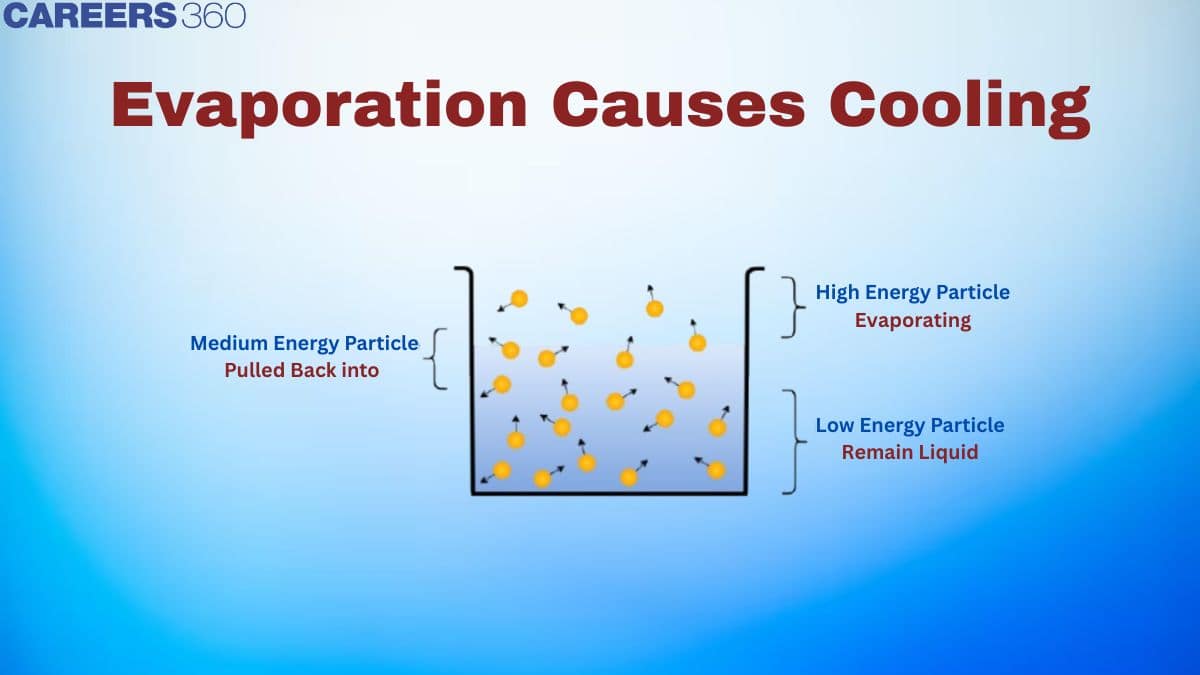
Evaporation causes cooling is the transformation of a liquid or solid into vapour. When you spray perfume on your body, it makes you feel colder. The same can be said for acetone and water. This is a result of evaporation, or the transformation of materials from a liquid to a gaseous state. The only difference is the speed with which you feel the chill.
When it comes to acetone, the region of your body that comes into contact with the liquid cools the fastest. This occurs because acetone evaporates at a faster rate than water or scent. The amount of water that evaporates is determined by the temperature as well as the amount of water that needs to be evaporated. The Sahara Desert, for example, has very little evaporation, causing cooling, but why is that? Although the Sahara can get very hot, it is mostly sand, thus there isn't much water to evaporate.
KCC Institute of Legal and Higher Education, Greater Noida
Law Admissions 2026 Open | Avail Merit-Based Scholarships
Global Institute of Business Studies, Bengaluru
BBA/MBA/PGDM Early Bird Applications Deadline 19th Oct '26. Apply now using coupon code CAREER250 and get ₹250 off the application fee
Some Solved Examples
Question 1: We feel cooler when sweat evaporates from our skin because evaporation:
A. Releases heat to the surroundings
B. Absorbs heat from the surroundings
C. Increases body temperature
D. Does not involve energy transfer
Solution:
During evaporation, sweat absorbs heat from the skin to change into vapour, lowering body temperature.
Hence, the correct answer is option (B)
Question 2. The cooling effect of evaporation occurs because:
A. Low-energy molecules escape from the liquid
B. All molecules leave the liquid surface
C. High-energy molecules escape, lowering the average kinetic energy
D. Vapour molecules return heat to the liquid
Solution :
Faster (high-energy) molecules escape first, reducing the average kinetic energy and temperature of the remaining liquid.
Hence, the correct answer is option (C)
Question 3. Which substance produces the fastest cooling effect on the skin?
A. Water
B. Perfume
C. Acetone
D. Glycerine
Solution:
Acetone evaporates faster due to weaker intermolecular forces, so it absorbs heat more quickly.
Hence, the correct answer is option (C)
Question 4. Why does water kept in an earthen pot (matka) become cool in summer?
A. Heat is released during evaporation
B. Water evaporates through pores, absorbing heat
C. Earthen pots block sunlight
D. Water boils slowly
Solution:
Water seeps through pores and evaporates, absorbing heat from the remaining water.
Hence, the correct answer is option (B)
Question 5. Which factor does NOT increase the rate of evaporation?
A. Increase in temperature
B. Increase in surface area
C. Increase in humidity
D. Increase in wind speed
Solution:
High humidity already contains water vapour, reducing further evaporation.
Hence, the correct answer is option (C)