KCC Institute of Legal and Higher Education, Greater Noida
Law Admissions 2026 Open | Avail Merit-Based Scholarships


What is Mohr's salt, and why is it widely used in analytical chemistry and laboratory experiments? Mohr's salt is a double salt of ferrous sulfate and ammonium sulfate $\left(\mathrm{NH}_4\right)_2 \mathrm{Fe}\left(\mathrm{SO}_4\right)_2\left(\mathrm{H}_2 \mathrm{O}\right)_6$ that is known for its remarkable stability against oxidation. Due to its pure crystalline nature and accurate composition, it serves as an important primary standard in redox titrations. In this article, we will study the formula, structure and preparation of Mohr's salt along with its properties.
This Story also Contains
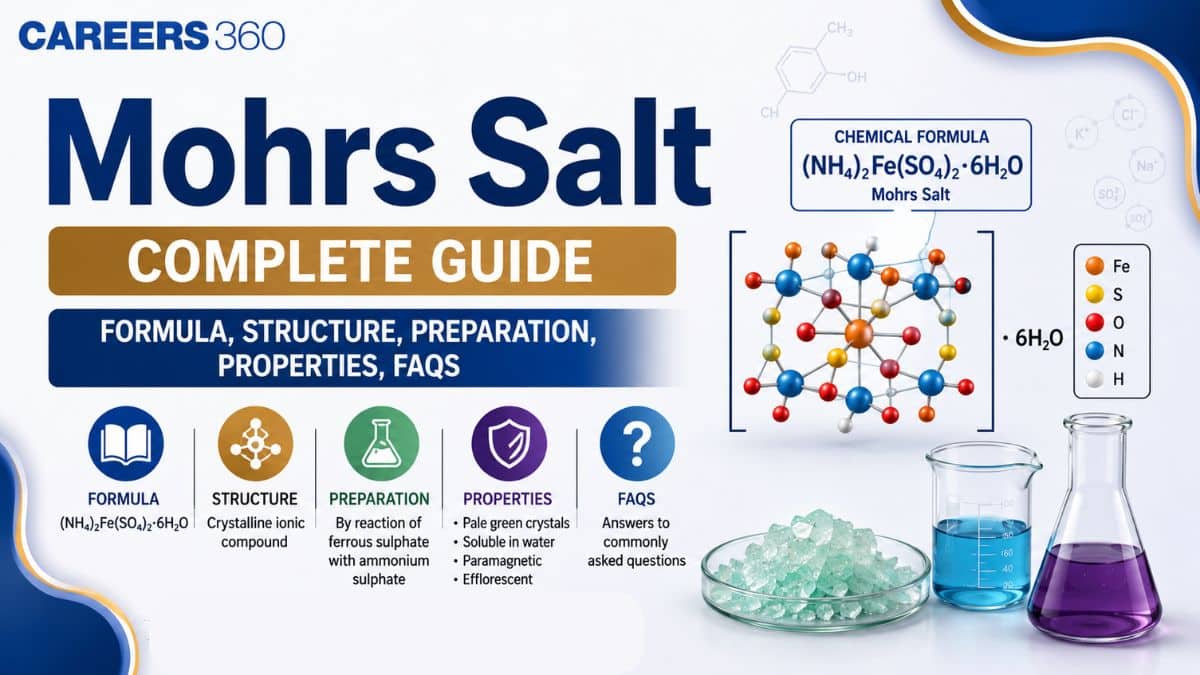
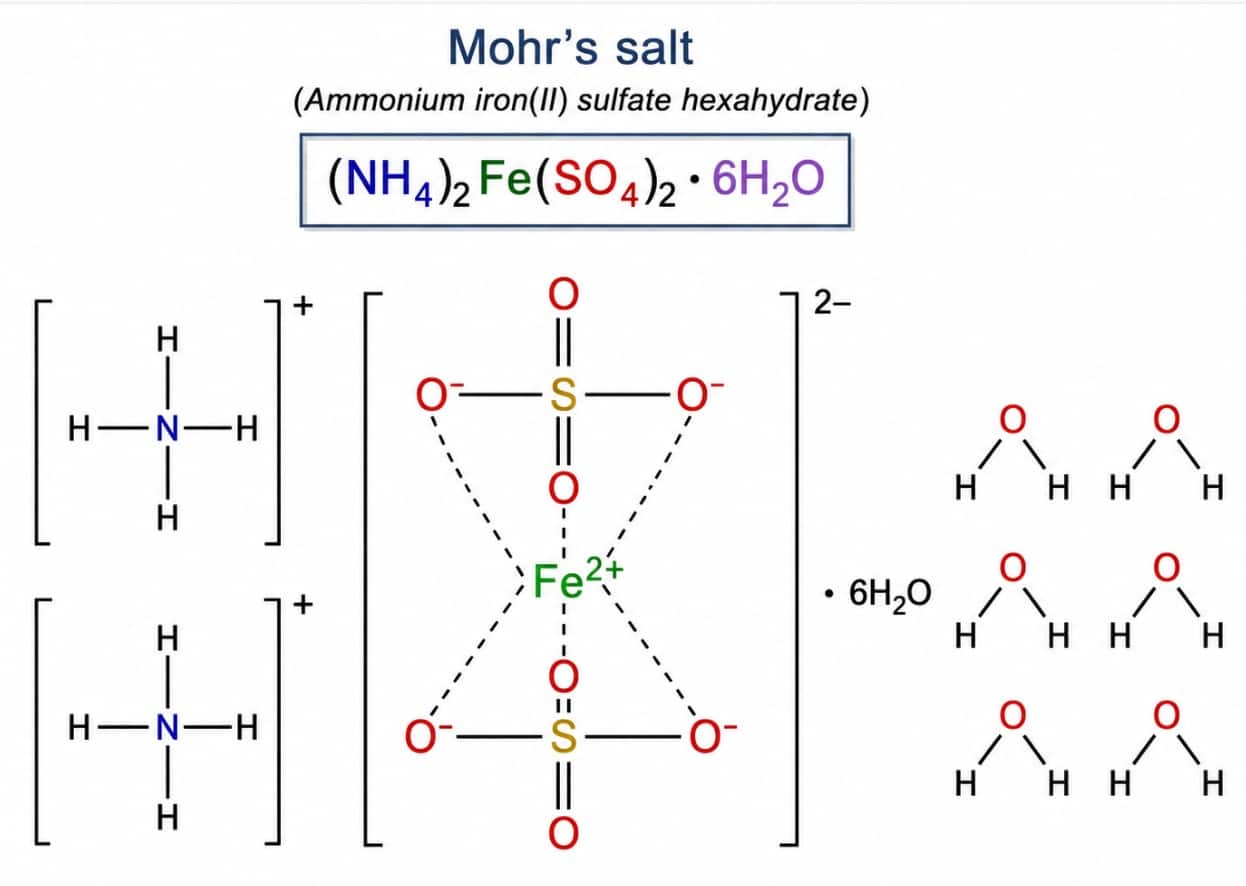
Mohr's salt is a double salt of ferrous sulfate and ammonium sulfate whose chemical formula is $\left(\mathrm{NH}_4\right)_2 \mathrm{Fe}\left(\mathrm{SO}_4\right)_2\left(\mathrm{H}_2 \mathrm{O}\right)_6$. Mohr's salt appears as pale green crystals and is an important source of Fe²⁺ (ferrous) ions in laboratory work. It is more stable than ordinary ferrous sulfate because the ammonium sulfate present in the crystal structure prevents the oxidation of Fe²⁺ to Fe³⁺ by atmospheric oxygen. Due to its high purity and stability, Mohr's salt is widely used as a primary standard in redox titrations, particularly those involving potassium permanganate (KMnO₄) and potassium dichromate ($\mathrm{K}_2 \mathrm{Cr}_2 \mathrm{O}_7$). It is highly soluble in water and contains six molecules of water of crystallisation.
Law Admissions 2026 Open | Avail Merit-Based Scholarships
BBA/MBA/PGDM Early Bird Applications Deadline 06th Nov'26. Apply now using coupon code CAREER250 and get ₹250 off the application fee
Mohr's salt is prepared by dissolving ferrous sulfate $\left(\mathrm{FeSO}_4 \cdot 7 \mathrm{H}_2 \mathrm{O}\right)$ and ammonium sulfate $\left(\left(\mathrm{NH}_4\right)_2 \mathrm{SO}_4\right)$ in water containing a small amount of dilute sulfuric acid. The acidic medium prevents the oxidation of Fe2+ ions to Fe3+. The solution is heated until both salts dissolve completely and then allowed to cool slowly. On cooling, pale green crystals of Mohr's salt separate out. These crystals are filtered, washed with a small amount of cold water or alcohol, and dried.
$\mathrm{FeSO}_4 \cdot 7 \mathrm{H}_2 \mathrm{O}+\left(\mathrm{NH}_4\right)_2 \mathrm{SO}_4 \rightarrow\left(\mathrm{NH}_4\right)_2 \mathrm{Fe}\left(\mathrm{SO}_4\right)_2 \cdot 6 \mathrm{H}_2 \mathrm{O}+\mathrm{H}_2 \mathrm{O}$
Related Topics Link -
Also read
Question 1: The equivalent weight of Mohr's salt, $\left(\mathrm{NH}_4\right)_2 \mathrm{Fe}\left(\mathrm{SO}_4\right)_2 \cdot 6 \mathrm{H}_2 \mathrm{O}$, in acidic $\mathrm{KMnO}_4$ titration is:
(A) $392 \mathrm{~g} \mathrm{eq}^{-1}$
(B) $196 \mathrm{~g} \mathrm{eq}^{-1}$
(C) $98 \mathrm{~g} \mathrm{eq}^{-1}$
(D) $56 \mathrm{~g} \mathrm{eq}^{-1}$
Solution:
The molar mass of Mohr's salt is:
$392 \mathrm{~g} \mathrm{~mol}^{-1}$
One mole of Mohr's salt contains one $\mathrm{Fe}^{2+}$ ion.
$\mathrm{Fe}^{2+} \rightarrow \mathrm{Fe}^{3+}+e^{-}$
Since one mole loses one mole of electrons, the $\mathbf{n}$-factor $=\mathbf{1}$.
$\text { Equivalent weight }=\frac{\text { Molar mass }}{n \text {-factor }}=\frac{392}{1}=392 \mathrm{~g} \mathrm{eq}^{-1}$
Hence, the correct answer is option (A).
Question 2: The percentage by mass of iron (Fe) in Mohr's salt, $\left(\mathrm{NH}_4\right)_2 \mathrm{Fe}\left(\mathrm{SO}_4\right)_2 \cdot 6 \mathrm{H}_2 \mathrm{O}$, is closest to:
(A) $10.2 %$
(B) $14.3 %$
(C) $18.4 %$
(D) $22.8 %$
Solution:
Molar mass of Mohr's salt:
$392 \mathrm{~g} \mathrm{~mol}^{-1}$
Mass of Fe per mole:
$56 \mathrm{~g}$
Percentage of iron:
$\frac{56}{392} \times 100=14.29 \% \approx 14.3 %$
Hence, the correct answer is option (B).
Question 3: Mohr's salt, $\left(\mathrm{NH}_4\right)_2 \mathrm{Fe}\left(\mathrm{SO}_4\right)_2 \cdot 6 \mathrm{H}_2 \mathrm{O}$, is widely used as a primary standard in redox titrations. Which one of the following statements correctly explains this property?
(A) It contains $\mathrm{Fe}^{3+}$ ions that are highly stable in air.
(B) The presence of ammonium sulfate stabilizes $\mathrm{Fe}^{2+}$ ions, making the salt less susceptible to oxidation by atmospheric oxygen.
(C) It is completely insoluble in water, preventing oxidation of $\mathrm{Fe}^{2+}$ ions.
(D) It acts as a strong oxidizing agent in acidic medium.
Solution:
Mohr's salt is a double salt of ferrous sulfate and ammonium sulfate:
$\left(\mathrm{NH}_4\right)_2 \mathrm{Fe}\left(\mathrm{SO}_4\right)_2 \cdot 6 \mathrm{H}_2 \mathrm{O}$
The $\mathbf{F e}^{\mathbf{2 +}}$ ions present in Mohr's salt are more stable than those in ordinary ferrous sulfate because ammonium sulfate reduces their oxidation to $\mathrm{Fe}^{3+}$ in the presence of air. This high stability, along with its purity, makes Mohr's salt an excellent primary standard for redox titrations such as $\mathrm{KMnO}_4$ and $\mathrm{K}_2 \mathrm{Cr}_2 \mathrm{O}_7$ titrations.
Hence, the correct answer is option (B).
Practice More questions with the link given below:

Law Admissions 2026 Open | Avail Merit-Based Scholarships
BBA/MBA/PGDM Early Bird Applications Deadline 06th Nov'26. Apply now using coupon code CAREER250 and get ₹250 off the application fee
Ranked #36 amongst institutions in Management by NIRF | 100% Placement
Globally Recognized by AACSB (US) & AMBA (UK) | 18 LPA Avg. CTC for PGPM 2026
NEET PG All India & State College Predictor with Admission Process Guide
Top B-School: Ranked #9 in NIRF Management Rankings 2025.