KCC Institute of Legal and Higher Education, Greater Noida
Law Admissions 2026 Open | Avail Merit-Based Scholarships


Birth control, also known as contraception, refers to methods used to prevent pregnancy by avoiding fertilisation or implantation. It helps individuals and couples plan families, manage reproductive health, and avoid unwanted pregnancies. This guide explains types of birth control methods, mechanisms, effectiveness, and NEET-focused exam points.
This Story also Contains
Birth control is a commonly known term that stands for "contraception." It refers to different ways and tools for preventing pregnancy, giving a person or a couple an opportunity and freedom to plan a family. It helps control their fertility according to their will to do so. It prevents the implantation or fertilisation process in humans. There are many methods of contraception, which will be elaborated on in the following points; therefore, making regard towards safe sex an informed choice.
Birth Control methods help individuals or couples plan if and when they want to conceive. They can also protect against sexually transmitted infections (STIs) in some cases. Birth control methods vary in their mode of action, duration of effectiveness, and reversibility. The details are given below:
Barrier methods prevent the structure of sperm from reaching the egg. Some of the commonly used barrier methods are
Condoms are available for men and women; condoms are efficient in preventing pregnancies and also protect from sexually transmitted diseases.
Law Admissions 2026 Open | Avail Merit-Based Scholarships
BBA/MBA/PGDM Early Bird Applications Deadline 19th Oct '26. Apply now using coupon code CAREER250 and get ₹250 off the application fee
A diaphragm is a dome-shaped cup used in the vagina before intercourse, but it should be used with spermicide for better performance.
It changes the balance of the body's hormones to prevent ovulation. Some of the hormonal birth control methods are mentioned below:
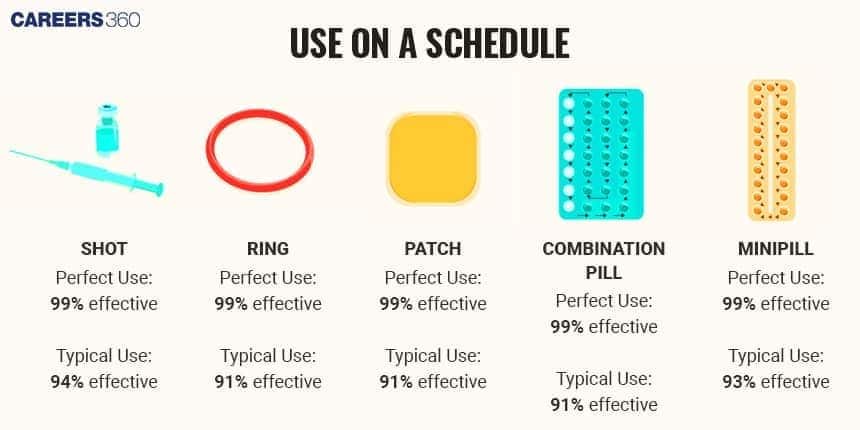
Taken orally daily, the tablets inhibit ovulation, and birth control pills can also help a female to regulate their menstrual cycle and eliminate painful menstrual cramps.
Adhesive patches, impregnated with hormones, are applied transdermally; while they adhere or stick on the skin, hormones are absorbed across the skin into the bloodstream, consequently hindering ovulation.
The hormonal shot is injected every three months, and it serves to prevent ovulation.
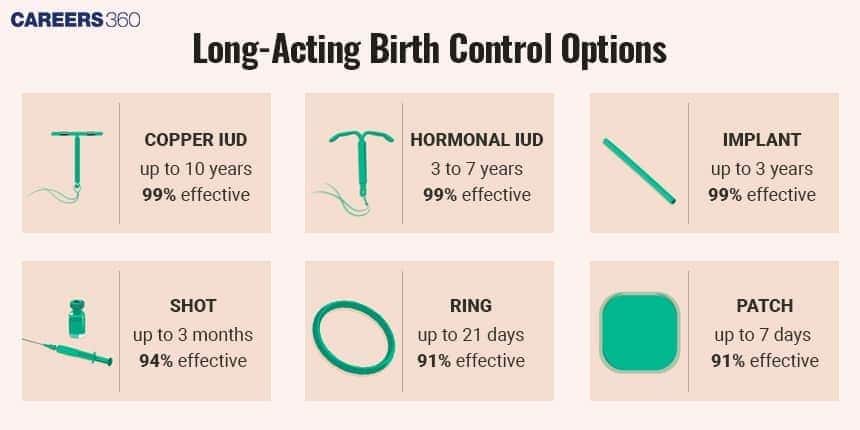
IUDs are devices that are inserted into the uterus. These are long-term protection lasting 3–10 years.
Release hormones to prevent fertilisation.
Copper ions create a hostile environment for sperm.
This involves tracking the cycle of fertility in women. This comprises:
These include abstinence and the rhythm method, where intercourse is avoided during a woman's fertile period. A woman is fertile for 9 days each month, starting 5 days before ovulation and lasting 3 days after.
The penis is withdrawn before ejaculation. It is less reliable due to possible sperm in pre-ejaculate.
Exclusive breastfeeding prevents ovulation for up to 6 months. Effective only if periods haven't resumed and feeding is regular.
Permanent methods are surgeries for someone who doesn't plan to have children in the future:
This is a surgical method in the female reproductive system that blocks their fallopian tubes so they cannot get pregnant.
This is a specific surgical method in male reproductive system, cutting the vas deferens so that sperm cannot mix with semen.
Different contraceptive methods offer different levels of protection against the pregnancy-parturition-lactation cycle in humans. The effectiveness of a method depends on how it works and how correctly and consistently it is used. The effectiveness of contraceptive methods sharply varies:
IUDs and Implants: More than 99% effective.
Hormonal Methods: 91-99% effective, depending on proper use.
Barrier Methods: 82-98% effective, depending on correct usage.
Choosing the right contraceptive method depends on many personal factors. Health conditions, lifestyle, and future family plans all affect the decision. It's best to take advice from a doctor to find the safest and most suitable method. Some factors are discussed below:
A person should be able to consult their health professional to outline for them any preconditions they have that need to be considered when choosing the appropriate birth control method.
Consider your lifestyle, the frequency at which you have sex, and which method you are most comfortable with while choosing a birth control method.
Consider the possible side effects associated with each method, including hormonal fluctuations, mood swings, or allergic reactions to the process.
Important questions asked in NEET from this topic are:
Hormonal methods of birth control
Natural methods of birth control
Q1. Choose the right one among the statements given below:
IUDs are generally inserted by the users themselves.
IUDs increase the phagocytosis reaction in the uterus.
IUDs suppress gametogenesis.
IUDs once inserted, need not be replaced.
Explanation: IUD stands for Intrauterine Device and serves as a contraceptive method. It is a minute, commonly T-shaped object inserted into the uterus by a medical professional. IUD Categories:
1. Hormonal IUDs:
- Emit a small quantity of progestin hormone.
- Examples include Mirena, Kyleena, Skyla, and Liletta.
- Function: Increase cervical mucus thickness to hinder sperm, reduce uterine lining receptiveness, and occasionally suppress ovulation.
2. Non-Hormonal (Copper) IUDs:
- Composed of plastic with a copper coating.
- Example: ParaGard.
- Function: Copper acts as a spermicide, impairing sperm movement and fertility.
- Inhibits egg fertilization.
IUD Mechanism:
Both types obstruct fertilization by impairing sperm mobility and viability. Additionally, they may modify the uterine lining to prevent a fertilized egg from implanting (secondary effect).
Hence, the correct answer is option 2) IUDs increase phagocytosis reaction in the uterus.
Q2. One of the legal methods of birth control is:
by a premature ejaculation during coitus
abortion by taking an appropriate medicine
by abstaining from coitus from day 10 to 17 of the menstrual cycle
by having coitus at the time of daybreak
Explanation: Natural methods to avoid fertilization work on the principle of avoiding chances of ovum and sperm meeting. Periodic abstinence is one such method in which couples avoid or abstain from coitus from day 10 to 17 of the menstrual cycle when ovulation could be expected. Pregnancy could be avoided by abstaining from coitus from days 10 to 17 of the menstrual cycle.
Hence, the correct answer is option 3) by abstaining from coitus from day 10 to 17 of the menstrual cycle.
Q3. Assertion: Natural methods of pregnancy prevention are effective.
Reason: Natural methods of pregnancy prevention, such as periodic abstinence, rely on tracking the menstrual cycle to identify the fertile period and avoid sexual intercourse during that time.
Both Assertion and Reason are true, and Reason is the correct explanation of Assertion.
Both Assertion and Reason are true, but Reason is not the correct explanation of Assertion.
The assertion is true, but the Reason is false.
The assertion is false, but the reason is true.
Explanation: Natural methods of pregnancy prevention can be effective when used consistently and correctly, but they are generally less reliable than other methods of contraception, such as hormonal contraceptives or intrauterine devices (IUDs). Natural methods, such as periodic abstinence, can be challenging to use because they require a high level of commitment and self-discipline. Additionally, natural methods are less effective in cases where the menstrual cycle is irregular or unpredictable.
The reason provided is correct. Natural methods of pregnancy prevention, such as periodic abstinence, rely on tracking the menstrual cycle to identify the fertile period and avoid sexual intercourse during that time. However, the effectiveness of natural methods is variable, and they may not be suitable for everyone.
Hence, the correct option is 1) Both Assertion and Reason are true, and Reason is the correct explanation of Assertion.
Also Read:
Frequently Asked Questions (FAQs)
Yes, depending on the type one is taking, one can experience nausea, headache, and mood swings, among other effects.
There are many different methods and gadgets for birth control that can stop conception. These techniques can be used on both men and women. Only a few of the numerous approaches are trustworthy. The method's efficacy is based on how meticulously it is applied.
Injections for birth control are increasingly accessible as well. IUDs, also known as intrauterine devices, are little T-shaped objects inserted into the uterus. There are two different IUD kinds. Small amounts of copper are released by copper IUDs into the uterus, stopping sperm from reaching the ovary.
Natural birth control is a way to avoid getting pregnant without using drugs or other artificial means. Based on knowledge and observations of a woman's body and menstrual cycle, several ideas have been developed.
The most frequent adverse effects are headaches, nausea, aching breasts, and spotting or bleeding between periods (this is more frequent with progestin-only pills). However, symptoms often disappear within two to three months and don't affect everyone who takes the medication. You shouldn't feel ill or unpleasant while using birth control.
The IUD and implant are the most user-friendly and reliable forms of birth control, and they also work the best at preventing conception. If used properly, other birth control methods, such as the pill, ring, patch, and injection, are also quite effective at preventing pregnancy.


Law Admissions 2026 Open | Avail Merit-Based Scholarships
BBA/MBA/PGDM Early Bird Applications Deadline 19th Oct '26. Apply now using coupon code CAREER250 and get ₹250 off the application fee
Ranked #36 amongst institutions in Management by NIRF | 100% Placement
Globally Recognized by AACSB (US) & AMBA (UK) | 18 LPA Avg. CTC for PGPM 2026
Leading Design College | 95% Placement Record | Merit-cum-Means Scholarships for Deserving Students
NEET PG All India & State College Predictor with Admission Process Guide