ATIT
Ranked 1 st among Top Law Schools of super Excellence in India - GHRDC | NAAC A+ Accredited | #36 by NIRF


Photophosphorylation is the light-dependent synthesis of ATP during photosynthesis. In cyclic photophosphorylation, electrons cycle through PSI forming ATP only, while in non-cyclic photophosphorylation, both PSII and PSI work together to produce ATP, NADPH, and oxygen.
This Story also Contains
Photophosphorylation is an important biochemical process, whereby light energy is converted into a form of chemical energy, specifically ATP, in the chloroplasts of plant cells. During photophosphorylation, electrons flow down a gradient of several proteins in the thylakoid membrane to eventually result in the production of ATP during the light-dependent reactions of photosynthesis. Photophosphorylation is the step providing energy for the subsequent stages of photosynthesis, by which carbon dioxide is fixed into glucose.
Apart from synthesising ATP, photophosphorylation plays a significant role in the homeostasis of energy and reducing powers required during sugar synthesis. This would account for the way plants harness light energy to be stored in the form of chemical energy while maintaining energy homeostasis for their growth and development.
There are two major types of photophosphorylation based on the electron flow pathway:
Cyclic Photophosphorylation
Non-Cyclic Photophosphorylation
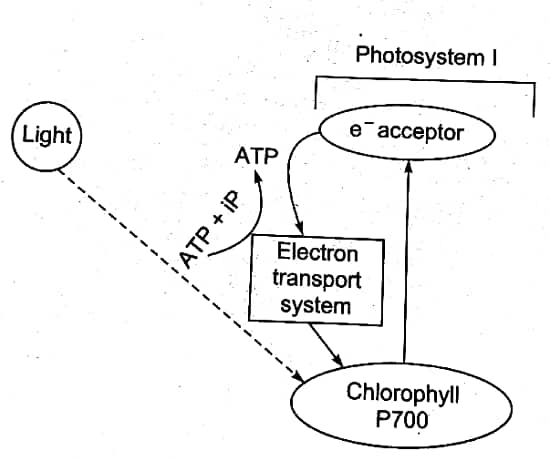
Cyclic photophosphorylation is the process of ATP synthesis by which electrons cycle around Photosystem I without generating NADPH or oxygen.
Photon Absorption: Absorption of light photons by Photosystem I, exciting an electron.
Transport of Electron: Flow of excited electrons in the electron transport chain.
Energy in Electron Flow: This energy from the electron flow is used in pumping protons across the thylakoid membrane, generating a proton gradient that drives ATP synthesis.
Return of Electron: Electrons ultimately return to PSI to complete the cycle.
Absorption of Photons: In PSI, the photons get absorbed, exciting electrons into higher energy states.
Electron Transfer: Electron transport entails a series of proteins in the thylakoid membrane, including plastoquinone, the cytochrome b6f complex, and plastocyanin.
ATP Formation: Electron flow gives the energy to pump protons into the thylakoid lumen, thus developing a proton gradient. It is this gradient that is harnessed by the enzyme ATP synthase to produce ATP from ADP and inorganic phosphate.
Recycling: Electrons get passed back to PSI, so the cycle starts all over again.
Noncyclic photophosphorylation refers to the process in which light energy is used to generate both ATP and NADPH as well as the formation of oxygen due to the linear electron flow from water to NADP+.
Photon Absorption (PSII): Photons are absorbed by PSII, which excites an electron and starts its transport.
Splitting of Water: In the oxygen-evolving complex of PSII, water is split into oxygen, protons, and electrons.
Electron transport chain: Electron transport, including plastoquinone, the b6f complex of cytochrome, and plastocyanin, passes electrons over to PSI.
Photon Absorption (PSI): More photons absorb in PSI, further exciting electrons. These electrons then reduce NADP+ to NADPH.
ATP and NADPH Formation: A proton gradient created by electron transport drives ATP synthesis with the help of an enzyme, namely ATP synthase.
Feature | Cyclic Photophosphorylation | Non-Cyclic Photophosphorylation |
PS I | PSI and PSII | |
Electron flow | Cyclic (returns to PSI) | Linera |
Products | ATP only | ATP, NADPH, O2 |
Oxygen | Absent | Present |
Water splitting | Absent | Present |
Function | More ATP generation | Main light reaction pathway |
Conditions | Low CO2 or high light | Normal conditions |
The PSI and PSII operate in the Z-scheme to help in electron transport and energy conversion.
Photosystem | Function | Reaction Centre Pigment |
PSI | Absorbs light, reduces NADP+ to NADPH | P700 |
PSII | Absorbs light, splits water, releases O2 | P680 |
The importance of photophosphorylation in photosynthesis includes:
It provides ATP and NADPH for the Calvin cycle or dark reactions.
It supports the synthesis of glucose and other organic compounds.
It regulates the energy homeostasis within chloroplasts.
It balances light harvesting complex and carbon fixation in various environmental conditions.
Important topics for NEET are:
Mechanism of Cyclic and Non-cyclic Photophosphorylation
Cyclic vs Non-cyclic Photophosphorylation
Q1. Cyclic photophosphorylation results in the formation of
NADPH + H+
ATP AND NADPH + H+
ADP and NADP
ATP
Correct answer: 4) ATP
Explanation:
Cyclic Photophosphorylation -
Operates at low light intensity, low CO2 availability and anaerobic condition, and only ATP is produced.
- wherein
It requires no external electron donor, and no photolysis of H2O
Hence, the correct answer is option 4) ATP.
Q2. Where does Cyclic Photophosphorylation occur in chloroplasts?
Intermembrane space
Stroma lamellae
Grana lamellae
Thylakoid lumen
Correct answer: 2) Stroma lamellae
Explanation:
The chloroplasts' Stroma lamellae are where cyclic photophosphorylation takes place.
The grana, or stacked thylakoid discs, are connected via the stroma lamellae, portions of the thylakoid membranes. Photosystem I (PSI), which is found in the stroma lamellae, is the primary site of cyclic photophosphorylation.
Through the cyclic passage of electrons through PSI, ATP is produced in this process without the formation of oxygen or NADPH.
Both ATP and NADPH are produced by non-cyclic photophosphorylation, which is carried out by grana lamellae, or the stacked thylakoid membranes.
Hence, the correct answer is option 2)Stroma lamellae
Q3. Cyclic photophosphorylation is functional under
Low light intensity
High CO2 availability
Aerobic conditions
Anaerobic conditions
Low CO2 availability
High light intensity
Choose the correct option
I, IV and V
I. III and IV
II, III and V
I and VI
Correct answer: 1) I, IV and V
Explanation:
It operates under aerobic conditions coupled with optimum light intensity in the functioning of cyclic photophosphorylation. The process mainly takes place in the thylakoid membranes of chloroplasts and involves only photosystem I, where re-excited electrons are recycled back to the photosystem, resulting in the production of ATP without oxygen or NADPH release. Multiple sources indicate that it does not operate effectively under low light intensity or anaerobic conditions.
Hence, the correct answer is option 1) I, IV, and V
Also Read:
Frequently Asked Questions (FAQs)
The end products of non-cyclic photophosphorylation are ATP and NADPH. These energy-rich molecules are then used in the Calvin cycle for carbon fixation and the production of glucose.
It contributes to the generation of extra ATP that the Calvin cycle requires when there is a need relative to NADPH, especially under high light conditions.
PSII absorbs light and performs a water-splitting, then PSI absorbs more light to drive the electron transport chain that gives off NADPH.
Photophosphorylation is a key process in the conversion of light energy into chemical energy. It produces both ATP and NADPH, which are used for carbon fixation in the Calvin cycle and hence modulate the efficiency of photosynthesis.
Cyclic photophosphorylation results in only ATP because electrons are recycled in PSI, while in noncyclic photophosphorylation, both ATP and NADPH are formed along with oxygen evolution as a result of the flow of electrons from water to NADP+.

Ranked 1 st among Top Law Schools of super Excellence in India - GHRDC | NAAC A+ Accredited | #36 by NIRF
Law Admissions 2026 Open | Avail Merit-Based Scholarships
Get Job Ready in Healthcare | Employability-Focused Programs
Highest CTC: 24 LPA | Average CTC: 12.32 LPA | 85 Placement Partners
Leading Design College | Highest CTC: ₹12 LPA | Average CTC: ₹7.5 LPA | Scholarships for Deserving Students
Attend 9-Hour Masterclass on 10th October 2026 to help you score 99+ percentile in CAT 2026