KCC Institute of Legal and Higher Education, Greater Noida
Law Admissions 2026 Open | Avail Merit-Based Scholarships


Have you ever wondered where we get the water we drink, the air we breathe, the food we eat, and the minerals used in industries? These valuable gifts provided by nature are known as natural resources. They are essential for the survival and development of all living organisms and play a crucial role in human life and economic growth. In this article, we will study about the natural resources, their type and uses along with some solved question related to natural resources.
This Story also Contains
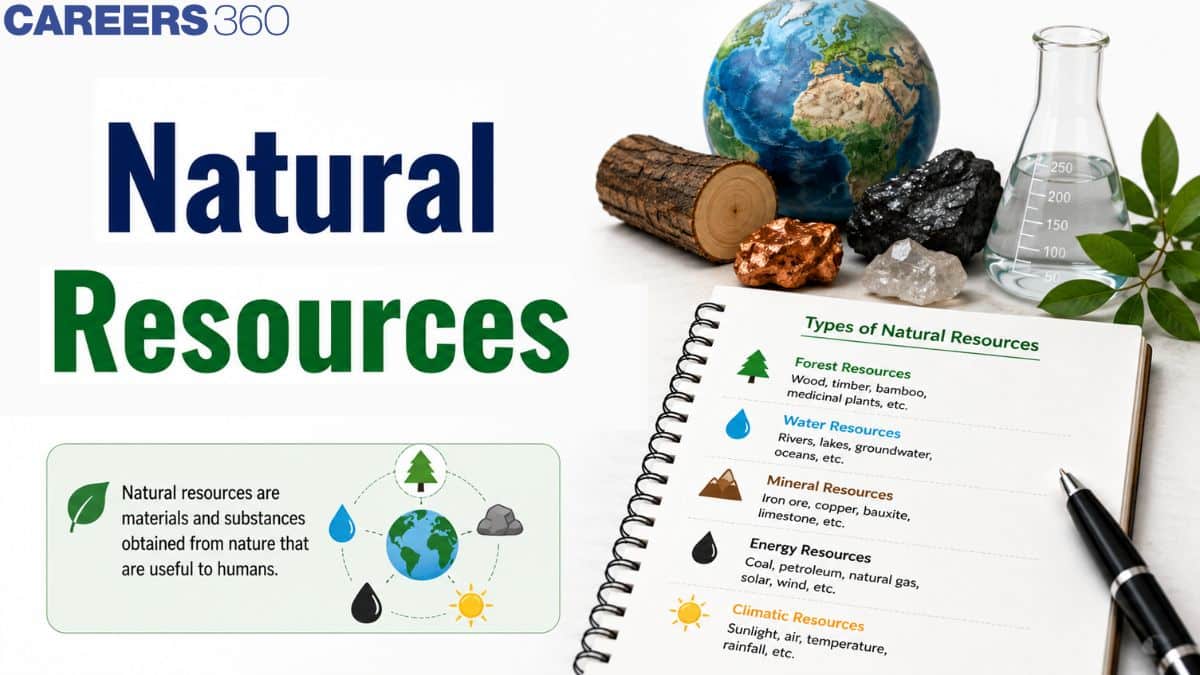
Natural resources are those resources which are obtained from nature in natural ways i.e. human help is not needed for this purpose. Or we can also define natural resources as those resources which are found in the environment and further developed without any interaction of humans. The name of natural resources are Sunlight, air, water, soil, plants, animals and fossil fuels. Natural resources are those resources which occur naturally and these useful for living beings and by some modifications or purifications it can also be used for many other purposes like clothes, metals, fertilizers, fossil fuels etc.
Examples:
Law Admissions 2026 Open | Avail Merit-Based Scholarships
BBA/MBA/PGDM Early Bird Applications Deadline 19th Oct '26. Apply now using coupon code CAREER250 and get ₹250 off the application fee
Also Read:
Based on availability of resources, these are categorised into two different categories known by the names:
Renewable natural resources are those resources that can be replenished or renewed naturally within a relatively short period of time. These resources are considered sustainable because they can be used repeatedly without being permanently depleted if managed properly. They are generally environmentally friendly and have a lower impact on nature.
Characteristics:
Examples:
Non-renewable natural resources are those resources that exist in limited quantities and cannot be replenished within a human lifetime. Once these resources are exhausted, they take millions of years to form again. Therefore, they are also known as exhaustible resources. Their excessive use can lead to depletion and environmental pollution.
Characteristics:
Examples:
|
Related Topics Link, |
Several natural resources may be renewable in nature. Out of all these resources, the five main natural resources are explained as follows:
1. Air: Air is one of the most important natural resources and is kept in the category of Renewable natural resources. As we know, air is the gases present in our atmosphere, or we can say that the atmosphere is because of the gases or air present. Air is important for all living organisms to survive on this planet. The environment contains several gases in its air, like Oxygen, nitrogen, carbon dioxide, carbon monoxide, etc. Life is not possible without good air, so we have to take all strict actions to purify our air or reduce air pollution.
2. Water: The second major natural resource is water, and it is kept in the category of Renewable natural resources. It is already known to us that 70% of our Earth is covered with water. The major sources of water are rainfall, lakes, rivers, ponds, sea, etc. Out of these 70% water bodies, only 2% of water is pure in nature, which we drink. We can’t imagine our life without the existence of water. Major uses of water are drinking, cooking, cleaning, etc. Hence we have to save water as much as we can and should not pollute the water by adding industrial or household waste into water bodies as it will be harmful to us and as well as for aquatic animals.
3. Soil: Soil is the most important resource for us and plants. Plants grow in soil, and the crop we need to prepare food is also grown in the soil. Soil is also kept in the category of natural renewable resources, as with the breakage of big mountains, they get converted into soil. Soil consists of many organic minerals, air, water, etc., which are helpful for any plant or crop to grow. Soil is the basic source of nutrients for plants and animals, and for many insects it is home, i.e. soil provides shelter to them. Soil is used for agricultural purposes.
4. Iron: Iron is made up of silica and has many uses, such as being used in the construction of buildings, other household things like an almirah, table, chair, etc., and also used in automobiles like cars, buses, etc. Iron is also used in making strong weapons. Iron is said to be non-renewable in nature; it cannot be renewed, so we have to use this resource for our needs only.
5. Forests: Forests are said to be the most important natural resource, which is useful for us as well as for animals. It provides shelter to animals and also provides food to them. Trees in forests also become the major resources of wood, paper, medicines, etc for us. But with the increasing population, the demand for construction increases, which reduces the forest area and will hurt our environment, as trees are a major source that reduces pollution.
This suggests that natural resources are very important for us, so we have to follow some methods to conserve natural resources, which can be discussed as follows:
Also read
Question 1: Which of the following is a renewable natural resource?
A. Coal
B. Petroleum
C. Wind Energy
D. Natural Gas
Solution:
Wind is continuously replenished by natural atmospheric processes and hence is a renewable resource. Coal, petroleum, and natural gas are fossil fuels and are non-renewable.
Hence, the correct answer is option (C)
Question 2: Which of the following resources is classified as an exhaustible natural resource?
A. Sunlight
B. Wind
C. Water Cycle
D. Petroleum
Solution:
Petroleum is available in limited quantities and takes millions of years to form. Therefore, it is an exhaustible (non-renewable) resource.
Hence, the correct answer is option (D)
Question 3: Which statement is incorrect regarding renewable resources?
A. They can be replenished naturally.
B. They are generally sustainable.
C. They are available in unlimited quantities under all conditions.
D. They can be used repeatedly if managed properly.
Solution:
Renewable resources can regenerate, but overexploitation may still deplete them temporarily. Therefore, they are not unlimited under all conditions.
Hence, the correct answer is option (C)
Question 4: Consider the following resources:
1. Coal
2. Forests
3. Petroleum
4. Wind
The non-renewable resources among these are:
A. 1 and 2 only
B. 2 and 4 only
C. 1 and 3 only
D. 1, 2 and 3 only
Solution:
Coal and petroleum are fossil fuels and are non-renewable. Forests and wind are renewable resources.
Hence, the correct answer is option (C)


Law Admissions 2026 Open | Avail Merit-Based Scholarships
BBA/MBA/PGDM Early Bird Applications Deadline 19th Oct '26. Apply now using coupon code CAREER250 and get ₹250 off the application fee
Ranked #36 amongst institutions in Management by NIRF | 100% Placement
Globally Recognized by AACSB (US) & AMBA (UK) | 18 LPA Avg. CTC for PGPM 2026
Leading Design College | 95% Placement Record | Merit-cum-Means Scholarships for Deserving Students
NEET PG All India & State College Predictor with Admission Process Guide