

KCC Institute of Legal and Higher Education, Greater Noida
Law Admissions 2026 Open | Avail Merit-Based Scholarships


An ellipse is the set of all points (x, y) in a plane such that the sum of their distances from two fixed points is a constant. The line that passes through the focus and is perpendicular to the directrix is called the major axis (focal axis) of the ellipse. We have another axis of the ellipse called the minor axis. So, the ellipse has 2 axes one major axis and another minor axis. In real life, we use Ellipse in race tracks, architectural design, mirrors, and celestial orbits.
This Story also Contains
.png)
In this article, we will cover the concept of Horizontal and Vertical Ellipse. This category falls under the broader category of Coordinate Geometry, which is a crucial Chapter in class 11 Mathematics. It is not only essential for board exams but also for competitive exams like the Joint Entrance Examination(JEE Main) and other entrance exams such as SRMJEE, BITSAT, WBJEE, BCECE, and more. A total of twenty questions have been asked on JEE MAINS( 2013 to 2023) from this topic including two in 2021, and one in 2022.
The locus of a point moves in a plane such that the ratio of the distance from a fixed point (focus) to the distance from a fixed line (directrix) is constant. The constant is known as eccentricity e and for ellipse 0 < e < 1.
Horizontal Ellipse
When the major axis is along the X-axis and the minor axis is along the Y-axis, i.e. a > b, it is called a horizontal ellipse.
the length of the major axis is 2a
the length of the minor axis is 2b
The foci are S (0, ae) and S’(0, -ae)
When the major axis is along the Y-axis and the minor axis is along the X-axis, i.e. b > a, it is called a vertical ellipse.
Then, AA’ = 2a and BB’ = 2b
the length of the major axis is 2b
the length of the minor axis is 2a
The foci are S (0, be) and S’(0, -be)
The equation of directrix MZ and M’Z’ are $
y=\frac{b}{e} \text { and } y=-\frac{b}{e}
$
Equation | $\frac{x^2}{a^2}+\frac{y^2}{b^2}=1 ; a>b$ | $\frac{x^2}{a^2}+\frac{y^2}{b^2}=1 ; a<b$ |
|---|---|---|
Graph |
|
|
Centre | (0, 0) | (0, 0) |
Vertices | $( \pm \mathrm{a}, 0)$ | $(0, \pm \mathrm{b})$ |
Length of Major Axis | $2a$ | $2b$ |
Length of Minor Axis | $2b$ | $2a$ |
Foci | $( \pm a e, 0)$ | $(0, \pm \mathrm{be})$ |
Distance b/w foci | $2ae$ | $2be$ |
Equation of Directrices | $\mathrm{x}= \pm \frac{\mathrm{a}}{\mathrm{e}}$ | $y= \pm \frac{b}{e}$ |
Distance b/w Directrices | $\frac{2 \mathrm{a}}{\mathrm{e}}$ | $\frac{2 b}{e}$ |
Eccentricity, e | $e=\sqrt{1-\frac{b^2}{a^2}}$ | $e=\sqrt{1-\frac{a^2}{b^2}}$ |
Length of Latusrectum | $\frac{2 b^2}{a}$ | $\frac{2 \mathrm{a}^2}{\mathrm{~b}}$ |
Endpoint of Latusrectum | $\left( \pm \mathrm{ae}, \pm \frac{\mathrm{b}^2}{\mathrm{a}}\right)$ | $\left( \pm \frac{a^2}{b}, \pm b e\right)$ |
Focal radii | $S P+S^{\prime} P=2 a$ | $S P+S^{\prime} P=2 b$ |
Parametric coordinates | $(a \cos \theta, b \sin \theta) \quad 0 \leq \theta \leq 2 \pi$ | $(a \cos \theta, b \sin \theta) \quad 0 \leq \theta \leq 2 \pi$ |
Tangent at vertices | $\mathrm{x}= \pm \mathrm{a}$ | $y= \pm b$ |
Law Admissions 2026 Open | Avail Merit-Based Scholarships
BBA/MBA/PGDM Early Bird Applications Deadline 19th Oct '26. Apply now using coupon code CAREER250 and get ₹250 off the application fee
Example 1: Let $E_1: \frac{x^2}{a^2}+\frac{y^2}{b^2}=1, a>\mathrm{b}$. Let $E_2$ be another ellipse such that it touches the endpoints of the major axis of $E_1$ and the foci of $E_2$ are the endpoints of the minor axis of $\mathrm{E}_1$. If $\mathrm{E}_1$ and $\mathrm{E}_2$ have the same eccentricities, then its value is : [JEE MAINS 2021]
Solution

$
\begin{aligned}
&\text { As per the question, }\\
&\begin{aligned}
& b=c e_2 \text { and } e_1=e_2 \\
\Rightarrow & b=c e_2 \text { and } e_1^2=e_2^2 \\
\Rightarrow & b=c e_2 \text { and } 1-\frac{b^2}{a^2}=1-\frac{a^2}{c^2} \\
\Rightarrow & b=c e_2 \quad \text { and } \quad \frac{b^2}{a^2}=\frac{a^2}{c^2} \\
\Rightarrow & b=c e_2 \quad \text { and } \quad c^2=\frac{a^4}{b^2} \\
\Rightarrow & c=\frac{b}{e_2} \quad \text { and } \quad c=\frac{a^2}{b} \\
\Rightarrow & \frac{b}{e_2}=\frac{a^2}{b} \\
\Rightarrow & e_2=\frac{b^2}{a^2} \\
\Rightarrow & e_2=1-e_1^2 \\
\Rightarrow & e_1=1-e_1^2 \\
\Rightarrow & e_1^2+e_1-1=0 \\
\Rightarrow & e_1=\frac{\sqrt{5}-1}{2}
\end{aligned}
\end{aligned}
$
Hence, the correct answer is $\frac{-1+\sqrt{5}}{2}$
Example 2: Let $\mathrm{S}=\left\{(\mathrm{x}, \mathrm{y}) \in \mathbb{N} \times \mathbb{N}: 9(\mathrm{x}-3)^2+16(\mathrm{y}-4)^2 \leq 144\right\}$ and $\mathrm{T}=\left\{(\mathrm{x}, \mathrm{y}) \in \mathbb{R} \times \mathbb{R}:(\mathrm{x}-7)^2+(\mathrm{y}-4)^2 \leq 36\right\}$. Then $\mathrm{n}(\mathrm{S} \cap \mathrm{T})$ is equal to $\qquad$
[JEE MAINS 2022]
Solution

For $\mathrm{x}=1 \Rightarrow(1,4)$
For $\mathrm{x}=2 \Rightarrow(2,4),(2,5),(2,3),(2,6),(2,2)$
For $\mathrm{x}=3 \Rightarrow(3,4),(3,5),(3,3),(3,6),(3,2)(3,7),(3,1)$
For $\mathrm{x}=4 \Rightarrow(4,4),(4,5),(4,3),(4,6),(4,2)$
For $\mathrm{x}=5 \Rightarrow(5,4),(5,5),(5,3),(5,2),(5,6)$
For $\mathrm{x}=6 \Rightarrow(6,4),(6,3),(6,5)$
For $\mathrm{x}=7 \Rightarrow(7,4)$
$\therefore$ Total 27 common points
Ans:27
Example 3: If $x^2+9 y^2-4 x+3=0, x, y \in \mathbb{R}$, then x and $y$ respectively lie in the intervals :
[JEE MAINS 2021]
Solution: To find the Range of x , make quadratic in y
$
\begin{aligned}
& 9 y^2+x^2-4 x+3=0 \\
& D \geq 0 \\
& \Rightarrow 0-4 \times 9 \times\left(x^2-4 x+3\right) \geq 0 \\
& \Rightarrow(x-1)(x-3) \leq 0 \Rightarrow x \epsilon[1,3]
\end{aligned}
$
To Find the Range of y , make quadratic in x
$
\begin{aligned}
& x^2-4 x+9 y^2+3=0 \\
& D \geq 0 \\
& \Rightarrow 4^2-4 \times\left(9 y^2+3\right) \geq 0 \Rightarrow 9 y^2-1 \leq 0 \\
& \Rightarrow(3 y-1)(3 y+1) \leq 0 \Rightarrow y \epsilon\left[\frac{-1}{3}, \frac{1}{3}\right]
\end{aligned}
$
Hence, the answer is $[1,3]$ and $\left[-\frac{1}{3}, \frac{1}{3}\right]$
Example 4: What are the coordinates of the midpoints of the ellipse $x^2+4 y^2-6 x+40 y=0$
Solution: We know that the center of the Ellipse is the mid-point of the two foci of the ellipse.

$
\begin{aligned}
& x^2-6 x+4\left(y^2+10 y\right)=0 \\
& x^2-6 x+9+4\left(y^2+10 y+25\right)=100+9 \\
& (x-3)^2+4(y+5)^2=109
\end{aligned}
$
Centre is $(3,-5)$
Hence, the answer is $(3,-5)$
Example 5: Consider an ellipse, whose center is at the origin and its major axis is along the $x$-axis. If its eccentricity is $\frac{3}{5}$ and the distance between its foci is 6 , then the area (in sq. units) of the quadrilateral inscribed in the ellipse, with the vertices as the endpoints of major and minor axes of the ellipse, is
Solution
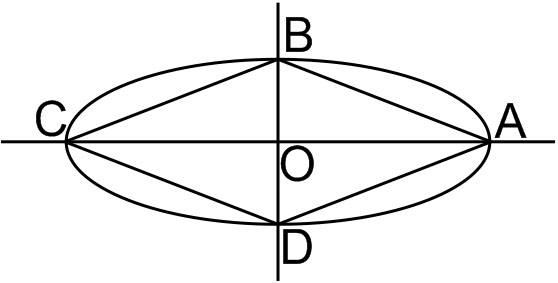
Given
$
e=\frac{3}{5}
$
and
$
2 a e=6 \Rightarrow a e=3
$
Hence $a=5$
$
b^2=a^2\left(1-e^2\right) \Rightarrow b=4
$
Area of quadrilateral $\mathrm{ABCD}=4 \operatorname{Ar}(\Delta A O B)$
$
\begin{aligned}
& =4 \times \frac{1}{2} \times a \times b \\
& =4 \times \frac{1}{2} \times 5 \times 4 \\
& =40
\end{aligned}
$
Hence, the answer is 40

Law Admissions 2026 Open | Avail Merit-Based Scholarships
BBA/MBA/PGDM Early Bird Applications Deadline 19th Oct '26. Apply now using coupon code CAREER250 and get ₹250 off the application fee
Ranked #36 amongst institutions in Management by NIRF | 100% Placement
Globally Recognized by AACSB (US) & AMBA (UK) | 18 LPA Avg. CTC for PGPM 2026
Leading Design College | 95% Placement Record | Merit-cum-Means Scholarships for Deserving Students
NEET PG All India & State College Predictor with Admission Process Guide