


Intersection of Line and Circle
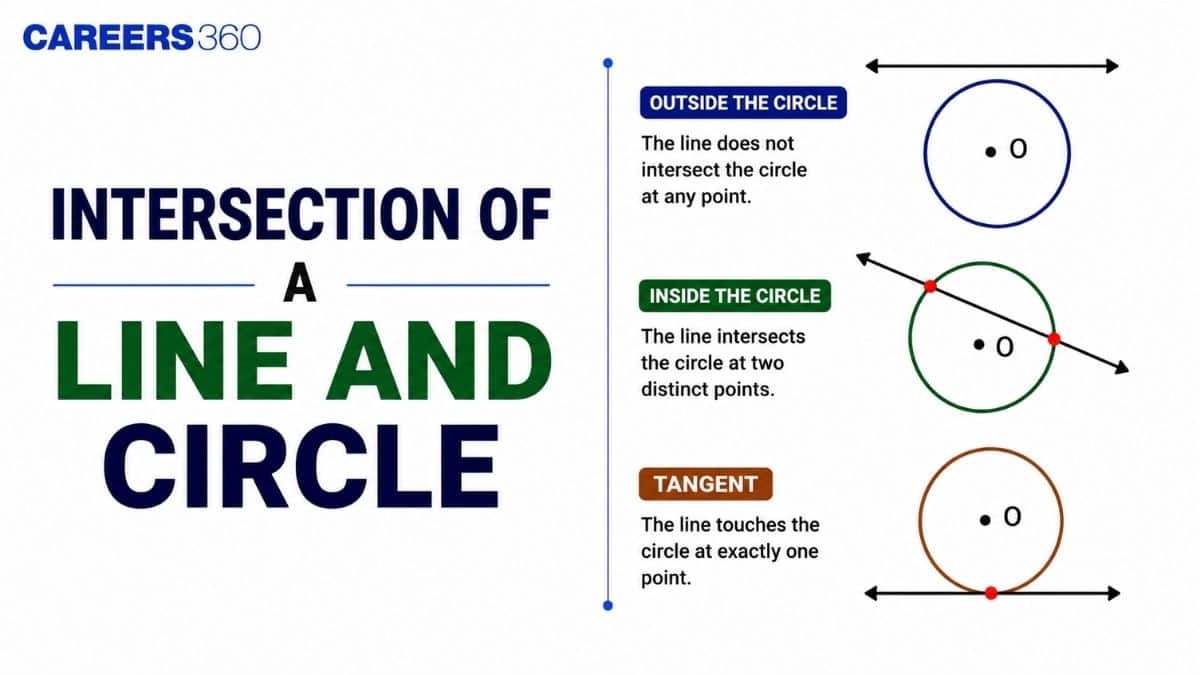
Think of a straight road passing through a circular garden. The road may cut across the garden at two places, just touch its boundary, or miss it entirely. These three possibilities perfectly illustrate the concept of the intersection of a line and a circle. In coordinate geometry, finding the points of intersection involves solving the equations of the line and the circle simultaneously. The nature of these intersection points also helps determine whether the line is a secant, a tangent, or lies completely outside the circle. This topic plays an important role in coordinate geometry and frequently appears in JEE, NDA, CUET, and other competitive examinations. In this article, you'll explore the conditions for intersection, different methods of finding the points of intersection, important formulas, graphical interpretation, and solved examples in mathematics.
This Story also Contains
- What is the Intersection of a Line and Circle?
- Basics of Coordinate Geometry
- Different Types of Intersection
- Methods to Find the Intersection of a Line and Circle
- Conditions for Intersection
- Line and Circle
- Nature of the Intersection
- Properties of Line-Circle Intersection
- Applications of Intersection of a Line and Circle
- Intersection of a Line vs Tangent to a Circle
- Best Books for Intersection of a Line and Circle
- Shortcut Tips and Tricks
- Important Formulae and Results
- Solved Examples Based on the Intersection of a Line and a Circle
What is the Intersection of a Line and Circle?
The intersection of a line and a circle refers to the common point or points that satisfy both the equation of the line and the equation of the circle. Depending on the position of the line relative to the circle, they may intersect at two points, touch at exactly one point, or have no common point at all. This concept is an important part of coordinate geometry and is frequently used in mathematics, engineering, computer graphics, and competitive examinations.
Intersection of a Line and Circle Meaning in Simple Words
In simple words, the intersection of a line and a circle means finding the point(s) where a straight line meets a circle. Sometimes the line cuts the circle, sometimes it just touches it, and sometimes it does not meet the circle at all.
Definition of Intersection of a Line and Circle
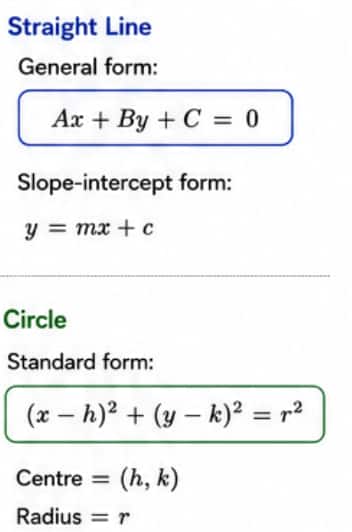
The intersection of a line and a circle is the set of points that satisfy both the equation of the line and the equation of the circle simultaneously.
If the equations are
$Ax+By+C=0$
and
$(x-h)^2+(y-k)^2=r^2$
then every common solution of these equations represents an intersection point.
Why Finding the Intersection is Important
Finding the intersection helps us:
Determine whether a line is a secant, tangent, or external line.
Solve coordinate geometry problems efficiently.
Find points of contact between curves.
Understand geometric relationships.
Solve many JEE, NDA, CUET, and engineering entrance examination questions.
Real-Life Applications
The concept of line-circle intersection is used in:
Road and railway design.
Computer graphics.
Robotics.
GPS navigation.
Engineering drawing.
Architecture.
Basics of Coordinate Geometry
Before finding the points of intersection, it is important to understand the basic equations of lines and circles.
Equation of a Straight Line
A straight line can be written in several forms. The most common general form is
$Ax+By+C=0$
Other forms include:
Slope-intercept form
$y=mx+c$
Point-slope form
$y-y_1=m(x-x_1)$
Each form is useful depending on the given information.
Standard Equation of a Circle
A circle with centre
$(h,k)$
and radius
$r$
has the equation
$(x-h)^2+(y-k)^2=r^2$
If the centre is at the origin, the equation becomes
$x^2+y^2=r^2$
Centre and Radius of a Circle
Every circle is completely determined by:
Its centre, which specifies the location.
Its radius, which specifies the size.
These two quantities are essential while determining whether a line intersects the circle.
Position of a Point with Respect to a Circle
A point may lie:
Inside the circle.
On the circle.
Outside the circle.
This depends on the distance of the point from the centre compared with the radius.
Different Types of Intersection
The number of common points depends on the relative position of the line and the circle.
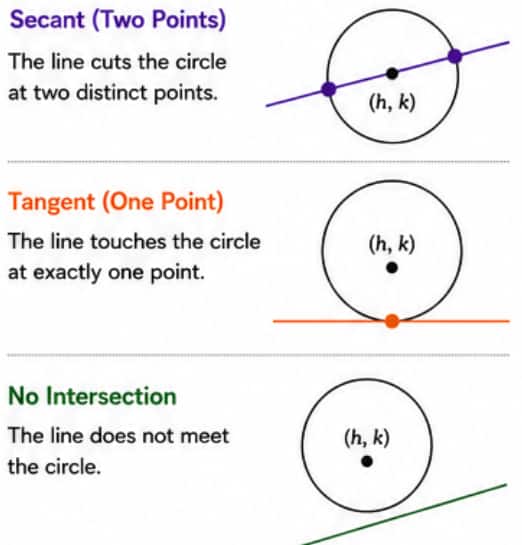
Two Points of Intersection (Secant)
If the line passes through the circle, it intersects the circle at two distinct points.
Such a line is called a secant.
This happens when the perpendicular distance from the centre to the line is less than the radius.
One Point of Intersection (Tangent)
If the line touches the circle at exactly one point, it is called a tangent.
At the point of contact, the tangent is perpendicular to the radius.
No Point of Intersection
If the line lies completely outside the circle, it has no common point with the circle.
Such a line is called an external line.
Special Cases
Some important special situations include:
The line passes through the centre of the circle.
The line is parallel to the coordinate axes.
The circle is centred at the origin.
The line coincides with a diameter.
These cases often simplify calculations.
Methods to Find the Intersection of a Line and Circle
Several methods can be used depending on the form of the equations.
Algebraic Method
The algebraic method involves solving the equations of the line and the circle simultaneously.
After substituting one equation into the other, the resulting quadratic equation gives the intersection points.
This is the most commonly used method in competitive examinations.
Substitution Method
In this method, one variable from the line equation is expressed in terms of the other variable.
The resulting expression is substituted into the circle equation to obtain the required solution.
It is particularly useful when one equation is already solved for a variable.
Elimination Method
The elimination method removes one variable by combining the equations appropriately.
It is often preferred when both equations are given in general form.
Parametric Method
In advanced coordinate geometry, the line is represented using parametric equations.
Substituting the parametric coordinates into the circle equation helps determine the points of intersection efficiently.
This method is frequently used in higher mathematics and engineering.
Conditions for Intersection
The relative position of the line and circle can be determined without solving the equations completely.
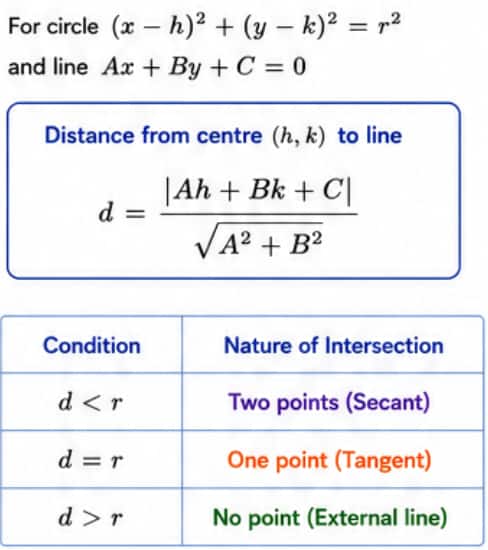
Distance from the Centre to the Line
Discriminant Method
After substituting the line equation into the circle equation, a quadratic equation is obtained.
Its discriminant determines the number of intersection points.
Positive discriminant: Two points.
Zero discriminant: One point.
Negative discriminant: No real point.
Tangency Condition
A line is tangent to the circle when
Distance from centre = Radius
or equivalently,
the quadratic equation obtained after substitution has discriminant equal to zero.
Secant Condition
A line is a secant when Distance from centre < Radius or the discriminant of the quadratic equation is positive.
This indicates two distinct intersection points.
Line and Circle
A circle is the locus of a moving point such that its distance from a fixed point is constant.
S is a circle with centre O and radius r, and L is a straight line in the plane of the circle.
Equation of circle $S: x^2+y^2=a^2 \quad \ldots$ (i)
Equation of line $L: y=m x+c$
To find their point(s) of intersection, we can solve these equations simultaneously
$\begin{aligned}
& x^2+(m x+c)^2=a^2 \\
& \left(1+m^2\right) x^2+2 m c x+c^2-a^2=0
\end{aligned}$
Case (1)
If line L intersects the circle S in two distinct points, then Equation (iii) will have two real and distinct roots

So, Discriminant of equation (iii) > 0
In this case, the line is a secant to the circle, i.e., it represents the equation of chord to the circle.
Case (2)
If the line L touches the circle, then Equation (iii) will have two equal real roots
So, Discriminant of equation (iii) = 0

$\begin{aligned} & \mathrm{B}^2-4 \mathrm{AC}=0 \\ & 4 \mathrm{~m}^2 \mathrm{c}^2-4\left(1+\mathrm{m}^2\right)\left(\mathrm{c}^2-\mathrm{a}^2\right)=0 \\ & \mathrm{a}^2=\frac{\mathrm{c}^2}{1+\mathrm{m}^2} \\ & \mathrm{c}^2=a^2\left(1+\mathrm{m}^2\right)\end{aligned}$
In this case, the line is tangent to the circle
This is also the condition of tangency to the circle.
Case (3)
If the line L and the circle S have no common points, then Equation (iii) will have imaginary roots
So, the Discriminant of equation (iii) < 0

Alternate method to check the position of the line with respect to the circle
We can find the distance OM between the line and the center of the circle, and compare it with the radius of the circle
- If OM < r, then the line is a chord (secant) to the circle
- If OM = r, then the line is tangent to the circle
- If OM > r, then the line does not intersect the circle at any point
Nature of the Intersection
The position of the line relative to the circle determines how they intersect. By examining the equation of the line and its distance from the centre of the circle, we can easily identify the nature of the intersection and simplify many coordinate geometry problems.
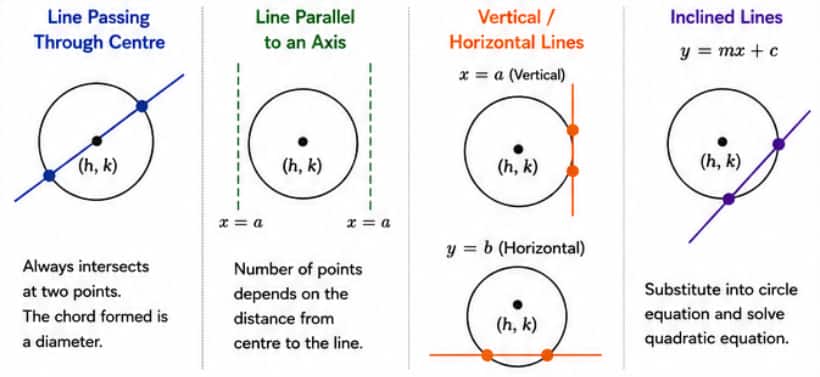
Line Passing Through the Centre
If the line passes through the centre of the circle, it always intersects the circle at two points.
The line divides the circle into two equal halves, and the chord formed is the diameter, which is the longest possible chord of the circle.
Such problems often become simpler because the midpoint of the two intersection points is the centre of the circle.
Line Parallel to an Axis
A line may be parallel to either the $x$-axis or the $y$-axis.
For example,
$x=a$ or $y=b$
These equations simplify substitution into the circle equation since only one variable needs to be determined.
The number of intersection points depends on the distance of the line from the centre of the circle.
Vertical and Horizontal Lines
Vertical lines have equations of the form $x=a$
while horizontal lines have equations of the form $y=b$
These special cases are easier to solve because they reduce the problem to solving a single-variable quadratic equation.
They frequently appear in coordinate geometry and competitive examinations.
Inclined Lines
An inclined line is any line that is neither vertical nor horizontal.
Its equation is generally written as $y=mx+c$ or $Ax+By+C=0$
To find the points of intersection, substitute the equation of the line into the circle equation and solve the resulting quadratic equation.
Properties of Line-Circle Intersection
Several important properties help determine the relationship between a line and a circle without performing lengthy calculations.
Number of Common Points
A line and a circle can have:
Two common points, if the line is a secant.
One common point, if the line is a tangent.
No common point, if the line lies outside the circle.
Thus, the maximum possible number of intersection points is two.
Relationship Between Radius and Distance
The relationship between the radius and the perpendicular distance from the centre to the line determines the type of intersection.
If Distance $<r$, the line is a secant.
If Distance $=r$, the line is a tangent.
If Distance $>r$, the line does not intersect the circle.
This property provides the quickest way to determine the nature of the intersection.
Geometrical Interpretation
Geometrically, the intersection points represent the locations where the straight line meets the circular boundary.
As the line moves closer to or farther from the centre:
Two intersection points gradually approach each other.
They coincide when the line becomes a tangent.
They disappear once the line moves outside the circle.
This visual interpretation helps understand the transition between a secant, tangent, and external line.
Important Observations
Some useful observations include:
Every tangent touches the circle at exactly one point.
A secant always intersects the circle at two distinct points.
A diameter is a special chord passing through the centre.
Every diameter is formed by a secant passing through the centre.
The tangent at any point on a circle is perpendicular to the radius drawn to the point of contact.
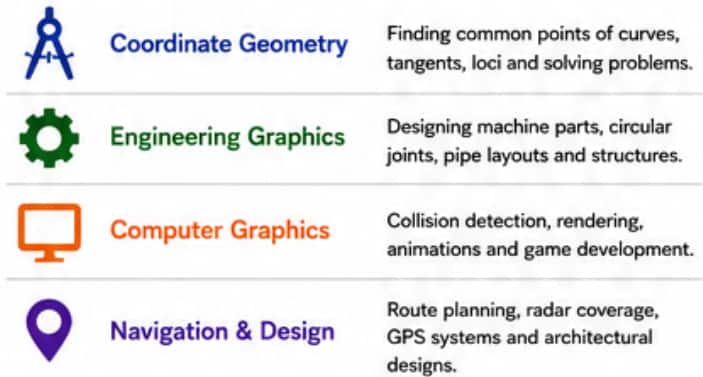
Applications of Intersection of a Line and Circle
The concept of line-circle intersection has applications far beyond coordinate geometry. It is widely used in mathematics, engineering, computer graphics, and navigation systems.
Intersection of a Line vs Tangent to a Circle
Although a tangent is a special type of line related to a circle, it differs significantly from a line that intersects the circle at two points.
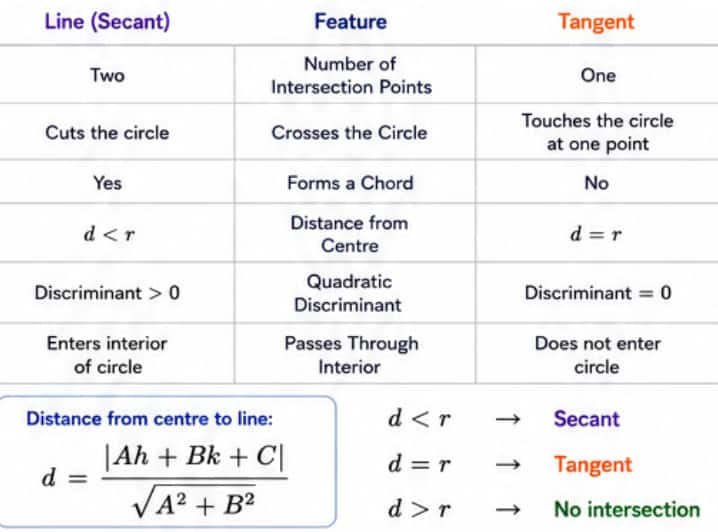
Key Differences
An intersecting line (secant) cuts the circle at two distinct points.
A tangent touches the circle at exactly one point without entering its interior.
A secant forms a chord, whereas a tangent touches the circle only at the point of contact.
Similarities
Both:
Are straight lines.
Can be represented using linear equations.
Interact with the circle.
Are important concepts in coordinate geometry.
Are frequently used in competitive examinations.
Formula Comparison
For a line
$Ax+By+C=0$
and a circle of radius $r$ with centre $(h,k)$,
Distance from the centre to the line is
$\frac{|Ah+Bk+C|}{\sqrt{A^2+B^2}}$
If Distance $=r$ the line is a tangent.
If Distance $<r$ the line is a secant.
If Distance $>r$ there is no intersection.
Comparison Table
Best Books for Intersection of a Line and Circle
Understanding the intersection of a line and a circle requires a solid grasp of coordinate geometry, straight lines, and circles. The following books explain these concepts with numerous solved examples.
| Book Name | Best For | Why It Helps |
|---|---|---|
| NCERT Mathematics Class 11 | Beginners | Covers circles and straight lines with basic examples |
| Coordinate Geometry by S.L. Loney | Concept Building | Classic text for analytical geometry |
| Cengage Mathematics – Coordinate Geometry | JEE Preparation | Excellent explanation with advanced problems |
| Plane Coordinate Geometry by Arihant | Competitive Exams | Covers all standard coordinate geometry concepts |
| IIT Mathematics by M.L. Khanna | Advanced Learners | High-level coordinate geometry questions |
| Objective Mathematics by R.D. Sharma | Practice | Good collection of solved and objective problems |
Shortcut Tips and Tricks
Many intersection problems become easier by first identifying the nature of the line with respect to the circle before solving the equations.
| Trick | Explanation |
|---|---|
| Compare Distance from Centre | Quickly determine whether the line intersects, touches, or misses the circle. |
| Use the Discriminant | Discriminant indicates the number of intersection points. |
| Substitute Line into Circle | Eliminates one variable immediately. |
| Use Parametric Form | Helpful for advanced coordinate geometry problems. |
| Remember Tangency Condition | Tangency occurs when the discriminant equals zero. |
| Sketch the Figure | A rough diagram helps avoid sign mistakes. |
| Simplify Before Expanding | Reduces lengthy algebraic calculations. |
Important Formulae and Results
The following formulas are commonly used while solving problems involving the intersection of a line and a circle.
| Concept | Formula |
|---|---|
| Circle | $(x-h)^2+(y-k)^2=r^2$ |
| General Circle | $x^2+y^2+2gx+2fy+c=0$ |
| Line | $Ax+By+C=0$ |
| Tangency Condition | Distance $=r$ |
| Secant Condition | Distance $<r$ |
| No Intersection | Distance $>r$ |
Solved Examples Based on the Intersection of a Line and a Circle
Example 1: The circle $x^2+y^2=4x+8y+5$ intersects the line $3x-4y=m$ at two distinct points if
$-85<m<-35$
$-35<m<15$
$15<m<65$
$35<m<85$
Solution:
The given circle is
$x^2+y^2-4x-8y-5=0$
The given line is
$3x-4y=m$
Substitute
$x=\frac{m+4y}{3}$
into the equation of the circle.
$\begin{aligned}
&\frac{(m+4y)^2}{9}+y^2-\frac{4(m+4y)}{3}-8y-5=0\
&\frac{25}{9}y^2+y\left(\frac{8m}{9}-\frac{40}{3}\right)+\left(\frac{m^2}{9}-5\right)=0
\end{aligned}$
Multiplying throughout by $9$,
$25y^2+8y(m-15)+(m^2-45)=0$
For the line to intersect the circle at two distinct points,
$D>0$
$\begin{aligned}
&[8(m-15)]^2-4(25)(m^2-45)>0\
&16m^2-3840m+23040-25m^2+1125>0
\end{aligned}$
On simplifying,
$(m+35)(m-15)<0$
Therefore,
$m\in(-35,15)$
Hence, the answer is option (2).
Example 2: Two common tangents to the circle $x^2+y^2=2a^2$ and the parabola $y^2=8ax$ are
$x=\pm(y+2a)$
$y=\pm(x+2a)$
$x=\pm(y+a)$
$y=\pm(x+a)$
Solution:
For the parabola
$y^2=4ax$
the tangent is
$y=mx+\frac{a}{m}$
Therefore, for
$y^2=8ax$,
the tangent is
$y=mx+\frac{2a}{m}$
For the circle
$x^2+y^2=2a^2$
a tangent is
$y=mx+a\sqrt{2(1+m^2)}$
Since the tangent is common,
$a\sqrt{2(1+m^2)}=\frac{2a}{m}$
Squaring,
$\begin{aligned}
&(m^2+1)m^2=2\
&m^4+m^2-2=0\
&(m^2+2)(m^2-1)=0
\end{aligned}$
Hence,
$m=\pm1$
Substituting,
$y=\pm(x+2a)$
Hence, the answer is option (2).
Example 3: If the chord $y=mx+1$ of the circle $x^2+y^2=1$ subtends an angle of measure $45^\circ$ at the major segment of the circle, then the value of $m$ is
Solution:
The given circle is
$x^2+y^2=1$
and the chord is
$y=mx+1$
Since the chord subtends an angle of $45^\circ$ at the major segment, it subtends an angle of $90^\circ$ at the centre.
Homogenizing the circle using
$y=mx+1$,
we get
$x^2+y^2=(y-mx)^2$
which simplifies to
$x^2(1-m^2)+2mxy=0$
For
$ax^2+by^2+2hxy=0$
to subtend an angle of $90^\circ$ at the origin,
$a+b=0$
Applying this condition,
$m=\pm1$
Hence, the value of $m$ is $\pm1$.
Example 4: If the line $3x-4y-\lambda=0$ touches the circle $x^2+y^2-4x-8y-5=0$ at $(a,b)$, then $\lambda+a+b$ is equal to:
Solution:
The centre of the circle is
$(2,4)$
and the radius is
$\sqrt{4+16+5}=5$
Since the line is tangent,
$\frac{|3(2)-4(4)-\lambda|}{\sqrt{3^2+(-4)^2}}=5$
$\Rightarrow\frac{|6-16-\lambda|}{5}=5$
Hence,
$\lambda=15$
or
$\lambda=-35$
The tangent at $(a,b)$ is
$\begin{aligned}
&xa+yb-2(x+a)-4(y+b)-5=0\
&\Rightarrow(a-2)x+(b-4)y-(2a+4b+5)=0
\end{aligned}$
Comparing with
$3x-4y-\lambda=0$,
$\frac{a-2}{3}=\frac{b-4}{-4}=\frac{2a+4b+5}{\lambda}=l$
Case I: $\lambda=15$
Then,
$a=3l+2,\qquad b=4-4l$
Substituting,
$2(3l+2)+4(4-4l)+5=15l$
$\Rightarrow l=1$
Thus,
$a=5,\qquad b=0$
Therefore,
$\lambda+a+b=15+5+0=20$
Case II: $\lambda=-35$
Similarly,
$25-10l=-35l$
$\Rightarrow l=-1$
Thus,
$a=-1,\qquad b=8$
Therefore,
$\lambda+a+b=-35-1+8=-28$
Hence, the required value is 20.
Example 5: The points of intersection of the line $ax+by=0,;(a\ne b)$ and the circle $x^2+y^2-2x=0$ are $A(\alpha,0)$ and $B(1,\beta)$. The image of the circle with $AB$ as a diameter in the line $x+y+2=0$ is
$x^2+y^2+3x+3y+4=0$
$x^2+y^2+3x+5y+8=0$
$x^2+y^2-5x-5y+12=0$
$x^2+y^2+5x+5y+12=0$
Solution:
The only possible values are
$\alpha=0,\qquad\beta=1$
The circle having $AB$ as diameter is
$\begin{aligned}
&(x-0)(x-1)+(y-0)(y-1)=0\
&x^2+y^2-x-y=0
\end{aligned}$
Reflecting this circle in the line
$x+y+2=0$
gives
$x^2+y^2+5x+5y+12=0$
Hence, the answer is option (4).
Related Topics to Intersection of a Line and Circle
The intersection of a line and a circle is closely related to equations of a circle, equations of a straight line, tangent to a circle, normal to a circle, chord of contact, coordinate geometry, and distance of a point from a line.
Frequently Asked Questions (FAQs)
If the centre of the circle is $(h,k)$ and the line is $Ax+By+C=0$, then the perpendicular distance is $\frac{|Ah+Bk+C|}{\sqrt{A^2+B^2}}$.
Yes. After substituting the line equation into the circle equation, examine the discriminant $(D)$ of the resulting quadratic equation.
- If $D>0$, the line intersects the circle at two distinct points.
- If $D=0$, the line is tangent to the circle.
- If $D<0$, the line does not intersect the circle.
Yes. Vertical lines ($x=a$) and horizontal lines ($y=b$) can intersect, touch, or miss a circle depending on their distance from the centre.
No. A straight line can intersect a circle at a maximum of two distinct points.
Compare the perpendicular distance from the centre of the circle to the line with the radius. If the distance is less than the radius, the line intersects the circle at two points. If it is equal to the radius, the line touches the circle at one point.
