KCC Institute of Legal and Higher Education, Greater Noida
Law Admissions 2026 Open | Avail Merit-Based Scholarships


Imagine creating a 6-digit password where the same digit can be used more than once. Unlike ordinary permutations, you don't have to worry about using each digit only once - repetition is completely allowed. Problems like these are solved using the concept of permutation with repetition. It is one of the most useful counting techniques in combinatorics, helping us calculate the number of possible arrangements when objects can be selected multiple times. This concept has numerous applications in mathematics, coding theory, password generation, probability, genetics, and computer science. In this article, we will discuss the definition of permutation with repetition, its formula, derivation, properties, solved examples, and real-life applications.
This Story also Contains
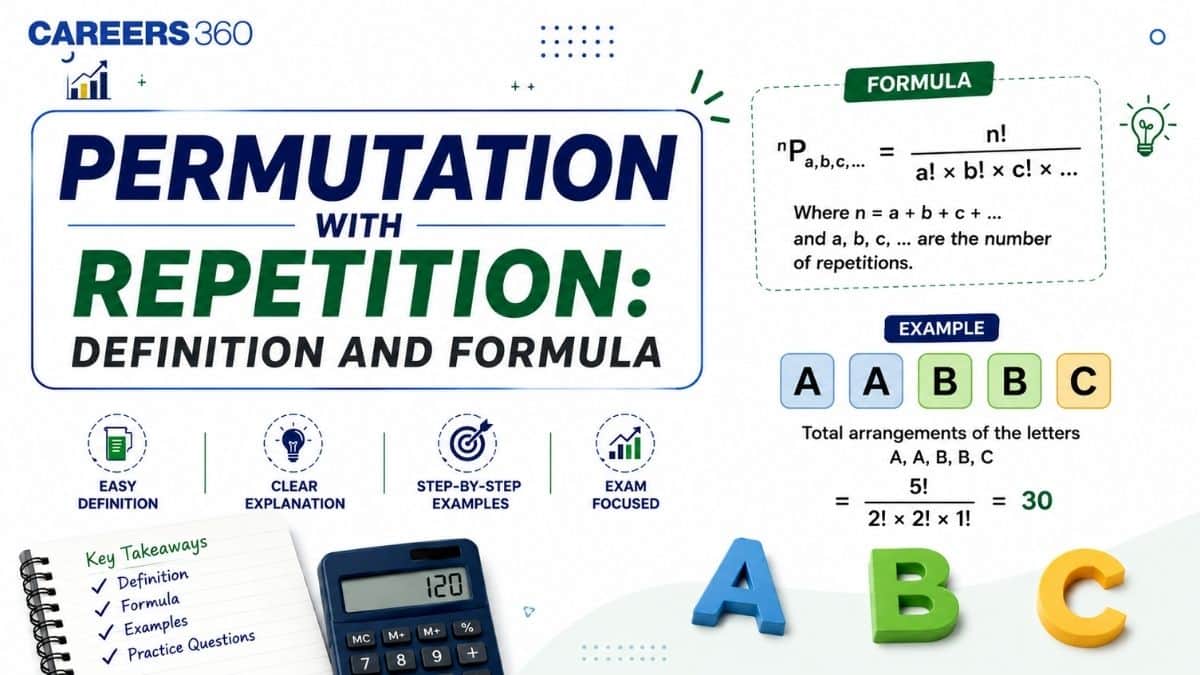
Permutation with repetition is a counting technique used when arranging objects and the same object is allowed to appear more than once. Unlike ordinary permutations, where each object can be used only once, permutation with repetition allows repeated selections, resulting in a larger number of possible arrangements. This concept is widely used in combinatorics, probability, coding theory, computer science, and competitive examinations.
Permutation with repetition means arranging objects where an item can be selected multiple times.
For example, if you are creating a 4-digit PIN using the digits $0$ to $9$, each digit can be used repeatedly. Therefore, numbers like $1111$, $2020$, and $9999$ are all valid arrangements.
Permutation with repetition refers to the number of ordered arrangements that can be formed when each object may be selected more than once.
If there are $n$ different objects and $r$ positions to fill, then the total number of arrangements is
$n^r$
where:
$n$ is the number of available objects.
$r$ is the number of positions to be filled.
Law Admissions 2026 Open | Avail Merit-Based Scholarships
BBA/MBA/PGDM Early Bird Applications Deadline 06th Nov'26. Apply now using coupon code CAREER250 and get ₹250 off the application fee
Permutation with repetition is important because many real-life arrangements allow repeated choices. It is widely used in:
Password generation.
PIN and OTP creation.
Computer programming.
Coding theory.
Probability problems.
Artificial intelligence and machine learning.
It is also a frequently tested topic in JEE, CAT, NDA, CUET, and other competitive examinations.
Some common examples include:
Creating ATM PINs.
Generating passwords.
Forming vehicle registration numbers.
Creating binary strings.
DNA sequence analysis.
Generating computer codes.
Before learning permutation with repetition, it is essential to understand the basic concept of permutations and the role of repetition in counting problems.
A permutation is an arrangement of objects in a specific order.
For example, arranging the letters A, B, and C gives
ABC, ACB, BAC, BCA, CAB, CBA
Since the order changes, each arrangement is considered different.
Repetition means that the same object may be selected more than once.
For example, when forming a 3-letter code from the letters A and B, arrangements such as
AAA, ABB, BAB, BBB
are all allowed because repetition is permitted.
When repetition is not allowed, each object can appear only once.
For example,
ABC
is valid, but
AAB
is not.
When repetition is allowed, objects can appear multiple times.
For example,
AAA
and
ABA
are both valid arrangements.
Understanding this difference helps students choose the correct counting formula.
The Fundamental Principle of Counting states that if one task can be completed in $m$ ways and another independent task can be completed in $n$ ways, then both tasks together can be completed in
$m\times n$
ways.
Using this principle, if each of the $r$ positions has $n$ possible choices, then the total number of arrangements becomes
$n\times n\times\cdots\times n=n^r$
This forms the basis of the permutation with repetition formula.
The formula for permutation with repetition is simple because every position can be filled independently using any of the available objects.
If there are $n$ different objects and $r$ positions, then
$\text{Number of permutations with repetition}=n^r$
This is one of the most frequently used formulas in combinatorics.
In the formula
$n^r$
$n$ represents the number of available objects.
$r$ represents the number of positions to be filled.
For example, if there are $5$ letters and we want to form a $3$-letter code, the number of possible arrangements is
$5^3=125$
Suppose there are $n$ choices for each position.
The first position can be filled in $n$ ways.
The second position can also be filled in $n$ ways.
Similarly, every position has $n$ possible choices.
Using the Fundamental Principle of Counting,
$n\times n\times\cdots\times n=n^r$
Hence,
$\boxed{n^r}$
is the required formula.
Use the formula $n^r$ whenever:
Repetition is allowed.
Order matters.
Every position has the same number of choices.
Typical examples include passwords, PINs, lock combinations, and coding sequences.
Permutation with repetition appears in many different forms depending on the nature of the objects being arranged.
Digit arrangement problems often allow repetition.
For example, the number of 5-digit numbers formed using digits $0$-$9$ with repetition allowed is
$10^5$
provided leading zeros are permitted.
Letters can also be repeated while forming words or codes.
For example, using the letters A, B, and C to form 4-letter strings gives
$3^4=81$
possible arrangements.
Passwords and PINs are among the most common applications of permutation with repetition.
If each character can be reused, every position has the same number of possible choices.
Permutation with repetition is also used to count binary sequences, DNA sequences, computer instructions, and signal patterns where repeated symbols are allowed.
Although both involve arrangements, the counting methods are different depending on whether repetition is permitted.
Without repetition,
${}^nP_r=\frac{n!}{(n-r)!}$
With repetition,
$n^r$
The latter is much simpler because every choice remains available throughout the arrangement.
In both cases, order matters.
However, only permutation with repetition allows the same object to occupy multiple positions.
Since repetition increases the number of available choices, permutation with repetition usually produces more arrangements than ordinary permutation.
| Feature | Without Repetition | With Repetition |
|---|---|---|
| Formula | ${}^nP_r=\frac{n!}{(n-r)!}$ | $n^r$ |
| Repetition Allowed | No | Yes |
| Order Matters | Yes | Yes |
| Same Object Multiple Times | Not Allowed | Allowed |
| Number of Arrangements | Smaller | Larger |
Permutation with repetition has several mathematical properties that simplify counting problems.
Each object remains available after every selection.
Choosing an object once does not reduce the number of choices for the remaining positions.
Every position is filled independently of the others.
This independence makes the counting process straightforward.
The total number of arrangements follows directly from the Fundamental Principle of Counting.
If each of the $r$ positions has $n$ choices, then the total number of arrangements is
$n^r$
Some useful observations include:
Repetition always increases the total number of arrangements.
The formula does not involve factorials.
Every position has the same number of choices.
The method is applicable only when repetition is explicitly allowed.
Permutation with repetition has numerous practical applications across mathematics and technology.
Password systems often allow characters to repeat.
The formula $n^r$ helps determine the total number of possible passwords.
Digital communication systems use repeated symbols while generating codes and transmitting information.
Permutation with repetition helps count the total number of valid codewords.
Computer scientists use permutation with repetition in:
Password security.
Cryptography.
Binary strings.
Data encoding.
Algorithm analysis.
Many probability problems begin by counting the total number of possible outcomes.
When repetition is allowed, permutation with repetition provides this count directly.
Students often lose marks by confusing different counting techniques.
Many students incorrectly apply
${}^nP_r$
instead of
$n^r$
Always check whether repetition is allowed.
If the question explicitly states that objects may repeat, the correct formula is
$n^r$
Using factorial-based formulas gives incorrect answers.
Words such as
"repetition allowed,"
"digits may repeat,"
"with replacement,"
indicate that the permutation with repetition formula should be used.
Students sometimes remove duplicate arrangements unnecessarily.
When repetition is allowed and order matters, every distinct arrangement should be counted.
The following formulas are commonly used in counting problems involving permutations.
The most important formulas include:
Permutation with repetition:
$n^r$
Permutation without repetition:
${}^nP_r=\frac{n!}{(n-r)!}$
Combination:
${}^nC_r=\frac{n!}{r!(n-r)!}$
| Counting Technique | Formula | Order Matters | Repetition Allowed |
|---|---|---|---|
| Permutation with Repetition | $n^r$ | Yes | Yes |
| Permutation without Repetition | ${}^nP_r=\frac{n!}{(n-r)!}$ | Yes | No |
| Combination | ${}^nC_r=\frac{n!}{r!(n-r)!}$ | No | No |
If there are $n$ objects of which p objects are of one type, $q$ objects of another type, r objects of yet another type, and all others are distinct, the total number of ways of arranging all the objects is $\frac{\mathrm{n}!}{\mathrm{p}!\mathrm{q}!\mathrm{r}!}$
By doing this we have now all the $n$ things different, therefore number of permutations should be $n!$
Suppose the total number of permutations are $x$, now if we replace all $p$ identical objects with $p$ different objects which are also different from the rest of the objects then we have $x \times p$ ! arrangements.
Again if we replace $q$ identical things with $q$ different things, then no. of permutations will become ( $x$ p! q!). Further, if we replace $r$ identical things with $r$ different things which are different from the rest, then a number of permutations will become ( $x$ p! q!) r!
By doing this we have now all the n things different, therefore number of permutations should be n !
The number of arrangements will be $x \times p!\times q!\times r!$
Now, we have replaced all identical objects and we are left with $n$ different objects which can be arranged in n! Ways.
Hence, $x \times p!\times q!\times r!=n!$
$
x=\frac{n!}{p!q!r!}
$
Example: In how many ways can the letters of the word "MISSISSIPPI" be arranged?
Solution: repeated letters $\mathrm{I}=4$ times, $\mathrm{S}=4$ times and $\mathrm{P}=2$ times
So using the above formula we have $x=\frac{11!}{4!\times 4!\times 2!}$
The formula for Circulation Permutations with Repetition for n elements is $=n!=n(n-1)$
Permutation with repetition is an important topic in combinatorics and counting principles. The following books explain its concepts with numerous solved examples and practice questions.
| Book Name | Best For | Why It Helps |
|---|---|---|
| NCERT Mathematics Class 11 | Beginners | Covers the basics of permutations and combinations |
| Higher Algebra by Hall &, Knight | Concept Building | Detailed explanation of counting techniques |
| Cengage Mathematics - Permutations &, Combinations | JEE Preparation | Excellent topic-wise coverage |
| Problems Plus in IIT Mathematics by A. Das Gupta | Advanced Practice | Challenging combinatorics problems |
| Objective Mathematics by R.D. Sharma | Competitive Exams | Large collection of objective questions |
| IIT Mathematics by M.L. Khanna | Higher-Level Learning | Covers advanced counting principles |
Most permutation with repetition questions can be solved quickly by identifying whether repetition is allowed before choosing the correct formula.
| Trick | Explanation |
|---|---|
| Check if Repetition is Allowed | This determines whether the standard permutation formula applies. |
| Use the Formula Directly | If repetition is allowed, use $n^r$. |
| Read the Question Carefully | Words like "can repeat" or "may repeat" indicate repetition. |
| Separate Arrangement from Selection | Ensure the problem asks for arrangements. |
| Count Available Choices | Every position usually has the same number of choices. |
| Draw Small Cases | Helps verify the formula for beginners. |
| Compare with Ordinary Permutations | This avoids using the wrong formula. |
The following formulas are frequently used in permutation with repetition problems.
| Concept | Formula |
|---|---|
| Permutation with Repetition | $n^r$ |
| Ordinary Permutation | ${}^nP_r=\frac{n!}{(n-r)!}$ |
| Factorial | $n!=n(n-1)(n-2)\cdots1$ |
| Circular Permutation | $(n-1)!$ |
| Permutation of Identical Objects | $\frac{n!}{p!q!r!\cdots}$ |
| Binary String Count | $2^n$ |
| Decimal Number Formation | $10^n$ (when repetition is allowed) |
Example 1: The total number of six-digit numbers formed using the digits $4$, $5$, and $9$ only and divisible by $6$ is: [JEE Main 2023]
Solution:
For a number to be divisible by $6$, it must be divisible by both $2$ and $3$.
Since the available even digit is only $4$, the units digit must be fixed as $4$.
Now consider the remaining five positions.
Case I: Six $4$s
There is only one arrangement.
$\frac{5!}{5!}=1$
Case II: Four $4$s, one $5$, and one $9$
The remaining five positions contain
$4,4,4,5,9$
Number of arrangements
$\frac{5!}{3!}=20$
Case III: Three $4$s and three $5$s
The remaining five positions contain
$4,4,5,5,5$
Number of arrangements
$\frac{5!}{2!3!}=10$
Case IV: Three $4$s and three $9$s
The remaining five positions contain
$4,4,9,9,9$
Number of arrangements
$\frac{5!}{2!3!}=10$
Case V: Two $4$s, two $5$s, and two $9$s
The remaining five positions contain
$4,5,5,9,9$
Number of arrangements
$\frac{5!}{2!2!}=30$
Case VI: One $4$, one $5$, and four $9$s
The remaining five positions contain
$5,9,9,9,9$
Number of arrangements
$\frac{5!}{4!}=5$
Case VII: One $4$, four $5$s, and one $9$
The remaining five positions contain
$5,5,5,5,9$
Number of arrangements
$\frac{5!}{4!}=5$
Therefore,
$\begin{aligned}
\text{Total numbers}
&, =1+20+10+10+30+5+5\
&, =81
\end{aligned}$
Hence, the answer is 81.
Example 2: The number of seven-digit integers with a sum of digits equal to $10$ and formed using the digits $1$, $2$, and $3$ only is: [JEE Main 2021]
Solution:
The possible digit combinations are:
Case I: , $1,1,1,1,1,2,3$
Number of arrangements
$\frac{7!}{5!}=7\times6=42$
Case II: , $1,1,1,1,2,2,2$
Number of arrangements
$\frac{7!}{4!3!}=\frac{7\times6\times5}{6}=35$
Therefore,
$\begin{aligned}
\text{Total numbers}
&, =42+35\
&, =77
\end{aligned}$
Hence, the answer is 77.
Example 3: The number of words (with or without meaning) that can be formed from all the letters of the word LETTER in which the vowels never come together is: [JEE Main 2020]
Solution:
The word is
LETTER
The vowels are
$E,E$
The consonants are
$L,T,T,R$
First, arrange the consonants.
Since the letter $T$ is repeated twice,
the number of arrangements is
$\frac{4!}{2!}=12$
This creates five gaps:
L, T, T, R, _
Choose any two of these five gaps for the two vowels.
This can be done in
${}^5C_2=10$
ways.
Since both vowels are identical,
their arrangement is
$\frac{2!}{2!}=1$
Therefore,
$\begin{aligned}
\text{Total words}
&, =\frac{4!}{2!}\times{}^5C_2\times\frac{2!}{2!}\
&, =12\times10\
&, =120
\end{aligned}$
Hence, the answer is 120.
Example 4: The total number of six-digit numbers in which only the digits $1$, $3$, $5$, $7$, and $9$ appear and each digit appears at least once is: [JEE Main 2020]
Solution:
There are six positions but only five distinct digits.
Therefore, exactly one digit must repeat.
First, choose the digit to be repeated.
This can be done in $5$ ways.
Now arrange the six digits.
Since one digit is repeated twice,
the number of arrangements is
$\frac{6!}{2!}$
Therefore,
$\begin{aligned}
\text{Total numbers}
&, =5\times\frac{6!}{2!}\
&, =\frac{5}{2}(6!)
\end{aligned}$
Hence, the answer is $\frac{5}{2}(6!)$.
Example 5: All possible numbers are formed using the digits $1,1,2,2,2,2,3,4,4$ taken all at a time. The number of such numbers in which the odd digits occupy even places is: [JEE Main 2019]
Solution:
The given digits are
$1,1,2,2,2,2,3,4,4$
There are a total of $9$ digits.
The even positions are
$2,4,6,8$
There are four even positions.
The odd digits are
$1,1,3$
These three digits must occupy any three of the four even positions.
The number of ways to choose these positions is
${}^4C_3$
Since the digit $1$ is repeated twice,
The arrangements of the odd digits are
$\frac{3!}{2!}=3$
Thus, the number of ways to place the odd digits is
${}^4C_3\times\frac{3!}{2!}=4\times3=12$
The remaining six positions are occupied by
$2,2,2,2,4,4$
The number of arrangements is
$\frac{6!}{4!2!}=\frac{6\times5}{2}=15$
Therefore,
$\begin{aligned}
\text{Total numbers}
& =12\times15\
& =180
\end{aligned}$
Hence, the answer is 180.
Permutation with repetition is closely connected with permutations, combinations, factorials, the Fundamental Principle of Counting, binomial expansion, probability, and combinatorics. Studying these topics strengthens problem-solving skills in counting techniques.
Frequently Asked Questions (FAQs)
Use permutation with repetition when:
Yes. In permutation with repetition, every position can be occupied by any of the available objects unless additional conditions or restrictions are specified.
Permutation with repetition is commonly used in forming passwords, PINs, lock combinations, telephone numbers, product codes, and sequences where repeating characters or digits is allowed.
In permutation without repetition, each object can be used only once. In permutation with repetition, the same object can be used multiple times, increasing the total number of possible arrangements.
Permutation with repetition is an arrangement of objects where some or all items can be repeated. Unlike ordinary permutations, the same element is allowed to appear multiple times in different positions.

Law Admissions 2026 Open | Avail Merit-Based Scholarships
BBA/MBA/PGDM Early Bird Applications Deadline 06th Nov'26. Apply now using coupon code CAREER250 and get ₹250 off the application fee
Ranked #36 amongst institutions in Management by NIRF | 100% Placement
Globally Recognized by AACSB (US) & AMBA (UK) | 18 LPA Avg. CTC for PGPM 2026
NEET PG All India & State College Predictor with Admission Process Guide
Top B-School: Ranked #9 in NIRF Management Rankings 2025.