


Weightlessness
Weightlessness, or zero gravity, is the sensation of having no weight due to the absence of gravitational forces. This phenomenon is commonly associated with astronauts floating in space, where Earth's gravitational pull becomes negligible. However, weightlessness can also be experienced on Earth during specific conditions, such as free-fall, parabolic flights, or when diving from high altitudes. In our everyday lives, we catch glimpses of weightlessness when jumping on a trampoline or going down a steep roller coaster—moments where gravity seems to lose its grip. These short-lived experiences offer a taste of what astronauts feel in orbit, where everything around them, including their own bodies, floats freely.
This Story also Contains
- Weightlessness
- Weightlessness in a Satellite
- Solved Examples Based on Weightlessness
- Example 1: Which of the following statements is incorrect regarding weightless?
- Summary
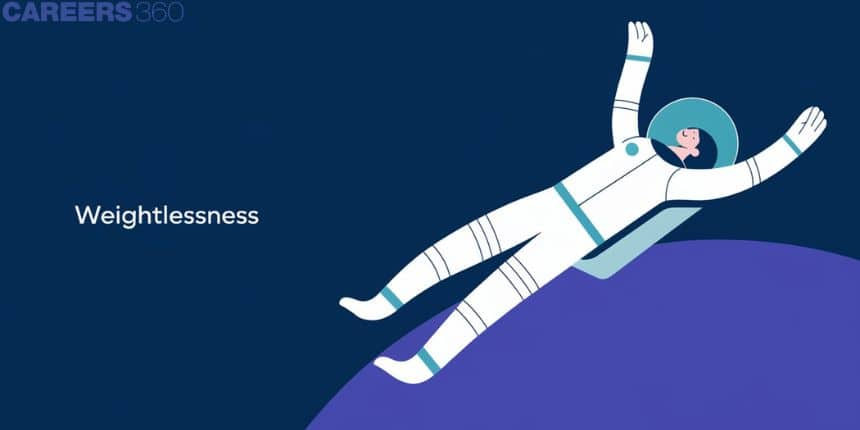
Weightlessness
Weightlessness, or zero gravity, is a condition where an object or person experiences no apparent weight. This phenomenon occurs when the force of gravity is counteracted by other forces, such as when an object is in free fall. In space, astronauts experience weightlessness because both they and the spacecraft are falling
There are basically three cases of weightlessness
When objects fall freely under gravity
When a man is in a free-falling lift, then he will feel the weightlessness.
2. When a satellite revolves in its orbit around the earth
Because of this, the astronauts will feel weightlessness in the satellite.
3. When bodies are at null points in outer space
As we go up from the earth’s surface the gravitational pull of the earth decreases and the gravitational pull of the moon increases. There is a point when both the gravitational force will be equal and opposite, that null the weight of the body and we feel weightlessness.
Weightlessness in a Satellite
The acceleration of the satellite is $\frac{G M}{r^2}$ towards the centre of the earth.
Let us suppose a body of mass $m$ placed on a surface inside the satellite moving around the earth.
Then force on the body are
(i) The gravitational pull of earth $=\frac{G M m}{r^2}$
(ii) The reaction by the surface $=R$
By Newton's law $\frac{G m M}{r^2}-R=m a$
$
\frac{G m M}{r^2}-R=m\left(\frac{G M}{r^2}\right) \quad \therefore \quad R=0
$
As the reaction becomes 0.
And from the Laws of motion, we know that the reaction on a body will give its weight.
So, the body will feel weightlessness in the satellite.
Recommended Topic Video
Solved Examples Based on Weightlessness
Example 1: Which of the following statements is incorrect regarding weightless?
1) When the body is in free fall occurs.
2) It can occur when the mass of the satellite is not negligible.
3) The time period of a simple pendulum $T=\infty$
4) None of these
Solution:
Weightlessness
The reaction of the weighing machine gives the measure of the weight
wherein
Conditions for weightlessness
- Free fall
- when bodies are at a null point in outer space
Weightless occurs only when the mass of the satellite is negligible so that it does not produce its own gravity.
Hence, the answer is the option (2).
Example 2: A person in an artificial satellite of Earth feels weightlessness because
1) The gravitational force of the earth provides the centripetal force to move in the orbit
2) possess weightlessness due to the additional gravitational pull of the planet
3) both A and B
4) none of the above
Solution:
Weightlessness in satellite
The acceleration of the satellite is $\frac{G M}{r^2}$ towards the centre of the earth.
Let us suppose a body of mass $m$ placed on a surface inside the satellite moving around the earth.
Then force on the body is
(i) The gravitational pull of earth $=\frac{G M m}{r^2}$
(ii) The reaction by the surface $=R$
By Newton's law $\frac{G m M}{r^2}-R=m a$
$
\frac{G m M}{r^2}-R=m\left(\frac{G M}{r^2}\right) \quad \therefore \quad R=0
$
As the reaction becomes 0.
And from the Laws of motion, we know that the reaction on a body will give its weight.
So, the body will feel weightlessness in the satellite.
So the answer is option A which says gravitational force requires centripetal force so that a satellite can move in its orbit.
Hence, the answer is the option (1).
Example 3:The astronaut in the satellite orbiting the earth feels weightlessness. Does the weightlessness depend upon the distance of the satellite from the Earth?
1) Yes
2) No
3) Yes, but for very low heights from the earth’s surface
4) Can not say
Solution:
A satellite revolving in an orbit of any radius experiences weightlessness. It is because, when a satellite revolves in an orbit, Its weight is used up to provide the necessary centripetal force. Thus, the weightlessness does not depend on the distance of the satellite from the Earth.
Hence, the answer is the option (2).
Summary
Weightlessness occurs when an object or person experiences no apparent weight, commonly felt in free fall, orbiting satellites, or at null points in space where gravitational forces cancel out. In a satellite, astronauts experience weightlessness because the satellite is in continuous free fall around Earth, with no reaction force on their bodies. This phenomenon has practical implications for scientific research and does not depend on the distance of the satellite from Earth.