


Aquatic Ecosystem - Types, Function & Defination
Aquatic ecosystems are natural water-based habitats that sustain a wide range of organisms. They are broadly classified into freshwater ecosystems, marine ecosystems, lentic ecosystems, and lotic ecosystems. They are vital for biodiversity, climate regulation, and human needs. Understanding types, examples, and the importance of aquatic ecosystems is essential for Class 12 Biology and NEET exams.
This Story also Contains
- Aquatic Ecosystem Definition
- Types of Aquatic Ecosystems
- Examples of Aquatic Ecosystems
- Importance of Aquatic Ecosystem
- Zones of Aquatic Ecosystem
- Functions of Aquatic Ecosystem
- Aquatic Ecosystem NEET MCQs
- Recommended Video on Aquatic Ecosystem
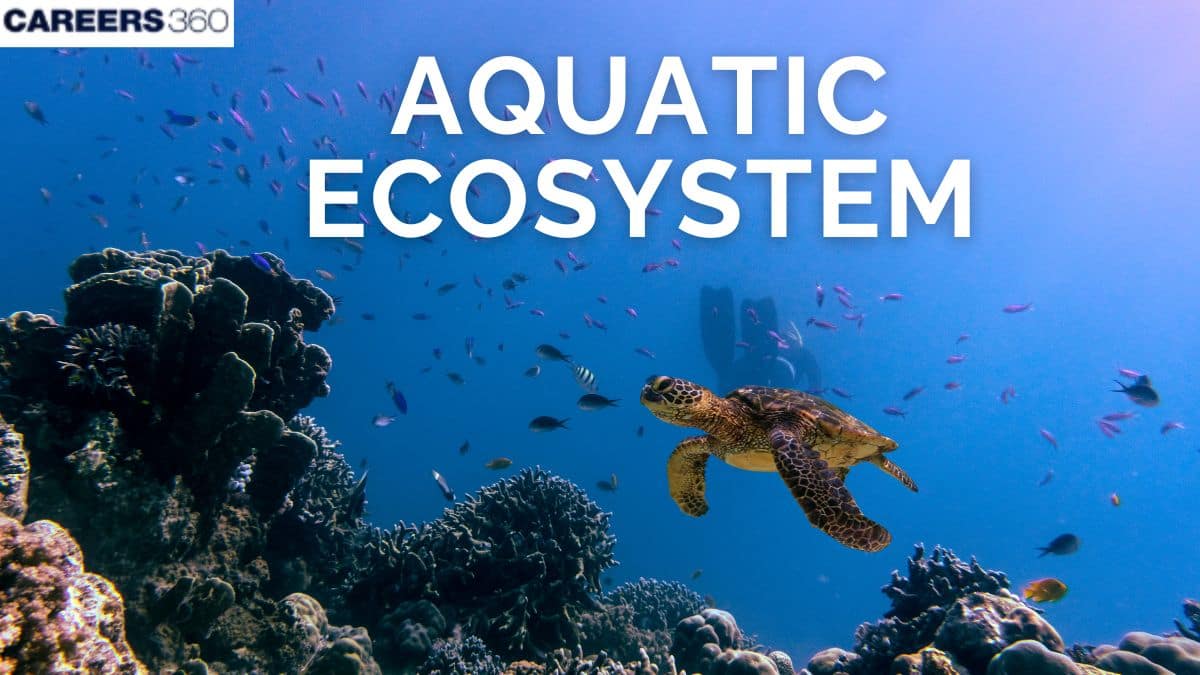
An ecosystem is the sum of all the organisms living within its boundaries and all the abiotic factors with which they interact. In aquatic ecosystems, biotic components such as producers, consumers, and decomposers interact with abiotic factors like water, light, oxygen, and nutrients. This interaction maintains ecological balance and supports life. Studying the types of aquatic ecosystems helps aspirants grasp ecological concepts, examples, and functions that are important for competitive exams.
Aquatic Ecosystem Definition
An aquatic habitat can be described as a complex community of living organisms that includes both plants, animals, and microorganisms, interacting both between themselves and with their physical environment, within a water body. These ecosystems are important in terms of maintaining global biodiversity and support an enormous variety of species that depend on aquatic environments for survival.
Types of Aquatic Ecosystems
Aquatic ecosystems may be classified into the following broad categories based on their characteristics:
Freshwater Ecosystems: All freshwater lakes, rivers, streams, and wetlands fall under this category. Freshwater ecosystems are home to a wide variety of species, which makes them an essential source of water for drinking and irrigation purposes.
Example - Ganga River, Amazon River, Keoladeo National Park (India), Florida Everglades
Marine Ecosystem: This portion of the Earth's surface is taken up by marine ecosystems. It is mainly composed of oceans, coral reefs, and estuaries. They are very rich in terms of species diversity and also play a critical role in regulating the weather.
Example - Pacific Ocean, Arabian Sea, Great Barrier Reef
Lentic Ecosystem: These are ecosystems that result from still or standing bodies of water, such as lakes and ponds. They show distinct zones, such as the littoral, limnetic, and benthic zones, hosting different species adapted to their respective environments.
Examples - Dal Lake, Vembanad Lake, rural ponds
Lotic Ecosystem: In contrast, lotic ecosystems refer to flowing water bodies, such as rivers and streams. The dynamics of an ecosystem are characterised by changing parameters, thus hosting species adapted to the current conditions of the flow.
Examples - Ganga River, Nile River, mountain streams
Examples of Aquatic Ecosystems
There are many examples of aquatic ecosystems, which depict their diversity:
Ponds and Lakes: Freshwater ecosystems harbour different organisms, from fish and amphibians to aquatic plants.
Rivers: Lotic ecosystems often support species such as salmon and various aquatic invertebrates.
Coral Reefs: The marine ecosystems are mostly well known for biodiversity, housing numerous species of fish and other marine creatures.
Wetlands: Transitional areas between land and water, with unique communities of plants and animals.
Importance of Aquatic Ecosystem
Aquatic environments play a critical role for several reasons:
Biodiversity: They support an incredibly wide variety of species, which add to global biodiversity.
Ecosystem Services: The key areas of importance of aquatic ecosystems are the filtration of water, regulatory functions of the climate system, and nutrient cycling.
Human Use: Many communities find food, recreation, and economic sources in aquatic ecosystems, such as commercial fisheries and tourism.
Aquaculture: Aquatic ecosystems support fish farming and aquaculture, which enhance food production and livelihood.
Hydroponics: Freshwater systems are vital for hydroponic farming, where plants are grown in water solutions without soil.
Controls Pollution: Wetlands and aquatic plants act as natural filters, cleaning pollutants from water.
Zones of Aquatic Ecosystem
Aquatic ecosystems, especially lakes and oceans, are divided into distinct zones based on depth, light penetration, and distance from the shore. Each zone has its own physical conditions and organisms.
1. Littoral Zone
Shallow water near the shore.
Well-lit, nutrient-rich, supports rooted plants, algae, and diverse fauna like snails, insects, and amphibians.
Most productive zone in freshwater bodies.
2. Limnetic Zone
Open water area away from the shore but still within the depth of light penetration.
Dominated by plankton, small fish, and zooplankton.
Primary site for photosynthesis in lakes and ponds.
3. Benthic Zone
The bottom surface of water bodies (lake/ocean floor).
Occupied by decomposers, detritivores, and benthic organisms like molluscs, worms, and some fish.
Plays a key role in nutrient recycling.
Functions of Aquatic Ecosystem
Aquatic ecosystems perform several vital functions that sustain biodiversity and regulate environmental balance. They act as natural reservoirs of water, provide habitats for diverse species, and maintain nutrient cycling. Some functions of an aquatic ecosystem are:
- Nutrient Cycling
- Habitat Provision
- Climate Regulation
- Water Purification
- Food and Livelihood
- Flood Control
Aquatic Ecosystem NEET MCQs
Q1. Whole ecosystem is too much big and complex to be studied at one time, it is convenient to divide it into two basic categories named as :
Inland and outland ecosystem
Complex and non-complex ecosystem
Estuary and forest ecosystem
Terrestrial and aquatic ecosystem
Correct answer: 4) Terrestrial and aquatic ecosystem
Explanation:
Terrestrial and the Aquatic Ecosystem -
Since the whole ecosystem is too big and complex to be studied at one time, it is convenient to divide it into two basic categories, namely the terrestrial and the aquatic.
- wherein
Forest, grassland and deserts are some examples of terrestrial ecosystems; ponds, lakes, wetlands, and rivers and estuaries are some examples of aquatic ecosystems.
Hence the correct answer is Option (4) Terrestrial and aquatic ecosystem.
Q2. Which of the following best describes an ecosystem?
A single organism
A group of organisms of the same species
A group of organisms of different species interacting with each other and their physical environment
A group of different species interacting with each other but not their physical environment
Correct answer: 3) A group of organisms of different species interacting with each other and their physical environment
Explanation:
A group of organisms of different species interacting with each other and their physical environment best describes an ecosystem. An ecosystem is a community of living organisms, along with their nonliving physical and chemical environment, that interact and function as a unit. The interactions between organisms and their environment are essential for maintaining the balance and sustainability of the ecosystem.
Hence, the correct answer is Option (3) A group of organisms of different species interacting with each other and their physical environment.
Q3. Which of the following is an example of an ecosystem?
A single tree
A group of ants
A coral reef
A single cell
Correct answer: 3) A coral reef
Explanation:
An ecosystem is a community of living and nonliving things interacting with each other in a specific environment. A coral reef is an excellent example of an ecosystem as it is a complex community of marine organisms interacting with each other and their physical environment. The reef provides a habitat for various organisms, including fish, invertebrates, and algae. The coral is a living organism that interacts with the other microorganisms and physical components of the ecosystem to create a thriving community.
Hence, the correct answer is option 3) A coral reef.
Recommended Video on Aquatic Ecosystem
Frequently Asked Questions (FAQs)
- It provides biotic and abiotic ecosystems for aquatic organisms and aquatic plants
- It provides suitable environmental conditions such as temperature, oxygen, nutrition, and pH.
- Provide a surface area for plant growth.
Swamps are the shallow marshy area covered by water and plants are grown over that.
Freshwater, marine, lentic, and lotic ecosystems are types of aquatic ecosystems.
Lotic is the Latin word that means organisms lives in moving water; And lentic is the Latin word that means organisms lives in static or standing water form.
