KCC Institute of Legal and Higher Education, Greater Noida
Law Admissions 2026 Open | Avail Merit-Based Scholarships


The cell is the smallest structural and fundamental unit of life. It is sometimes referred to as the "building block of life." A cell performs all the functions necessary for life, such as metabolism, energy conversion, and reproduction. Organisms may be single-celled, called unicellular organisms (like bacteria) or composed of many cells, called multicellular organisms (like human beings). The study of cells is the foundational base of biology, with its high weightage in NEET biology, Paramedical, and Pharmacy.
This Story also Contains
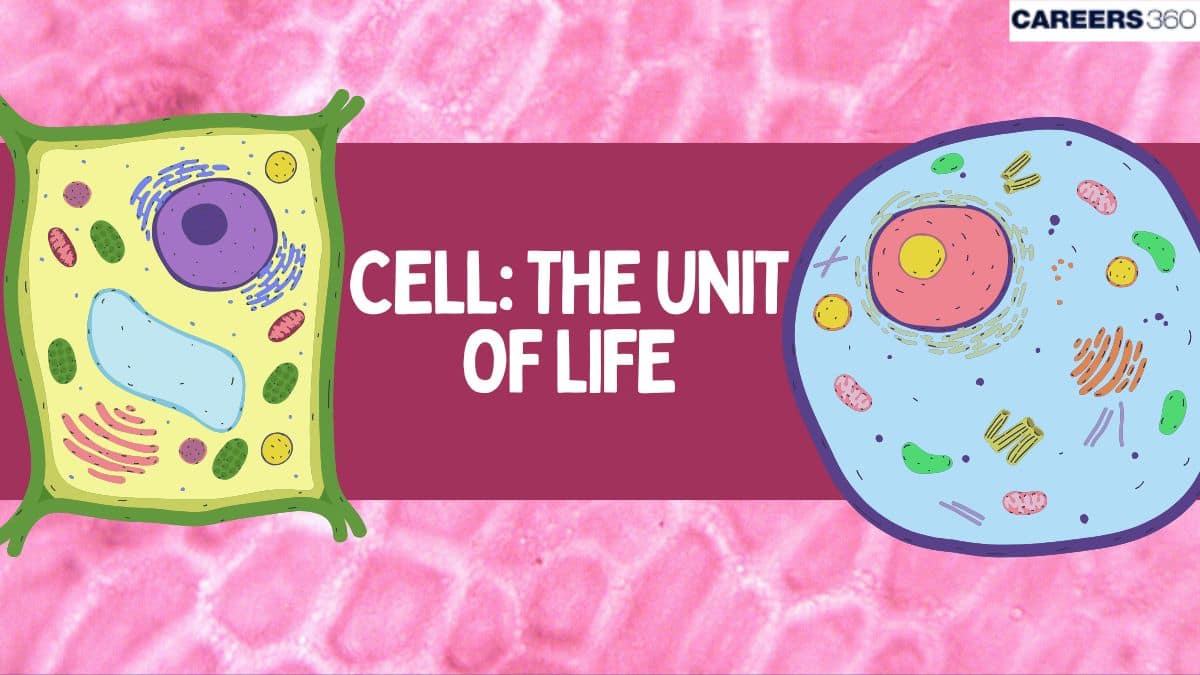
Each cell is enclosed by a plasma membrane and contains various structures (organelles) with a clear division of labour. Organelles perform specific tasks that keep the cell alive and functional. This article covers the cell structure, its organelles, the difference between prokaryotic & eukaryotic cells and cell theory.
The most fundamental, structural, and functional unit of all living beings is the cell. A cell is a structure containing organelles that perform essential processes for the cell to survive. Not all cells, however, are the same. Cells are capable of self-sustaining existence and executing vital life tasks. All creatures, including plants and animals, are made up of one or more cells, each of which originates from a previous cell. Some of the basic essential information about cells is discussed below:
Law Admissions 2026 Open | Avail Merit-Based Scholarships
BBA/MBA/PGDM Early Bird Applications Deadline 19th Oct '26. Apply now using coupon code CAREER250 and get ₹250 off the application fee
Cells can perform all the essential life activities: growth, metabolism and reproduction, on their own.
Cells have different organelles responsible for different functions. These organs are the nucleus, mitochondria, ribosomes, and many others. Each one of them has its specific role to play inside our body.
The cell membrane regulates the exchange of materials between the cell and its environment.
The genetic material of the cell is DNA, which is present in the nucleus and has all the essential instructions for cellular functions and reproduction.
Also Read:
Each cell is enclosed by a plasma membrane and contains various organelles, having a division of labour. These organelles are essential for the survival of the cell, the fundamental unit of life. Some organelles with their basic functions in the cell are given below:
Organelle | Basic Function |
|---|---|
The plasma membrane controls what enters and leaves the cell. | |
The nucleus stores DNA and regulates cell activities. | |
Cytoplama supports and holds organelles in place with its semi-fluid matrix. | |
Semi-autonomous organelles Mitochondria, Chloroplasts | Mitochondria provide energy to the cell in the form of ATP, and chloroplasts convert sunlight into energy (only in plant cells). |
The rough ER makes proteins, while the smooth ER makes lipids and detoxifies. | |
The Golgi apparatus packages and sends proteins and lipids around the cell. | |
Lysosomes break down waste. | |
The vacuoles store water and nutrients and help maintain pressure in plant cells. | |
It helps in cell division. | |
The ribosomes synthesise proteins for the cell. | |
The cell wall provides structure and protection to the cell (only in plant cells). |
Cells are the basic units of life, and they have several unique features that allow them to function effectively in living organisms. In NEET biology exam notes, the characteristics of cells are highly important because they explain how unicellular organisms and multicellular organisms survive and function. The following are some of the most important properties of cells:
Unique Feature | Description |
|---|---|
Ability to Perform Life Functions | Cells can carry out essential tasks like getting energy, growing, and reproducing. |
Uniqueness in Function | Each cell type has its own job, like muscle cells helping with movement or skin cells protecting the body. |
Independent Life for Some | Some organisms (like bacteria) live with just one cell that does everything needed to survive. |
Division into Tissues (Multicellular) | In bigger organisms, cells work together in groups (tissues) to do special jobs, like nerve or muscle tissues. |
Control Centre and Protection | The membrane controls entry, the nucleus gives instructions, and the cytoplasm is where all the work happens. |
The cell theory is a fundamental principle in biology. Matthias Schleiden (1838) and Theodor Schwann (1839) together proposed the initial form of the cell theory, combining their findings. Even though Schleiden and Schwann proposed the hypothesis, numerous renowned scientists have added to it, upgrading it from a theory to a commonly acknowledged fact.
The cell theory is a fundamental scientific principle that states:
All living organisms are composed of one or more cells.
The cell is the basic structural and functional unit of life.
All cells arise from pre-existing cells.
The cells can be comparable to factories in that they have various workers and departments working toward a shared goal. The different types of cells have different purposes. There are mainly two types of cells based on their cellular structure:
The basic difference between both types of cells is described below in the table:
| Key Features | Prokaryotic cell | Eukaryotic cell |
|---|---|---|
Nucleus |
|
|
Size |
|
|
Complexity |
|
|
Membrane bound Organelles |
|
|
Cell division |
|
|
Examples |
|
|
Ribosomes |
|
|
Cell Wall |
|
|
Metabolism |
|
|
DNA Structure |
|
|
Also Read:
Question 1: Which of the following is not the principle of cell theory
Cells are hereditary units
New cells are formed from pre-existing cells
Chemical constituents of cells of different tissues are different
Activity of an organism depends upon the sum total of the activities of an individual cell
Correct Answer: 3) Chemical constituents of cells of different tissues are different
Explanation:
The Cell Theory or Cell Principle or Cell Doctrine -
1. All living things, Animals, Plants, and Bacteria are composed of cells and cell products
2. The new cells are formed by the division of pre-existing cells
3. There are fundamental similarities in the chemical constituents and metabolic activities of all cells
4. The activity of an organism as a whole is the sum of the activities and interactions of its independent cell units
5. Cells are hereditary units
6. Cells are totipotent
Hence, the correct answer is option 3) Chemical constituents of cells of different tissues are different.
Question 2: Which is the smallest unit of life?
Cell
Tissue
Organ
Organelle
Correct Answer: 1) Cell
Explanation:
The cell is the smallest unit of life since it is the most fundamental building component of all living organisms. It is the smallest unit that displays all of the stated conditions for life. In prokaryotes, the cell is the foundation of all tissues and organs and develops the complete organism. Tissues arise when cells become specialised and arranged for a certain function. Tissues get organised to create organs, and organs collaborate in the body to perform a function in organ systems. The cell is the basis for all of these structures and every bodily component.
Hence, the correct answer is option 1) Cell.
Question 3: The exchange of materials b/w the cells and their surrounding is more efficient when
The surface-to-volume ratio is high.
The volume-to-surface ratio is high.
The surface-to-volume ratio is the unity.
All are correct depending upon the surroundings.
Correct Answer: 1)The surface-to-volume ratio is high.
Explanation:
A high surface-to-volume ratio (S/V ratio) facilitates more effective material exchange between cells and their environment. This is the reason:
The quantity of space accessible for exchange (such as the diffusion of waste, nutrients, and gasses) is determined by surface area.
The volume shows how much material must be swapped out to satisfy the demands of the cell.
Hence, the correct answer is option 1)The surface-to-volume ratio is high.
Question 4: Cell theory is not applicable to
Bacteria
Fungus
Algae
Virus
Correct Answer: 4) Virus
Explanation:
Viruses lack the conventional structure of a cell and do not execute any cell tasks, cell theory does not apply to viruses. Option (A),(B), and (C) are incorrect because bacteria, algae, and fungi are unicellular and multicellular creatures that have distinct cellular structures with cell organelles, generate energy by burning food, and reproduce. As a result, all living entities fall under the purview of cell theory.
Hence, the correct answer is option 4) Virus.
Frequently Asked Questions (FAQs)
In 1665, Robert Hooke discovered cells. Under a compound microscope, he examined a piece of cork and saw minute shapes resembling little apartments. As a result, he dubbed his discovery "cells."
Mitochondria are referred to as the "powerhouse" of the cell since it produces cellular energy in the form of ATP (adenosine triphosphate).
Cells are the basic structural and functional unit of life, as all living organisms are made up of cells. They perform essential functions like respiration, reproduction, metabolism, and heredity, making them the foundation of tissues, organs, and organ systems.
Chloroplast is called the kitchen of the cell because it makes food for the plant through photosynthesis. It uses sunlight, carbon dioxide, and water to make glucose (food) and oxygen.

Law Admissions 2026 Open | Avail Merit-Based Scholarships
BBA/MBA/PGDM Early Bird Applications Deadline 19th Oct '26. Apply now using coupon code CAREER250 and get ₹250 off the application fee
Ranked #36 amongst institutions in Management by NIRF | 100% Placement
Globally Recognized by AACSB (US) & AMBA (UK) | 18 LPA Avg. CTC for PGPM 2026
Leading Design College | 95% Placement Record | Merit-cum-Means Scholarships for Deserving Students
NEET PG All India & State College Predictor with Admission Process Guide