KCC Institute of Legal and Higher Education, Greater Noida
Law Admissions 2026 Open | Avail Merit-Based Scholarships


Phylum Mollusca is one of the largest groups in the animal kingdom. Molluscs are soft-bodied, unsegmented invertebrates with a calcareous shell for protection. Scientists have identified more than 85,000 species of molluscs living in freshwater and marine habitats. Common examples of Mollusca include snails, clams, squids, and octopuses.
This Story also Contains
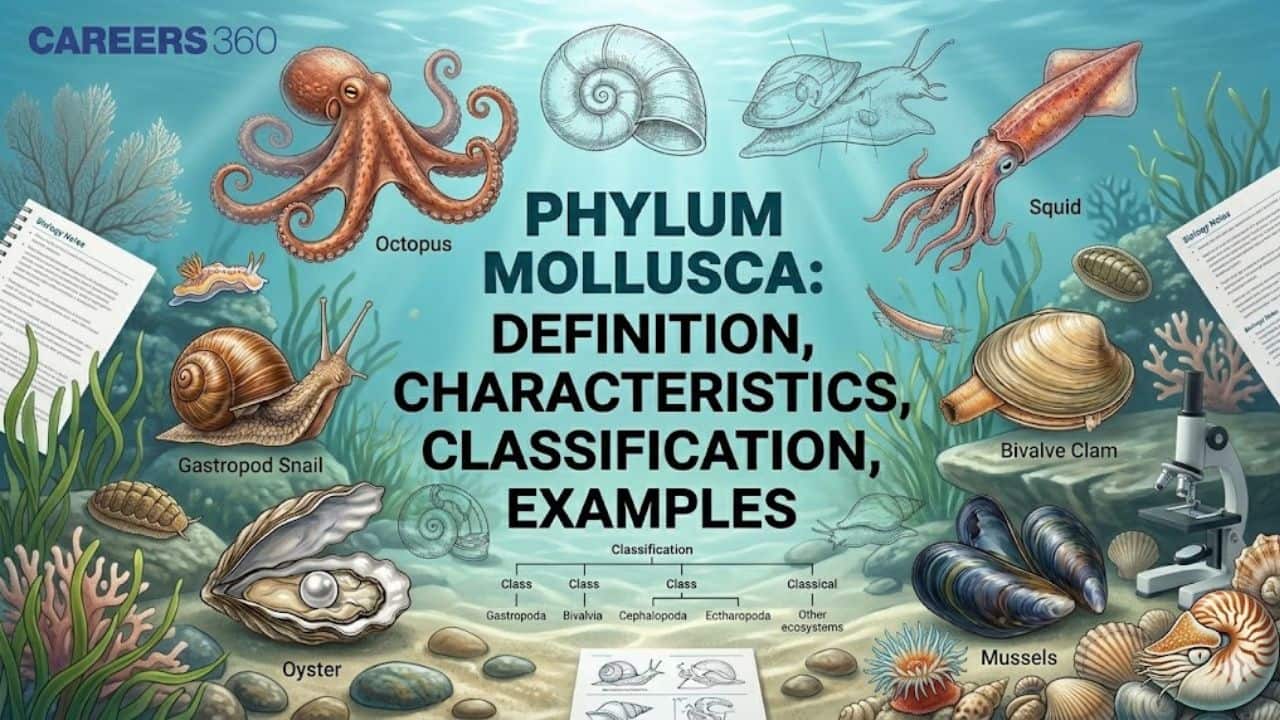
The body structure of Mollusca is simple but robust. It consists of a muscular foot for movement, a mantle that secretes the shell, and a visceral mass containing internal organs. This animal kingdom phylum has a complete digestive system and a simple circulatory system, except in cephalopods such as octopuses that have a closed circulatory system. Molluscs play an important role in ecosystems as grazers, filter feeders, and predators.
Molluscs are soft-bodied creatures in the phylum Mollusca. They are present in oceans, freshwater, and terrestrial habitats. They have a hard calcium carbonate-based shell, although there are some groups, such as octopuses and slugs, that do not possess a shell.
Molluscs have simple body structures such as a head, foot, and visceral mass. They are ecologically important in ecosystems as grazers, filter feeders, or predators, and they constitute one of the world's largest groups of animals. Some basic points are discussed below:
Molluscs have a soft and non-segmented body that is usually covered by a shell.
The body is organised into head, foot, and visceral mass.
The mantle is a sheet of tissue that aids in the development of the shell in most molluscs.
Bilateral symmetry is displayed in the body structure of molluscs.
They have a full digestive system with a mouth and anus.
Most molluscs utilise a radula (toothed organ) to feed.
They are in marine, freshwater, and terrestrial environments.
Animals such as snails, clams, squids, and octopuses are molluscs.
Law Admissions 2026 Open | Avail Merit-Based Scholarships
BBA/MBA/PGDM Early Bird Applications Deadline 06th Nov'26. Apply now using coupon code CAREER250 and get ₹250 off the application fee
Mollusca is a vast Animalia phylum of soft, unsegmented-body animals that are usually covered by a calcium carbonate shell.
Their body is divided into three distinct parts: a head for feeding and sensing, a foot of muscle to move, and a visceral mass containing internal organs.
Molluscs have a mantle that can secrete a shell and a radula (present in most molluscs) for scraping food. They have bilateral symmetry and a complete alimentary system.
Molluscs inhabit marine, freshwater, and terrestrial environments, and most have gills to breathe underwater. The characteristics are described below-
| Feature | Description |
|---|---|
| Soft-bodied animals |
|
| Body structure | The body is divided into head, foot, and visceral mass.
|
| Mantle and shell |
|
| Symmetry | Molluscs have bilateral symmetry, meaning the body can be split into two halves. |
| Body plan | Body form is versatile and varies in shape and function based on the environment. |
Mollusca are soft‑bodied, bilaterally symmetrical, triploblastic animals. Their body is divided into head, foot, visceral mass, and mantle. Most have a calcareous shell for protection.
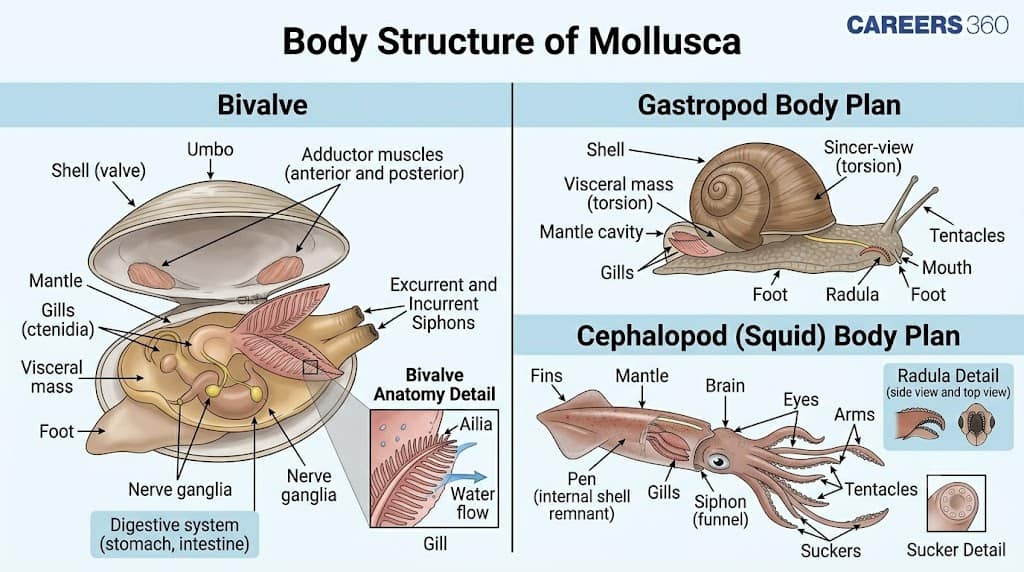
Mollusca is a vast phylum separated into various classes according to body structure, whether they have a shell or not, and habit. Some of the main classes are Gastropoda (snails and slugs), Bivalvia (clams, oysters), Cephalopoda (squids, octopuses), Polyplacophora (chitons), and Scaphopoda (tusk shells).
Each class exhibits distinct characters such as torsion in gastropods, hinged shells in bivalves, or tentacles in cephalopods. Molluscs inhabit marine, freshwater, and land habitats.
The characteristics of all of them are listed below-
| Class | Characteristics | Examples |
|---|---|---|
| Gastropoda |
| Helix aspersa (garden snail), Strombus gigas (queen conch) |
| Bivalvia |
| Crassostrea virginica (oyster), Mercenaria mercenaria (clam) |
| Cephalopoda |
| Enteroctopus dofleini (giant Pacific octopus), common squid |
| Polyplacophora |
| Tonicella lineata (lined chiton) |
| Scaphopoda |
| Dentalium entalis (tusk shell) |
The phylum Mollusca includes soft‑bodied animals, often protected by shells. The following are a few examples of the phylum Mollusca:
Turbinella (Shankha)
Loligo (Squid)
Limax (Slug)
Unio (Freshwater mussel)
Pila (Apple snail)
Helix (Garden snail)
Octopus (Devilfish)
Mollusca are important both economically and ecologically. They provide food, pearls, and shells and play a key role in ecosystems.
Food Source: Oysters, mussels, clams, and squids are eaten worldwide.
Pearl Formation: Oysters and mussels produce valuable pearls.
Shell Industry: Conch shells are used in ornaments, handicrafts, and lime production.
Fisheries: Squids and octopuses are harvested commercially.
Ecological Role: Filter feeders, decomposers, balance aquatic ecosystems.
Scientific Research: Cephalopods have been studied for their nervous system and learning.
Cultural Importance: Conch shells (Turbinella) are used in rituals and traditions.
Question: Radula is found in
1) Pila species
2)Chiton species
3)Lamellidens species
4)Pinctada species
Correct Answer: (1) Pila species
Explanation: Radula is a rasping, ribbon-like feeding organ found in most molluscs. It contains many rows of tiny chitinous teeth and is used to scrape or cut food before swallowing. In Pila (apple snail), which belongs to the class Gastropoda, the radula helps in scraping algae and plant material from surfaces. It is important to note that radula is absent in bivalves (like clams and oysters), but present in gastropods and cephalopods. Thus, radula is correctly found in the Pila species.
Hence, the correct answer is option (1) Pila species
Question:
Which of the following are unsegmented animals?
1)Platyhelminthes
2)Aschelminthes
3)Mollusca
4)All of these
Correct Answer: 4)All of these
Explanation: Unsegmented animals such as those in the phyla Cnidaria and Platyhelminthes. They do not exhibit distinct external segments along their body axis. Unlike segmented species, they lack the repetition of specific bodily structures within segments. Cnidarians, like jellyfish and corals, are radially symmetrical with a simple, unsegmented design and a central gastrovascular cavity for digestive purposes.
Flatworms include planarians, tapeworms, and flukes. They maintain a basic body structure that is bilaterally symmetrical. Despite some internal segmentation in tapeworms (proglottids), their external anatomy remains unsegmented. Sponges from the Porifera phylum are even more primitive, showcasing a rudimentary form with cells loosely arranged for water filtration.
Hence, the correct answer is option 4) All of these.
Question:Organisms that belong to the phylum Mollusca
1)Ascaris, Wuchereria, Hydra
2)Cockroaches, locust, Taenia
3) Pila, sepia, octopus
4)Planaria, taenia, Periplaneta
Correct Answer: 3) Pila, sepia, octopus
Explanation: Molluscs are soft-bodied, unsegmented animals with a mantle, muscular foot, and usually a calcareous shell (which may be reduced or absent in some forms, like octopus). They have a well-developed organ system and mostly possess a radula (except bivalves). Pila is a snail with a coiled shell and a creeping foot. Sepia and Octopus are marine molluscs with highly developed nervous systems and modified feet forming arms or tentacles. Thus, all three correctly belong to Phylum Mollusca.
Hence, the correct option is (3) Pila, sepia, octopus
Frequently Asked Questions (FAQs)
It includes soft body tissues usually enclosed in a shell, a head, a foot, a mass of viscera, a mantle that secretes shells in the shelled species and a radula for feeding.
Depending on the structures and life cycles, molluscs are divided into Gastropoda, Bivalvia, Cephalopoda, Polyplacophora, and Scaphopoda.
Molluscs form the basis of fisheries and aquaculture industry particularly clams and oysters since some of them produce pearls, and also useful in biomedical sciences, because of their complicated nervous systems.
Molluscs respond through growth modifications which include shell diversification and feed specialisation which comprise filter feeding, herbivores, and predators as well as burrowing, ability to camouflage and tolerability to extreme climatic conditions.
They consist of the preservation of the species' natural environment, counting populations, breeding in captivity and raising awareness to counter factors that threaten the existence of endangered species and thus total bio-diversity.

Law Admissions 2026 Open | Avail Merit-Based Scholarships
BBA/MBA/PGDM Early Bird Applications Deadline 06th Nov'26. Apply now using coupon code CAREER250 and get ₹250 off the application fee
Ranked #36 amongst institutions in Management by NIRF | 100% Placement
Globally Recognized by AACSB (US) & AMBA (UK) | 18 LPA Avg. CTC for PGPM 2026
NEET PG All India & State College Predictor with Admission Process Guide
Top B-School: Ranked #9 in NIRF Management Rankings 2025.