


Phylum Aschelminthes: Characteristics, Examples, Platyhelminthes, Classification, Topics
Aschelminthes, commonly called roundworms, are simple, unsegmented worms with a smooth, cylindrical body. They have a characteristic pseudocoelom, a complete digestive system and a tough protective outer layer called the cuticle. These worms reproduce through sexual reproduction and can be found in various environments, including soil, water and inside living organisms. Examples of such organisms are Ascaris lumbricoides, Ancylostoma duodenale, etc.
This Story also Contains
- Phylum Aschelminthes
- Phylum Aschelminthes Overview
- Classification of Aschelminthes
- Difference Between Platyhelminthes and Aschelminthes
- Phylum Aschelminthes Characteristics
- Morphology and Anatomy of Aschelminthes
- Economic Importance of Aschelminthes
- Important Examples of Aschelminthes
- Aschelminth Diseases
- Aschelminthes Quick Revision Notes
- Recommended Video on Phylum Aschelminthes:
.jpg)
In this topic, you will learn about the key features of Aschelminthes, including their body structure, types and how they survive in nature. They are classified into various other classes depending on the unique characteristics of animals. The ecological role, how they affect human and animal health and the diseases they may cause as parasites are also discussed in detail. Aschelmithes is a topic in the chapter Animal Kingdom in Biology.
Phylum Aschelminthes
Phylum Aschelminthes includes a group of worm-like invertebrates, otherwise called nematodes or roundworms, which are characteristically cylindrical with unsegmented bodies. Historically, the phylum Aschelminthes was considered a single phylum, but it became further divided into multiple phyla, with the nematodes being the best-studied ones. They were known and observed for centuries, but until recent decades, reasonably major forward steps were made in understanding their biology. Aschelminthes occupy quite an important place in the biological hierarchy since they are widely spread, perform some ecological functions, and have an impact on human health and agriculture.
Phylum Aschelminthes Overview
The phylum Aschelminthes includes bilaterally symmetrical, triploblastic, pseudocoelomate animals. These are commonly known as roundworms and possess an organ-system level organisation.
Feature | Description |
Symmetry | Bilateral symmetry |
Germ Layers | Triploblastic |
Body Cavity | Pseudocoelomate |
Body Shape | Elongated, cylindrical, unsegmented body tapering at both ends |
Level of Organisation | Organ-system level of organisation |
Body Covering | Thick, protective cuticle present |
Digestive System | Complete digestive tract with mouth and anus |
Circulatory System | Absent |
Respiratory System | Absent; gas exchange occurs through the body surface |
Excretory System | Excretory canals or renette cells are present |
Reproduction | Sexual reproduction; sexes are usually separate (dioecious) |
Fertilisation | Internal fertilisation |
Habitat | Free-living in soil and water or parasitic in plants and animals |
Examples | Ascaris, Ancylostoma (hookworm), Wuchereria |
Classification of Aschelminthes
Aschelminthes are pseudocoelomate and invertebrate animals that are characterised by a simple body plan and a pseudocoelom. The differences among these classes are quite distinct.
Class Nematoda
Nematodes are unsegmented, cylindrical worms covered by a tough, flexible cuticle that they moult periodically.
They have a complete digestive system with a distinct mouth and anus.
They have a simple nervous system in that they do not have a brain but have a ring of nervous tissue around their pharynx with longitudinal nerve cords that run down their length.
Nematodes have a sexual mode of reproduction, which means most species have separate male and female reproductive parts. The fertilisation is internal.
They are highly diversified and are found in almost every habitat, which includes soil, freshwater, and marine environments, and as parasites in the plant and animal bodies.
Examples
Ascaris lumbricoides: This is the most common nematode, or roundworm, that parasitises the intestines of humans.
Ancylostoma duodenale: Known as hookworm, it is responsible for anaemia and several other serious disorders.
Enterobius vermicularis: The pinworm, a nematode worm, lives in the intestines of children.
Class Rotifera
The rotifers are microscopic, aquatic animals that have their body divided into a head, trunk, and foot.
The head contains a rotating, ciliated organ, called the corona, used for locomotion and food capture.
They have a complete digestive system that contains a mastax, which is a unique pharynx provided with jaws to grind up the food.
Most rotifers are parthenogenetic, though some have sexual reproduction.
Mainly found in freshwater, some species inhabit marine and damp terrestrial habitats.
Examples
Brachionus plicatilis: A common rotifer species used in aquaculture.
Philodina roseola: A freshwater rotifer often used in scientific studies.
Class Gastrotricha
Gastrotrichs are tiny, worm-like, flattened animals covered with cilia, which assist in locomotion and nourishment.
They have a simple digestive system with a mouth, pharynx, and intestine.
They have sexual and asexual ways of reproduction through parthenogenesis. Many of them are hermaphrodites.
Gastrotrichs are mainly inhabitants of freshwater and marine sediments, on algae.
Examples
Chaetonotus: A genus of freshwater gastrotrichs.
Lepidodermella: Another genus commonly found in freshwater habitats.
Class Kinorhyncha
Kinorhynchs are otherwise known as mud dragons.
Their body is segmented, having a head, neck, and trunk. The body is adequately plated and spined.
They can move around by extending and retracting their head.
They get their food from microorganisms and organic matter in the sediment.
It has sexual reproduction with two distinct sexes.
Mostly found in sediments of marine environments.
Difference Between Platyhelminthes and Aschelminthes
Both Platyhelminthes and Aschelminthes are two important groups of invertebrate animals included in the Animal Kingdom. Although both of these groups contain simple worm-like organisms, they are different in body structure, body cavity, digestive systems, etc.
Feature | Platyhelminthes | Aschelminthes |
Body Shape | Dorsoventrally flattened body | Cylindrical, elongated body tapering at both ends |
Body Cavity | Acoelomate | Pseudocoelomate |
Digestive System | Incomplete digestive system with a single opening | Complete digestive system with mouth and anus |
Body Covering | Soft body; body wall lacks a cuticle | Body covered by a thick cuticle |
Level of Organisation | Organ-system level of organisation | Organ-system level of organisation |
Sexes | Mostly hermaphrodite | Sexes usually separate (dioecious) |
Examples | Taenia, Fasciola, Planaria | Ascaris, Ancylostoma, Wuchereria |
Phylum Aschelminthes Characteristics
Members of Phylum Aschelminthes (also known as Nematoda) are bilaterally symmetrical, unsegmented, and pseudocoelomate organisms with a complete digestive tract and a tough outer cuticle.
The Aschelminthes are bilaterally symmetrical, which means they have an elongate, basically cylindrical body, mostly tapering at both ends and are covered with a tough, non-living cuticle.
They develop bilateral symmetry, wherein there is the presence of a definite head and tail region.
They possess a well-developed digestive system with a definite mouth and anus.
Reproduction in most of them is sexual. They are dioecious, though hermaphroditism is also found.
The habitats of Aschelminthes range from soil to freshwater, marine environments, and even as parasites in plants and animals.
Their life cycle ranges from simple direct development to highly complex cycles involving multiple hosts.
Aschelminthes Diagram
The diagram given below shows the internal structure of the phylum Aschelminthes. They are triploblastic, having 3 germ layers- ectoderm, mesoderm and endoderm.
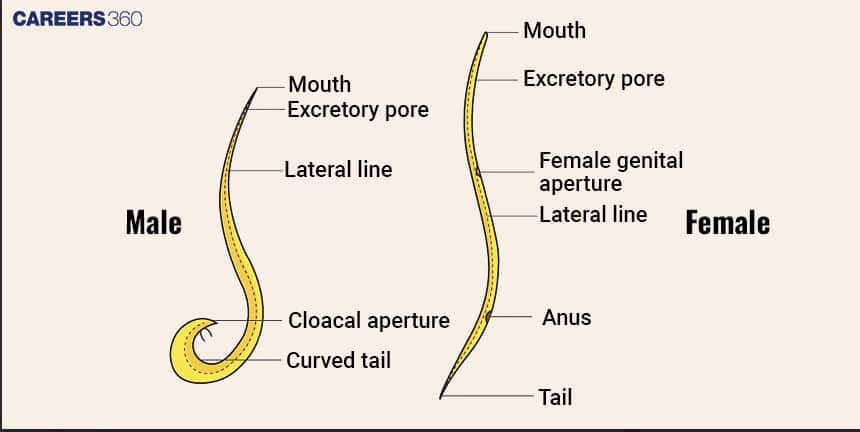
Morphology and Anatomy of Aschelminthes
These organisms have a cylindrical, elongated body tapered at both ends. They possess a straight alimentary canal, a pseudocoelomic cavity, and separate sexes (dioecious). Males are generally smaller than females and often possess curved posterior ends.
External Morphology
The size of the nematodes can vary from microscopic to a few meters. Their body shape is cylindrical, normally tapered at both ends.
It has a flexible, non-living cuticle that periodically undergoes moulting. There are also surface structures that may comprise sensory bristles or papillae.
Internal Anatomy
A complete digestive system will have a tubular gut extending from mouth to anus.
A relatively simple nervous system, wherein a nerve ring is found in the region of the pharynx; also, longitudinal nerve cords extend posteriorly.
Excretion is carried out by modified excretory cells or canals, often called renette cells.
They have complex systems of reproduction. In most instances, sexes are separate; female organs include ovaries, oviducts, and a uterus. Males have testes and copulatory spicules.
Economic Importance of Aschelminthes
While some nematodes help in decomposition and nutrient recycling, others are harmful parasites of plants, animals, and humans, causing economic loss in agriculture and livestock.
Nematodes are deeply involved in nutrient cycling and structural maintenance of soil through decomposing organic matter and by controlling microbial populations.
They contribute to the digestion of organic materials, thereby allowing for the re-circulation of nutrients through an ecosystem.
Most nematodes, however, currently represent very important agricultural pests that damage crops due to root infestation and lead to economic losses.
Parasitic nematodes present several different diseases that cause pathogens in both humans and animals, resulting in health challenges and economic costs.
Nematodes, particularly Caenorhabditis elegans, have been used as model organisms in laboratory research due to the simplicity of these organisms and their well-mapped genetic structure.
Important Examples of Aschelminthes
Here are a few examples of Aschelminthes which you should know:
Organism | Common Name | Importance |
Ascaris lumbricoides | Roundworm | Causes ascariasis |
Ancylostoma duodenale | Hookworm | Causes hookworm disease |
Enterobius vermicularis | Pinworm | Causes enterobiasis |
Wuchereria bancrofti | Filarial worm | Causes filariasis (elephantiasis) |
Aschelminth Diseases
Aschelminthes cause diseases such as ascariasis, filariasis, and hookworm infections in humans, which can lead to nutritional deficiencies, tissue damage, and developmental issues, especially in children. Common diseases caused by Aschelminthes are
Ascariasis: This is an infection by the helminth Ascaris lumbricoides, which mainly causes abdominal discomfort and malnutrition.
Hookworm infections: Infection by species such as Ancylostoma and Necator causes conditions such as anaemia and protein deficiency.
Filariasis is caused by filarial worms and might lead to conditions such as elephantiasis.
Enterobius vermicularis is the pinworm that causes enterobiasis. It makes it difficult to sleep and itches the posterior region.
Common Diseases Caused by Aschelminthes
Disease | Causative Organism |
Ascariasis | Ascaris lumbricoides |
Filariasis | Wuchereria bancrofti |
Hookworm Disease | Ancylostoma duodenale |
Enterobiasis | Enterobius vermicularis |
Aschelminthes Quick Revision Notes
Aschelminthes are commonly known as roundworms and are mostly represented by nematodes.
They are triploblastic, bilaterally symmetrical, and pseudocoelomate animals.
Their bodies are elongated, cylindrical, unsegmented, and covered by a tough cuticle.
They exhibit an organ-system level of organisation.
The digestive system is complete, with a distinct mouth and anus.
Specialised respiratory and circulatory systems are absent; gas exchange occurs through diffusion.
Excretion takes place through an excretory canal system.
Sexes are usually separate (dioecious), and fertilisation is internal.
Aschelminthes occur in soil, freshwater, marine habitats, and as parasites in plants and animals.
Common examples include Ascaris, Wuchereria, Ancylostoma, and Enterobius.
Also Read-
Recommended Video on Phylum Aschelminthes:
Frequently Asked Questions (FAQs)
Entire arrays of health disorders, from malnutrition to intestinal blockage, are caused by roundworms of the genus Ascaris and the hookworm, anaemia, and bronchitis.
The economic importance of nematodes lies in both ways: on one side, their examples are regarded as useful soil dwellers; on the other, they comprise some elite parasites for crops, animals, and humans.
Prevention involves hygiene, safe food and water practices, and vector control; treatment includes antiparasitic medications and supportive care.
The major groups are two: Nematoda, the roundworms, and Rotifera, or rotifers. Other minor classes include Gastrotricha and Kinorhyncha.
Aschelminthes are pseudo-celomate, unsegmented invertebrates with a simple body plan, bilateral symmetry, and a complete digestive system.