


Career in Defence after Engineering
A career in defence after engineering is considered one of the most respected and prestigious career paths in India. Every year, thousands of engineering graduates aspire to join the Indian Armed Forces and to serve the nation.
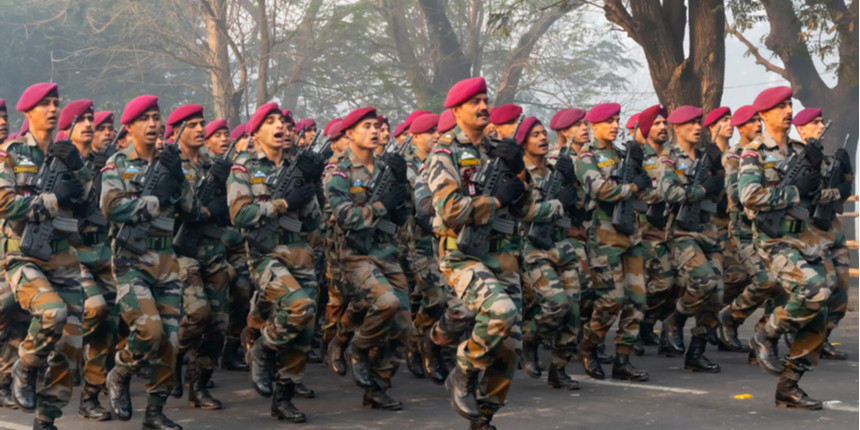
If you are wondering, "Can I join defence after engineering?" There are several entry schemes through which engineering graduates can join the Indian Armed Forces. Whether you are looking for defence jobs after engineering or aiming for a long-term defence career after engineering, this article will cover everything you need to know.
Entry Schemes in the Indian Armed Forces For Engineering Graduates
For those looking for defence jobs after engineering, here is a detailed table summarising the primary defence entry schemes available for engineering students and graduates.
Indian Army
Type of Entry | Commission | Age | Qualification | Mode of Selection |
Technical Graduate Course (TGC) (Men) | Permanent | 20 – 27 Yrs | Engineering Degree In a notified discipline. Final year students can apply | SSB Interview (No written exam, based on the engineering marks) |
Short Service Commission (Women Tech-Nontechnical) (Men and Women) | Short Service | 20 – 27 Yrs | Engineering Degree in a notified discipline | SSB Interview (No written exam, based on the engineering marks) |
Combined Defence Services (CDS)Exam | Permanent (at IMA) or Short Service (OTA) | 19-24 years (IMA) 19-25 years (OTA) | Degree from a recognised university | UPSC written exam and SSB interview |
Indian Air Force
Type of Entry | Commission | Age | Qualification | Mode of Selection |
Air Force Common Admission Test (AFCAT- Tech Branch) | PC and SSC | 20 – 26 Yrs | BE / BTech in the notified discipline with a minimum of 60% marks. And 10+2 in Physics and Maths | AFCAT CBT, Engineering Knowledge Test (EKT) and AFSB Interview |
CDS (for AFA only) | Permanent | 20– 24 Yrs | Engineering Degree and 10+2 in Physics and Maths | UPSC written exam and SSB interview |
Indian Navy
Type of Entry | Commission | Age | Qualification | Mode of Selection |
Short Service Commission (Executive and Technical) | Short Service | 19½ - 25 Yrs | BE/ BTech in the notified discipline with a minimum of 60% marks. | SSB Interview (No written exam, based on the engineering marks) |
Special Navy Architect Entry Scheme(SNAES) | Permanent | 21- 25 Yrs | BE / BTech in Naval Architecture with a minimum of 60% marks. | SSB Interview |
Selection Process for Defence Jobs after Engineering
Engineering graduates can join the Indian Armed Forces through different entry schemes. Read on to understand various selection processes for a career in defence after engineering, including written exams, SSB interviews and medical tests depending on the route chosen.
1. Combined Defence Services Examination (CDS) (UPSC)
Combined Defence Service Examination is conducted by the Union Public Service Commission (UPSC) as a common entry point for IMA, INA, AFA and OTA. This exam is conducted twice a year and is regarded as one of the most popular and competitive pathways for graduates to join the Indian Army, Navy and Air Force as commissioned officers.
CDS Examination Pattern:
For IMA, INA and AFA:
English 100 marks
General Knowledge: 100 marks
Elementary Mathematics: 100 marks
For OTA (Men and Women):
English: 100 marks
General Knowledge: 100 marks
It is important to note that this is an objective-type multiple-choice examination conducted offline in paper mode. Candidates should also be aware of the negative marking system for wrong answers.
Next Stage: SSB Interview:
Those who successfully qualify for the written exams are selected for the Short Service Board Interview (SSB). This is a five-day interview where candidates are evaluated for their qualities such as leadership skills, communication skills, decision-making ability, physical and mental adaptability and team spirit.
2. Technical Entry Schemes (No written Test)
Engineering graduates have a golden opportunity to directly apply for the technical entries like TGC, SSC Tech and SNAES. If you showcase excellent academic performance during your engineering degree, you will be shortlisted for the 5-day evaluation process of the SSB interview.
TGC (Army): Permanent Commission for men
SSC Tech (Army): Short Service Commission for men and Women
Executive/ Technical Branch (Navy): SSC based on engineering specialisation
SNAES (Navy): Permanent Commission for Naval Architecture Engineers
3. Air Force Common Admission Test (AFCAT)
The Air Force Common Admission Test (AFCAT) is an entrance exam held twice a year by the Indian Air Force to recruit deserving candidates to the Flying Branch, Ground Duty (Technical) and Ground Duty (Non-technical). AFCAT is an exclusive pathway towards the Technical Branch of the Indian Air Force. You can be selected for both Permanent Commission (for men) and Short Service Commission(for men and women).
Exam Pattern:
AFCAT Paper:
General awareness
Verbal ability in English
Numerical Ability
Reasoning Ability
Engineering Knowledge Test (EKT): This is an important additional test for all candidates applying for the Technical branch. Through this test, candidates are tested for their knowledge of the specific engineering discipline they graduated from.
This is an online mode Computer-Based Test in the Medium of English. The Negative Marking system is also applicable for this examination.
Clearing the AFCAT and EKT gives you entry to the prestigious defence jobs after engineering in the Indian Air Force.
Difference Between Permanent Commission And Short Service Commission
To help you clearly understand the difference between Permanent Commission (PC) and Short Service Commission (SSC), the table below highlights the key differences in tenure and career growth.
Type | Tenure | Career Prospects |
Permanent commission (PC) | Service till retirement (Up to 60 years) | Promotions up to the most senior ranks with benefits of a pension |
Short Service Commission (SSC) | Initial 10 years | Can opt for PC based on merit, otherwise should exit |
Training Academies
Selected candidates undergo training at top institutes that equip them with the skills and discipline needed for a successful career in defence after engineering.
1. Indian Military Academy(IMA) Dehradun: Trains PC officers for the Army
2. Officers Training Academy(OTA) Chennai: Trains SSC officers, both men and women
3. The Indian Naval Academy (INA), Ezhimala: This is the largest naval academy in Asia, located in Ezhimala, Kannur district, Kerala
4. Air Force Academy(AFA) Dundigal: Offers training for flying, technical and ground duty officers
By opting for a defence career after engineering, you are choosing more than just a profession, but also a commitment to serve the nation. Through popular examinations like CDS and AFCAT or direct entry routes like TGC and SSC Tech, engineering graduates have significant opportunities to enjoy a future in the Army, Navy or Air Force as officers. By developing the right skills and pursuing the relevant pathways, you can make your career dream come true.
Frequently Asked Questions (FAQs)
Yes, engineering graduates can join defence through CDS, AFCAT, TGC Or SSS Tech. These routes lead to officer roles in Army, Navy or Air Force after SSB and medical tests.
Those who join the Indian Military Academy, Dehradun as gentlemen cadets, undergo training. The duration of the training varies between three months to sixteen months depending on the entry mode. Once the training is complete, gentlemen cadets pass out as lieutenants in the Indian Army.
It is not mandatory to pass the navy swim test, but it is better if the individual does. In case an individual is not able to pass the navy swim test, then the person should try to score at least a ‘Good (low)’ score in the Physical Readiness Test (PRT).
