


Who is a Machinist?
Are you searching for a machinist job description? A machinist is someone who uses machine tools such as grinders, milling machines and lathes to produce precision metal parts. Machinists are experts who use equipment to form metal and other resources into various products. Individuals in the machinist career can develop completely new parts or repair existing pieces on machines.
The products that machinists produce range in size from small, like steel bolts and screws, to huge, like vehicle engines or hydraulic components. Several machinists are proficient at using both manuals as well as CNC (Computer Numerical Control) machinery. Individuals in the machinist career play a crucial role in determining the cutting path and feed rate. He or she programmes instructions into the CNC machine.
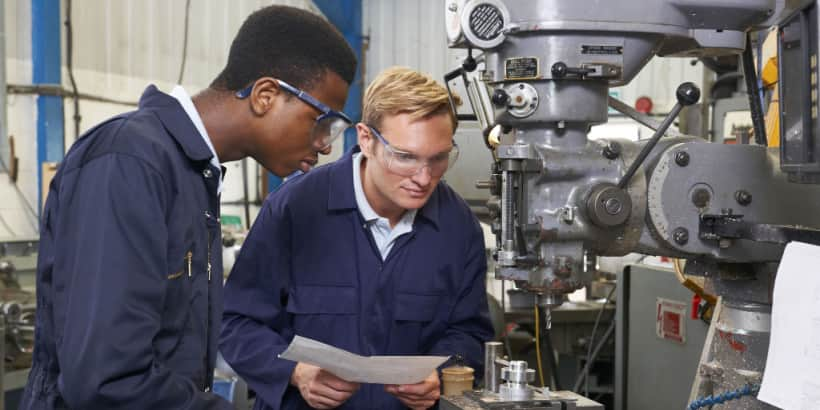
Machinist in a Nutshell
A machinist is a skilled worker who creates the metal parts of machinery systems working in the industry. Individuals in the machinist career remanufacture the broken part in machinery or create new parts such as bolts, anti-lock brakes, automobile pistons and hydraulic parts. Here, in this article, we will discuss the machinist job, machinist apprenticeship, automotive machinist career prospects.
Quick Facts for Machinist
Average Salary in India
₹25666.67Any Special Needs
NoSuitable for
Male, Female, OthersSuitable for - Male, Female, Others
A career as machinist is suitable for each gender. There are no gender-based restrictions. Whether one is male, female or belongs to any other gender can become a machinist with the ability to perform efficiently in the job. A machinist career is dominated by men.
Any Special Needs - No
A career as machinist is not suitable for candidates with special needs. It demands individuals with physical strength to lift heavy objects, stand for hours and perform other activities.
Table of Contents
Machinist
- What is the role of Machinist?
- Types of a Machinist
- What is the workplace/work environment of Machinist like?
- How to become a Machinist?
- What are the skills and qualities required to become a/an Machinist?
- Which certifications and internships can be helpful in becoming Machinist?
- Career path progression for Machinist
What is the role of Machinist?
A machinist is responsible for producing large quantities of a part used in industrial machinery systems. Several machinists may produce small batches or the same (one-of-a-kind) items. These parts include a range of simple steel bolts to titanium bone screws used as orthopaedic implants. Individuals in the machinist career make numerous parts such as hydraulic parts, anti-lock brakes, automobile pistons and other products. Several machinists repair old parts or create new parts. A machinist remanufactures the broken part in a machine discovered by an industrial machinery mechanic. He or she applies blueprints that were used in the creation of original parts to create a replacement.
Maintenance
A machinist is responsible for the maintenance of industrial machines and operating them. He or she produces precision tools. A machinist ensures that all the parts of machines are functioning properly.
Documentation
A machinist is responsible for writing reports and keeping records. It includes dimensions and specifications of the parts to be produced, blueprints and drawings.
Study
A machinist job involves studying blueprints, drawings and other engineering information to determine the methods of operations and dimensions required in the fabrication of products.
Programming Instructions
A machinist is responsible for giving programming instructions to software programmes. Thus, machines create parts following the instructions given to computers, electronic tools or numerically controlled machine tools.
Usage of Equipment
A machinist uses lathes, grinders, milling machines and other equipment to create parts or repair the ones which are not functioning properly.
Types of a Machinist
There are types of machinists. We have provided below descriptions of some of the common types of machinists jobs.
CNC Machinist: A CNC (Computer Numerical Control) machinist is also known as CNC machine operator. He or she feeds the programming instructions into computer software to create the machinery parts by equipment such as lathes, grinders and other equipment controlled by the computer.
Assembler: An assembler is a professional who plays a crucial role in the manufacturing process. He or she works with a variety of machinery tools and systems to create or repair parts or products for distribution.
Machine Operator: A machine operator is someone who works with heavy machinery systems. He or she stays engaged in assisting in the installation of the equipment and its maintenance that requires periodic tests and repairs.
What is the workplace/work environment of Machinist like?
Individuals in the machinist career path work in manufacturing plants of factories. His or her work involves working with heavy machinery. A machinist job demands creating tools or parts of machines such as bolts, titanium bone screws, anti-lock brakes and other parts used in machines. He or she uses hand tools, cutting tools, machine tools and measuring tools in his day-to-day work life.
Travel Dependency - Likely
A machinist does not require travel on a regular basis or occasionally. Individuals in the machinist career path have to perform assigned duties in the factory of manufacturing plant.
Employment Shifts - Full Time, Part Time
A machinist usually works full-time. He or she can also find part-time work. A machinist works from late morning to late evening. Evening and night shifts are common in this career.
Employment Nature - Contractual, Permanent
Individuals in the machinist career can find employment on both permanent as well as a contractual basis. Most jobs are provided on a permanent basis.
Work Place - Factory, Manufacturing Plant
A machinist is someone who creates machines or assembles their tiny parts in them. Individuals in the machinist career are responsible for the maintenance of heavy machinery and creating the metal parts used in it such as bolts, hydraulic screws, brakes and other parts.
Geographical Area - Semi-urban, Urban
Industries and factories are usually located in semi-urban and urban areas.
Time Pressure - Likely
At times, there could be extreme pressure when the machine does not function properly. It requires troubleshooting on an immediate basis.
Overtime
Individuals in the machinist career path have to work overtime during peak production hours.
Work Hours - 40
Individuals in the machinist career work a minimum of 40 hours. He or she may often be required to work on evening and night shifts.
How to become a Machinist?
In India, pursuing a career as a machinist can open the door to exciting opportunities in manufacturing and engineering. Learning how to become a machinist in India involves a combination of education and hands-on training. This section of the article will guide you through the steps and requirements to embark on this promising career path, exploring the essential qualifications and skills needed to excel in the field.
To become a successful machinist in India, you need a combination of hard and soft skills. These machinist skills are essential for operating machinery and ensuring precision in manufacturing processes:
Hard Skills:
Precision machining
Knowledge of machine tools
Blueprint reading and interpretation
CNC programming and operation
Material cutting and shaping techniques
Soft Skills:
Attention to detail
Problem-solving
Time management
Communication
Adaptability
What are the skills and qualities required to become a/an Machinist?
There are several requirements to become a machinist. One needs to fulfil them in order to opt for the role. We have provided below machinist skills required in performing day-to-day tasks. In this article, we will discuss how to become a Machinist.
Attention to Detail: Machining jobs demand inspecting the machines and ensuring everything is working properly. He or she has to test machines, and repair and install them.
Mathematical Skills: A machinist has to measure the dimensions of the tools to ensure their development based on the given specifications.
Computer Skills: A machinist is required to programme instructions into computer software to run CNC machines to create machine parts.
Craftsmanship: A machinist must be able to troubleshoot and discover new ways to improve productivity and efficiency manually or through CNC processes.
Technical Skills: Machining jobs demand the ability to adapt to technical aspects of work functions. He or she must be able to understand the functioning and requirements of various machines to design and produce metal parts and components.
Which certifications and internships can be helpful in becoming Machinist?
We have mentioned below certifications that individuals may opt for who want to establish a career as a machinist.
Internship Availability - Yes
Aspiring individuals can find moulding, stamping and machinist apprenticeship through various recruitment portals such as naukri.com, and monster. in and other websites. A machinist intern gets the opportunity to gain experience working with CNC milling, CNC lathe and bending machines.
Career Path Progression for Machinist
Machinist: A machinist is a skilled worker who fabricates precision parts for machines. They can work manually or with CNC machines to shape and craft components, playing a crucial role in manufacturing and engineering processes.
Numerical Control Programmer: Numerical Control Programmers are experts in programming computerized machines, such as CNC equipment. They write code and instructions that guide these machines to automate the manufacturing process, enhancing precision and efficiency in material processing.
Maintenance Technician: A maintenance technician is tasked with the critical job of maintaining and repairing machinery. They conduct regular inspections to detect faults and defects in equipment, ensuring that machines operate smoothly and efficiently.
Machinist Jobs and Salaries
Machinist
Average Monthly Salary:₹20000
Job Description
A machinist is someone who creates tools and parts used in bigger machinery used in manufacturing plants or factories. He or she inspects machinery for required repairing and documents it.
Salary Description
An entry-level machinist could earn more than Rs. 20000 per month. A senior-level machinist could earn more than Rs. 400,000 per annum.
Numerical Control Programmer
Average Monthly Salary:₹27000
Job Description
A numerical control programmer job involves determining the sequence and scheduling machine operations and selection of cutting pieces in the required shapes. He or revises programmes and eliminates errors.
Salary Description
An entry-level CNC programmer could earn more than Rs. 27,000 per month. A senior-level CNC programmer could earn more than Rs. 400,000 per month.
Maintenance Technician
Average Monthly Salary:₹30000
Job Description
A maintenance technician is responsible for the maintenance of the machines. He or she checks them and ensures that they function properly. When required, he or she repairs its parts, replaces them as well as installs them.
Salary Description
An entry-level experienced maintenance technician could earn more than 300,000 per annum. A senior-level experienced maintenance technician could earn more than Rs. 500,000 per annum.
What is the job outlook for Machinist?
There is less competition with a slower growth rate for a career as a machinist. One can easily find a job. But expectations of higher pay might disappoint. There is an average growth rate predicted for machinists. A machinist career does not attract individuals with higher qualifications. Hence, there is lesser competition and higher demand for machinists.
Frequently Asked Questions for Machinist
MachinistThe average salary of machinist in India is Rs. 202735, according to payscale.com.
A machinist is a skill-based career. One does not require any higher degree to become a machinist. A high school diploma is sufficient for the role.
The average salary of CNC programmer is Rs. 248781 in India, according to payscale.com.
A CNC programmer job demands proficiency in CAD/CAM skills as well as knowledge of G code (code language used in industrial machines to give instructions). A bachelor’s in computer applications and obtaining knowledge of CAD/CAM is sufficient for the role.
The average salary of CNC operator is Rs. 248781 in India, according to payscale.com.
Becoming a machinist can be challenging due to the precision and attention to detail required, but with dedication and training, it's a rewarding career that offers opportunities for growth and job security.
It takes several years of training and experience to become a proficient machinist. This can range from 2-4 years for formal apprenticeships, but ongoing learning is essential to becoming a skilled machinist.
Machinists are skilled workers who create or repair precision parts for machines. They use various tools, both manual and CNC (Computer Numerical Control) machines, to cut, shape, and finish materials like metal, plastic, or wood according to specific engineering designs.
Machinist Qualification typically includes a high school diploma or equivalent. Many machinists also undergo vocational training or apprenticeships to acquire the necessary skills.
