KCC Institute of Legal and Higher Education, Greater Noida
Law Admissions 2026 Open | Avail Merit-Based Scholarships


What is Aniline, and why is it considered one of the most important aromatic amines in organic chemistry? Aniline is an organic compound with the chemical formula C₆H₅NH₂, consisting of a phenyl group attached to an amino group. It is a colourless to slightly yellow oily liquid that serves as a key intermediate in the manufacture of dyes, pharmaceuticals, rubber-processing chemicals, pesticides, and various industrial products. In this article, we will cover the aniline formula, the aniline structure, the resonating structure of aniline, the density of aniline, the melting point of aniline, and the boiling point of aniline. Anilines are an important part of amines, and questions related to aniline frequently appear in competitive examinations such as JEE Main, JEE Advanced, NEET, BITSAT, and various state engineering and medical entrance exams.
This Story also Contains
 Formula, Preparation, Structure.jpg)
Aniline is the simplest organic compound that is an aromatic benzene with the chemical formula- $\mathrm{C}_6 \mathrm{H}_5-\mathrm{NH}_2$. Aniline is an aromatic amine in which an amine group (-NH2) is attached to a benzene group. Therefore, The Functional group of Aniline is amino group.
| Aniline boiling point- | 184.1⁰C |
| Aniline density- | 1.02 g/cm3 |
| Aniline Melting point- | -6.3⁰C |
The physical properties of aromatic amines depend on the presence of the amino group (–NH2) attached directly to an aromatic ring. Some important physical properties are:
Law Admissions 2026 Open | Avail Merit-Based Scholarships
BBA/MBA/PGDM Early Bird Applications Deadline 19th Oct '26. Apply now using coupon code CAREER250 and get ₹250 off the application fee
Isomerism in Aniline
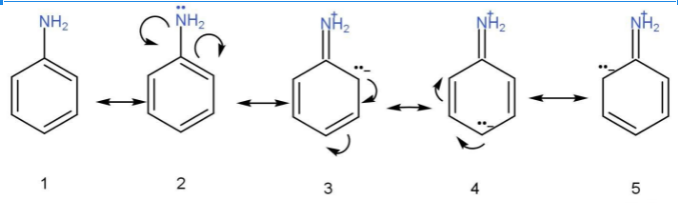
Aniline $\left(\mathrm{C}_6 \mathrm{H}_5 \mathrm{NH}_2\right)$ is an aromatic amine in which the amino group $\left(-\mathrm{NH}_2\right)$ is directly attached to a benzene ring. Aniline behaves as a weak base because the lone pair of electrons on the nitrogen atom can accept a proton $\left(\mathrm{H}^{+}\right)$. In aniline, the lone pair of electrons on the nitrogen atom is involved in resonance with the benzene ring. Due to delocalisation, the electron density on nitrogen decreases, making the lone pair less available for donation to a proton.
The lone pair on nitrogen participates in conjugation with the π-electrons of the benzene ring:
As a result, the lone pair is partially shared with the ring, reducing the tendency of nitrogen to donate electrons.
Aniline is less basic than ammonia because:
Therefore,
Basicity: $N H_3>C_6 H_5 N H_2$
Groups such as –CH3, –OCH3, –NH2 increase electron density on nitrogen and increase the basic strength of aniline.Example:
Groups such as –NO2, –CN, –COOH withdraw electron density and decrease the basic strength of aniline. Example:
A variety of substrates of are used to synthesize aniline such as alkyl halides, nitro groups, nitriles, amides, benzamides, and benzoic acid.
1. From Alkyl halides
Nucleophilic substitution reaction of ammonia on alkyl halides takes place at 373 K in a sealed tube. An ammonium salt is formed which reacts with a base to form primary amine.
$\mathrm{RX}+\mathrm{NH}_3 \rightarrow \mathrm{RNH}_3{ }^{+} \mathrm{X}^{-}$
$\mathrm{RNH}_3{ }^{+} \mathrm{X}^{-}+\mathrm{NaOH} \rightarrow \mathrm{RNH}_2+\mathrm{H}_2 \mathrm{O}+\mathrm{NaX}$
2. From Amides
Aniline can be prepared from benzamide by treating it with bromine and aqueous potassium hydroxide. This reaction is known as the Hofmann Bromamide Reaction or Hofmann Rearrangement.
$\mathrm{C}_6 \mathrm{H}_5 \mathrm{CONH}_2+\mathrm{Br}_2+4 \mathrm{KOH} \rightarrow \mathrm{C}_6 \mathrm{H}_5 \mathrm{NH}_2+2 \mathrm{KBr}+\mathrm{K}_2 \mathrm{CO}_3+2 \mathrm{H}_2 \mathrm{O}$
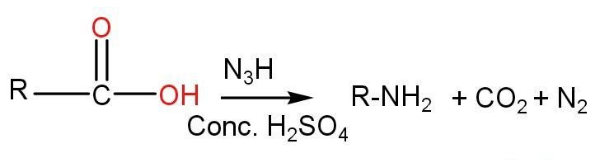
3. From Carboxylic acid
Carboxylic acids are used to synthesize primary amines in the presence of hydrazoic acid.
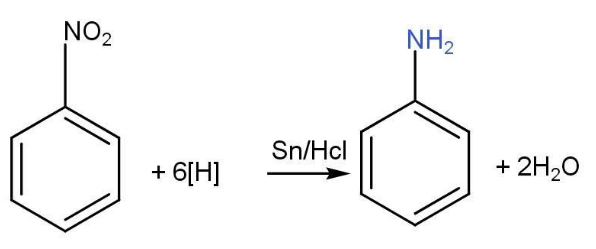
4. From Nitro Compounds
Nitro compounds get reduced in the presence of acid and active metals such as zinc, iron, and tin.
Also read :
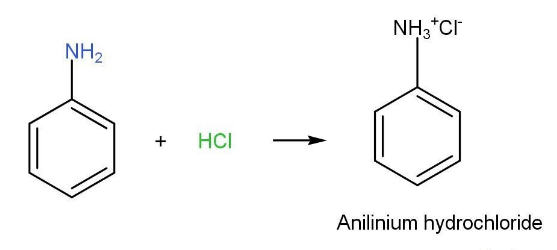
1. Reaction with Acid
Due to the presence of lone pair on nitrogen aniline behaves as basic in nature. Anilinium hydrochloride is the product that is formed. If a strong base is added, then aniline can be liberated.
2. Acylation
Benzenamine reacts with acetyl chloride in the presence of base such as pyridine to form analide. A hydrogen group of -NH2 is replaced with –RCO group. The presence of base is necessary for the removal of Cl of acid chloride. Base should be stronger than ammonia to shift the equilibrium to the right side of the reaction.
Aniline reacts with acetyl chloride or acetic anhydride to form acetanilide.
With Acetyl Chloride:
$\mathrm{C}_6 \mathrm{H}_5 \mathrm{NH}_2+\mathrm{CH}_3 \mathrm{COCl} \rightarrow \mathrm{C}_6 \mathrm{H}_5 \mathrm{NHCOCH}_3+\mathrm{HCl}$
With Acetic Anhydride:
$\mathrm{C}_6 \mathrm{H}_5 \mathrm{NH}_2+\left(\mathrm{CH}_3 \mathrm{CO}\right)_2 \mathrm{O} \rightarrow \mathrm{C}_6 \mathrm{H}_5 \mathrm{NHCOCH}_3+\mathrm{CH}_3 \mathrm{COOH}$
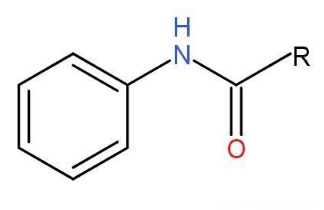
Analide formula is N- Phenyl ethanamide or acetanilide.
Analide structure is shown below-
|
Related Topics Link, |
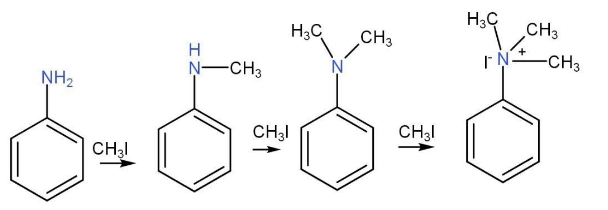
3. Alkylation of Aniline
It is possible to introduce a methyl group onto the nitrogen atom of -NH2 group by the removal of Hydrogen. An alkyl halide is introduced for the nucleophilic substitution reaction. Here the amine will act as nucleophile and alkyl halide performs the attack.
Also check-
Question 1: Arrange the following amines in the decreasing order of basicity:
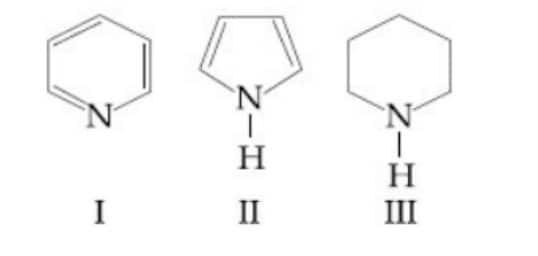
1) $\mathrm{I}>\mathrm{II}>\mathrm{III}$
2) $\mathrm{III}>\mathrm{I}>\mathrm{II}$
3) $\mathrm{III}>\mathrm{II}>\mathrm{I}$
4) $\mathrm{I}>\mathrm{III}>\mathrm{II}$
Solution:
The general order of basicity -
Aliphatic Amines > Ammonia > Aromatic Amines
Pyridine is more basic than pyrrole as the lone pairs over N in pyrrole is involved in aromaticity
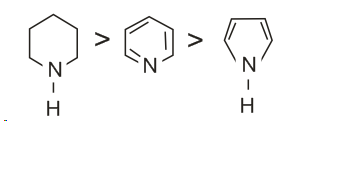
Hence, the correct answer is option (2)
Question 2: The increasing order of basicity of the following compounds is :

1) (A) < (B) < (C) < (D)
2) (B) < (A) < (D) < (C)
3) (D) < (A) < (B) < (C)
4) (B) < (A) < (C) < (D)
Solution:

Therefore, the correct order of Basic strength is (B) < (A) < (D) < (C).
Hence, the correct answer is option (2).
Question 3:
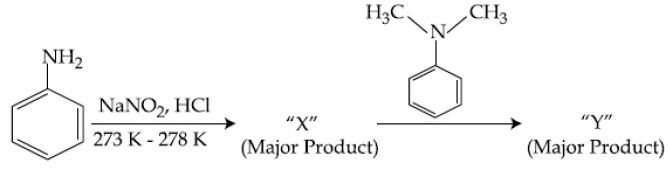
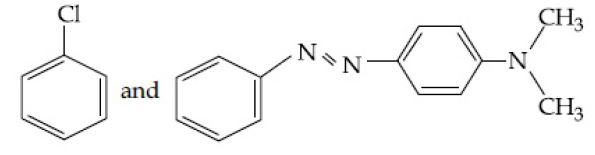
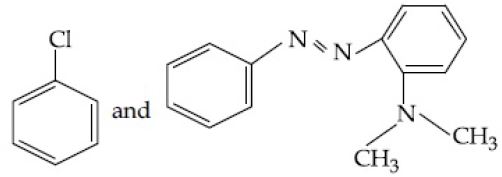
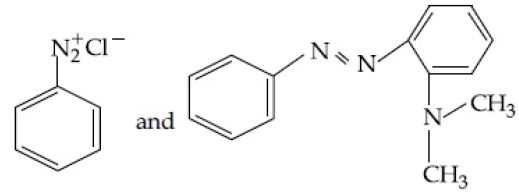
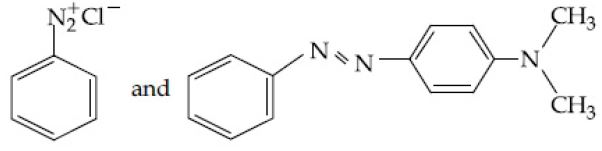
Considering the above reaction, X and Y respectively are :
1) 
2) 
3) 
4) 
Solution:
The reaction will be-
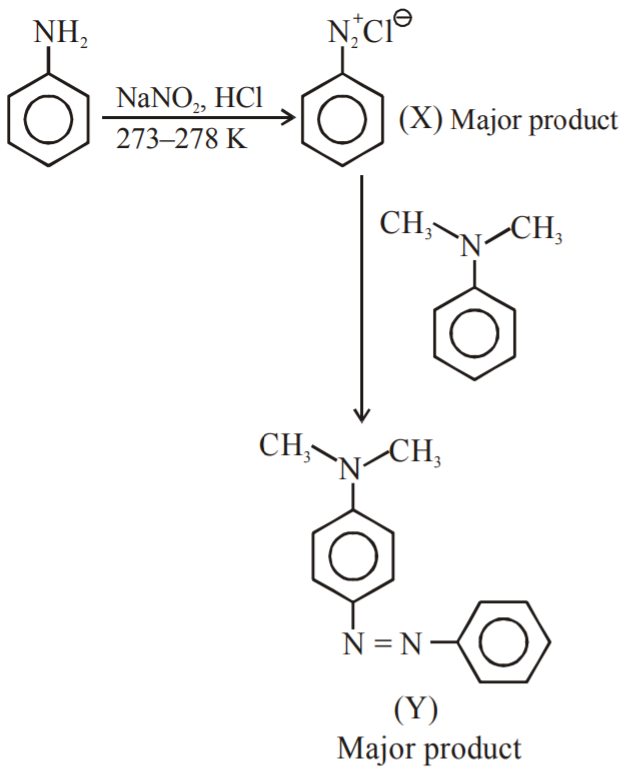
Hence, the correct answer is option (4)
Frequently Asked Questions (FAQs)
In anthranilic acid, benzene acts as electron withdrawing group that depresses the tendency of weak acidic group (-COOH) to donate its proton to amine -NH2 group. Whereas, in case of aliphatic chains for ex- glycine can exist as zwitter ion.
Aniline point is a measure of miscibility of lubricating oils with aniline when the volumes of aniline is equal to other lubricating oils.
Aniline is an unsaturated compound due to the presence of benzene ring. Benzene has three double bonds and these Double bonds make a compound unsaturated.
Aniline is converted to Diazonium salt. Diazonium salt is further converted to benzonitrile.
Aniline is an aromatic amine with a chemical formula of -C6H5NH2. A benzene group attached to a -NH2 group is called aniline.
-OCH3 group is electron releasing group release the electrons and increases the basic strength of aniline.


Law Admissions 2026 Open | Avail Merit-Based Scholarships
BBA/MBA/PGDM Early Bird Applications Deadline 19th Oct '26. Apply now using coupon code CAREER250 and get ₹250 off the application fee
Ranked #36 amongst institutions in Management by NIRF | 100% Placement
Globally Recognized by AACSB (US) & AMBA (UK) | 18 LPA Avg. CTC for PGPM 2026
Leading Design College | 95% Placement Record | Merit-cum-Means Scholarships for Deserving Students
NEET PG All India & State College Predictor with Admission Process Guide