


Zwitterion - Definition, Example, Structure, FAQs
What happens when a molecule contains both an acidic group and a basic group? Can a single molecule carry both positive and negative charges simultaneously? Such unique species are known as zwitterions. A zwitterion is a dipolar ion that possesses both a positively charged and a negatively charged center within the same molecule while remaining electrically neutral overall. Zwitterions are commonly observed in amino acids and play an important role in determining their physical and chemical properties.
This Story also Contains
- Zwitterion
- Zwitterion Example
- Isoelectric Point (pI)
- Zwitterion Structure of Alanine
- Zwitterion Structure of Glycine
- Some Solved Example
.jpg)
Zwitterion
A zwitterion is a molecule that contains both a positive charge and a negative charge at different atoms, but has an overall net charge of zero.
A classic example is an amino acid in water:
$\mathrm{H}_3 \mathrm{~N}^{+}-\mathrm{CH}(R)-\mathrm{COO}^{-}$
Here:
- The amino group ( $\mathrm{NH}_3^{+}$) carries a positive charge.
- The carboxylate group ( $C O O^{-}$) carries a negative charge.
- The molecule as a whole is electrically neutral.
Characteristics
- Common in amino acids, peptides, and proteins.
- Predominate at the molecule's isoelectric point (pI).
- Usually have high melting points and are highly soluble in water because they behave like internal salts.
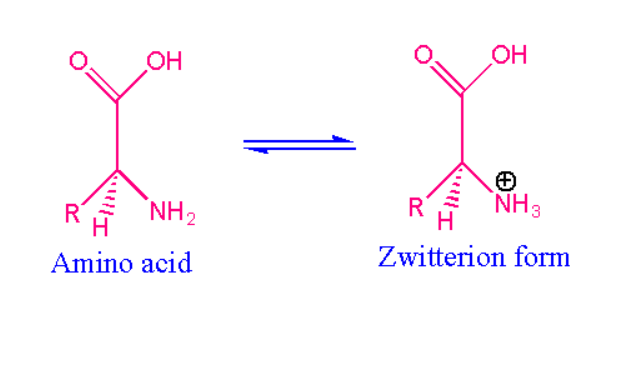
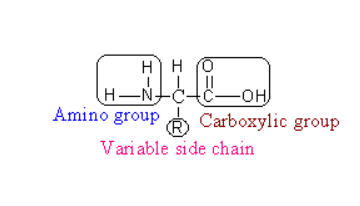
Zwitterion Example
A zwitterion is a molecule that contains both a positive charge and a negative charge but has an overall neutral charge.
1. Glycine
$\mathrm{NH}_3^{+}-\mathrm{CH}_2-\mathrm{COO}^{-}$
2. Alanine
$\mathrm{NH}_3^{+}-\mathrm{CH}\left(\mathrm{CH}_3\right)-\mathrm{COO}^{-}$
3. Valine
$\mathrm{NH}_3^{+}-\mathrm{CH}\left(\mathrm{CH}\left(\mathrm{CH}_3\right)_2\right)-\mathrm{COO}^{-}$
4. Aspartic Acid
$\mathrm{NH}_3^{+}-\mathrm{CH}\left(\mathrm{CH}_2 \mathrm{COOH}\right)-\mathrm{COO}^{-}$
5. Lysine
$\mathrm{H}_3 \mathrm{~N}^{+}-\left(\mathrm{CH}_2\right)_4-\mathrm{CH}\left(\mathrm{NH}_3^{+}\right)-\mathrm{COO}^{-}$
(Can contain more than one positive charge depending on the pH)
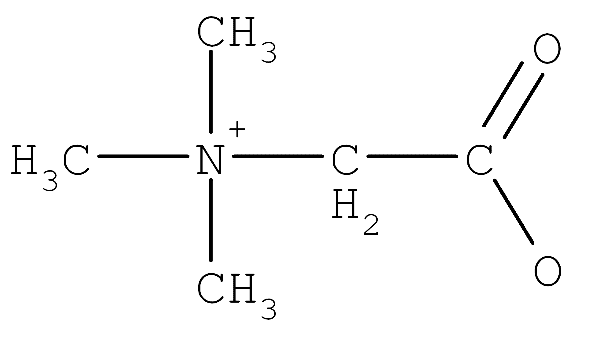
Other examples of zwitterions include trimethylglycine, psilocybin, and cocamidopropyl. The amino acids that are optically inactive are termed glycine.
Betaine is also one such example of a zwitterion, which is a chemically neutral compound. Betaine is a special type of zwitterion because it does not have any hydrogen atoms. It contains positively charged ammonium or phosphonium groups and negatively charged carboxylate groups.
Sulfamic acid exists as a neutral as well as zwitterion form.
Zwitterion Form of Amino Acids
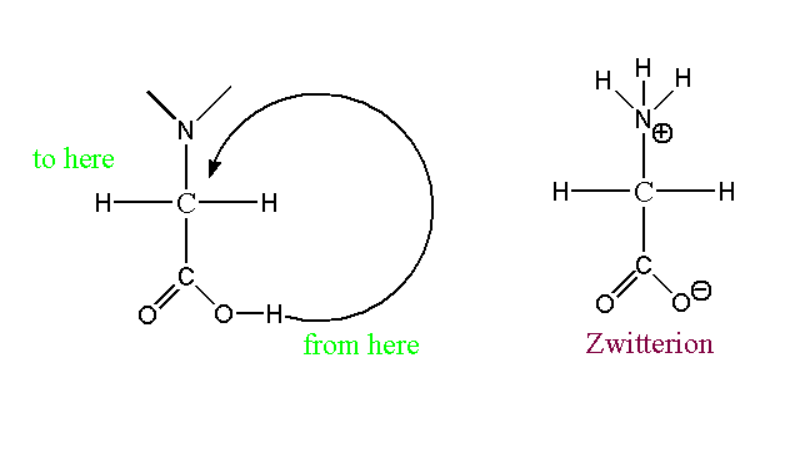
Amino acids contain both an acidic carboxyl group (-COOH) and a basic amino group (-NH₂). In aqueous solution, the carboxyl group donates a proton to the amino group, forming a dipolar ion called a zwitterion. The equilibrium exists between parent amino acid and its zwitterion. Amine is present in the amino acid group which is the stronger basic group while carboxylic is an acidic group. Zwitterion of an amino exists with pH range equal to isoelectric point. Based on the properties of amino acids each has its own pH value. Above and below the isoelectric point the molecule shows the pH values and has net charge which directly depends on the pH of the molecule and pH of the solution.
Related Topics Link,
Isoelectric Point (pI)
The isoelectric point (pI) is the pH at which a molecule carries no net electrical charge. At this pH, the positive and negative charges on the molecule are equal, and the molecule exists predominantly in its zwitterionic form.
Characteristics of Isoelectric Point
- The molecule has zero net charge.
- It exists mainly as a zwitterion.
- Mobility in an electric field becomes minimum or zero.
- Solubility is often lowest at the isoelectric point.
- The isoelectric point is an important property of amino acids and proteins.
Isoelectric Point of Amino Acids
The isoelectric point of an amino acid is the specific pH at which the amino acid exists predominantly as a zwitterion and has no net charge.
At the isoelectric point, the amino acid exists as:
$\mathrm{H}_3 \mathrm{~N}^{+}-\mathrm{CH}(R)-\mathrm{COO}^{-}$
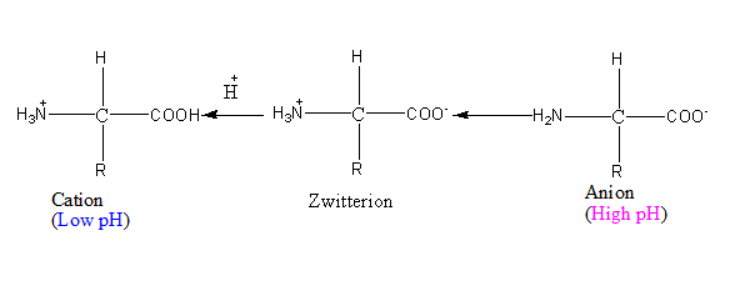
Behaviour of Amino Acids at Different pH
1. At pH below the isoelectric point (acidic medium):
- Amino acid carries a positive charge (cation).
- It migrates towards the cathode.
2. At the isoelectric point (pl):
- Amino acid exists mainly as a zwitterion.
- Net charge is zero.
- No migration occurs in an electric field.
3. At pH above the isoelectric point (basic medium):
- Amino acid carries a negative charge (anion).
- It migrates towards the anode.
Also read :
Zwitterion Structure of Alanine
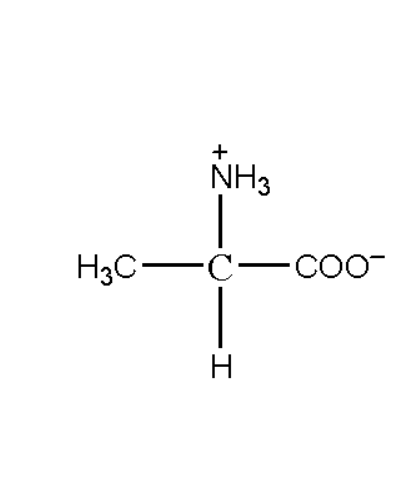
The alanine is a form of amino acid which means it contains one carboxylic group and one amino group. While defining the alpha amino acid the alanine is the example of such alpha amino acid group. The alanine is consisting of two carbon atoms where the same carbon atom has both amine and carboxylic group with molecular formulaC3H7NO2. The structure of alanine can be depicted as follows:
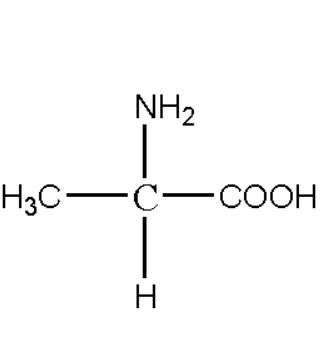
In the above structure we can see that protons from the carboxylic group will shift to the amine group. This happens as the carboxylic acid has a tendency to accept protons and amine to release the proton. The zwitterion is formed can be depicted as below
At pH 4 glycine exists as:
The simplest form of amino acid is glycine which can be represented by the symbol G or Gly. It is a form of amino acid which has a hydrogen atom in its side chain. Glycine is the only amino acid that can exist as achiral proteinogenic amino acid and can be fitted in both the environment as hydrophilic and hydrophobic. This happens because of one hydrogen atom.
At pH 4 glycine is found as in acidic form.
Zwitterion Structure of Glycine
The zwitterion structure can be represented at this pH range.
When reacts with hydrogen ion such reaction can proceed further:
Also check-
Some Solved Example
Question 1: At the isoelectric point of glycine, the predominant species is:
A) $\mathrm{H}_3 \mathrm{~N}^{+}-\mathrm{CH}_2-\mathrm{COOH}$
B) $\mathrm{H}_2 \mathrm{~N}-\mathrm{CH}_2-\mathrm{COO}^{-}$
C) $\mathrm{H}_3 \mathrm{~N}^{+}-\mathrm{CH}_2-\mathrm{COO}^{-}$
D) $\mathrm{H}_2 \mathrm{~N}-\mathrm{CH}_2-\mathrm{COOH}$
Solution:
At the isoelectric point, glycine exists predominantly as a zwitterion with both positive and negative charges but zero net charge.
Hence, the correct answer is option (C)
Question 2: An amino acid at pH lower than its isoelectric point will:
A) Move towards the anode
B) Move towards the cathode
C) Not move in an electric field
D) Decompose
Solution:
Below pI, the amino acid has a net positive charge and moves towards the cathode.
Hence, the correct answer is option (B)
Question 3: For glycine, $\mathrm{pKa}_1=2.34$ and $\mathrm{pKa}_2=$ 9.60. The isoelectric point is:
$p I=\frac{p K_{a 1}+p K_{a 2}}{2}$
A) 4.67
B) 5.97
C) 6.47
D) 7.97
Solution:
Substituting the given values:
$\begin{aligned}
& \mathrm{pl}=(2.34+9.60) / 2 \\
& \mathrm{pl}=11.94 / 2 \\
& \mathrm{pl}=5.97
\end{aligned}$
Hence, the correct answer is option (B)
Question 4: Which functional groups are present in the zwitterionic form of an amino acid?
A) $-\mathrm{NH}_2$ and -COOH
B) $-\mathrm{NH}_3{ }^{+}$and -COOH
C) $-\mathrm{NH}_2$ and $-\mathrm{COO}^{-}$
D) $-\mathrm{NH}_3{ }^{+}$and $-\mathrm{COO}^{-}$
Solution:
Amino acids contain both an amino group ( $-\mathrm{NH}_2$ ) and a carboxyl group ( -COOH ). In aqueous solution, a proton $\left(\mathrm{H}^{+}\right)$is transferred from the carboxyl group to the amino group.
$\mathrm{NH}_2-\mathrm{CH}(\mathrm{R})-\mathrm{COOH} \rightleftharpoons \mathrm{NH}_3{ }^{+}-\mathrm{CH}(\mathrm{R})-\mathrm{COO}^{-}$
- The amino group becomes $-\mathrm{NH}_3{ }^{+}$(positively charged).
- The carboxyl group becomes $-\mathbf{C O O}^{-}$(negatively charged).
Hence, the correct answer is option (D)
Question 5: Assertion (A): Amino acids exist as zwitterions in the crystalline state.
Reason (R): A proton transfers from the carboxyl group to the amino group within the molecule.
A) Both A and R are true, and R is the correct explanation of A.
B) Both A and R are true, but R is not the correct explanation of A.
C) A is true, but R is false.
D) A is false, but R is true.
Solution:
Assertion (A) is true because amino acids exist as zwitterions in the crystalline state.
Reason (R) is true because a proton is transferred from the –COOH group to the –NH₂ group.
This proton transfer forms the zwitterion $\mathrm{NH}_3{ }^{+}-\mathrm{CH}(\mathrm{R})-\mathrm{COO}^{-}$.
Hence, the correct answer is option (D)
Frequently Asked Questions (FAQs)
Isoelectric point pH can be defined as a particular pH range molecule carrying no net charge on it. The net charge is affected by the pH and its surrounding.
Zwitterion is composed of positively and negatively charged electrons and are neutral in nature. By adding the hydroxide ions the pH increases which ultimately exclude the hydrogen ions from the amine group.
The best example of zwitterion is amino acids. Amino acids consist of two functional groups: amine group and carboxyl group.
The isoelectric point definition is given by those points where the pH of anion are equal to pH of cation. At this point amino acids do not migrate, when a field is applied on it.
Dipolar ions are those that have both charges positive and negative and are amphoteric in nature.
Zwitterion can be defined as the molecule which is made up of two functional groups. The opposite charges present on the group will cancel out each other making the compound neutral.