


Petroleum - Introduction, Properties, Uses, Facts, FAQs
Petroleum is also known as “Black Gold” and the name itself indicates its importance to human’s daily life. Petroleum is utilised to form different products like plastics, gasoline, synthetic fabrics, etc. Due to
this reason petroleum is also referred to as the mother of all commodities.
This Story also Contains
- What is Petroleum?
- Different Types of Petroleum Products
- How is Petroleum Formed?
- Definition of Petroleum Refinery
- Purification of Petroleum
- Importance of Petroleum
- What are Petrochemicals?
What is Petroleum?
Petrol meaning (petrol name)
“Petra” is a Greek word and “Oleum” is a Latin word that means “rock oil” is used to derive the word petroleum. When it is drilled from the underground in the liquid form, it is called crude oil.
Crude oil meaning (what is the meaning of crude oil)
Crude oil is a naturally occurring petroleum oil that is composed of hydrocarbon derivatives and other organic materials. Crude oil, basically a type of fossil fuel, is refined to produce usable products including gasoline, diesel, and various other forms of petrochemicals. It is a non-renewable resource, i.e., it can't be replaced naturally at the rate we use it and therefore, a limited resource.
Example of Crude oils:
| TYPES | PROPERTIES | EXAMPLE |
| Very light oils | very volatile, evaporating within a few days. As a result, their toxicity levels also evaporate. | Gasoline, Jet Fuel, Kerosene, Petroleum Ether, Petroleum Naphtha, and Petroleum Spirit. |
| Light oils | moderately volatile and toxic. | Grade 1 and Grade 2 Fuel Oils and Diesel Fuel Oils as well as Most Domestic Fuel Oils |
| Medium oils | Medium oils have low volatility. They have higher viscosity as compared to light oils. It leads to higher toxicity which negatively impacts the environment. | Petroleum oil and paraffin oil |
| Heavy fuel oils | most viscous and least volatile. Hence, most toxic | Heavy fuel oils are grades 3,4,5 and 6. Fuel oils and heavy marine fuels are other examples. |
Petrol images are shown below.
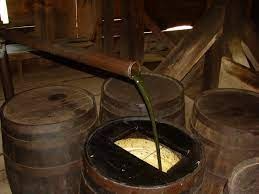

The Basic Constituents of Petroleum:
Carbon 84-87%, Hydrogen 11-14%, Sulfur 0.06-2%, Nitrogen 0.1-2%, Oxygen 0.1-0.2%, Metals 0-0.14%.
Also read -
- NCERT Solutions for Class 11 Chemistry
- NCERT Solutions for Class 12 Chemistry
- NCERT Solutions for All Subjects
The chemical formula for petrol (petrol formula/petrol molecular formula )
Typical petroleum is a mixture of different chemicals such as paraffin, olefins, and naphthalene. Petrol has a basic chemical formula since it is a mixture of various chemicals and is also blended as per its requirement. So, its general petrol chemical formula is CnH2n+2.
Properties of Petroleum (characteristics of petroleum)
Petroleum oil appears as very fluid, volatile liquids and also viscous, semisolid materials. The colour of the oil is mainly black or greenish-black tinge in colour but sometimes you can observe that the colour is reddish, light yellow, greenish oil is black in colour, or black with a greenish tinge in colour. Sometimes it can be transparent, light yellow, greenish-yellow in colour.
Petroleum oil majorly contains cyclohexanes, alkanes, aromatic hydrocarbons, and other complex hydrocarbons like asphaltenes. The two main constituents of petroleum are carbon and hydrogen.
The properties of petroleum oil may vary extensively. Heavier fractions like asphaltene contain more metal concentrations than saturated and aromatic fractions. Apart from this sulphur and nitrogen are present in traces in light petroleum.
Different Types of Petroleum Products
Different types of petroleum products are gasoline, liquified natural gas, liquified petroleum gas, kerosene, butane, fuel oil, diesel fuel, propane, paraffin wax, petroleum jelly, microcrystalline wax, etc.
How is Petroleum Formed?
Origin of oil
Petroleum is formed from the remains of dead plants (diatoms) such as algae and zooplankton and animals after being decayed by decomposers.
When plants and animals died millions of years ago they settled on the seabed. These dead plants and animals decomposed and mixed with sand.
Decomposition of the organic matter is done by bacterias which lead to a chemical reaction.
After decomposition, the matter having a large amount of carbon and hydrogen is left behind. Due to a deficiency of oxygen at the bottom of the sea, matter does not decompose completely. These partially decomposed organic substances remained on the seabed and eventually were covered with different layers of silt and sand.
The whole process took several million years and as a result of high temperature and pressure, the organic matter completely gets decomposed to form oil. The oil formed is known as crude oil.
Where is Crude oil Found?
crude oil—is a fossil fuel and found in large quantities beneath the Earth's surface; under multiple layers of slit of the seabed. It is of foul smell, yellowish black liquid. Crude oil is present in the underground areas known as reservoirs.
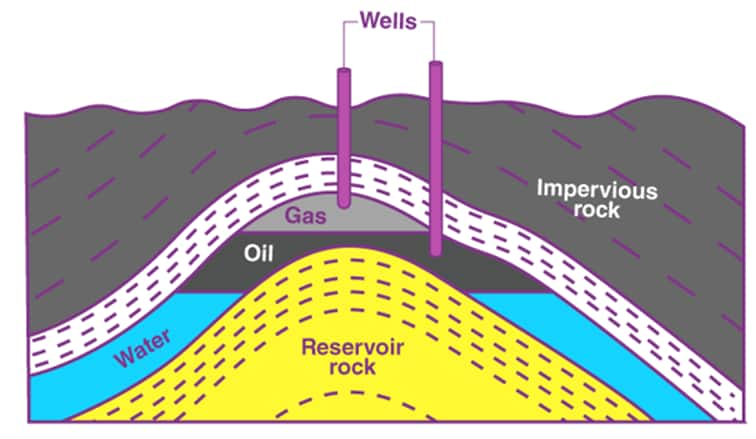
Petroleum refining process (describe the process of formation of petroleum).
An oil refinery or petroleum refining is an industrial manufacturing process, where crude oil is extracted and converted into more valuable goods, such as petroleum naphtha, gasoline, jet fuel, asphalt foundation, heating oil, petroleum kerosene, and liquefied gas. Oil refineries are huge industrial systems containing pipelines that hold fluid streams. The entire process is shown in a simple flowchart below:
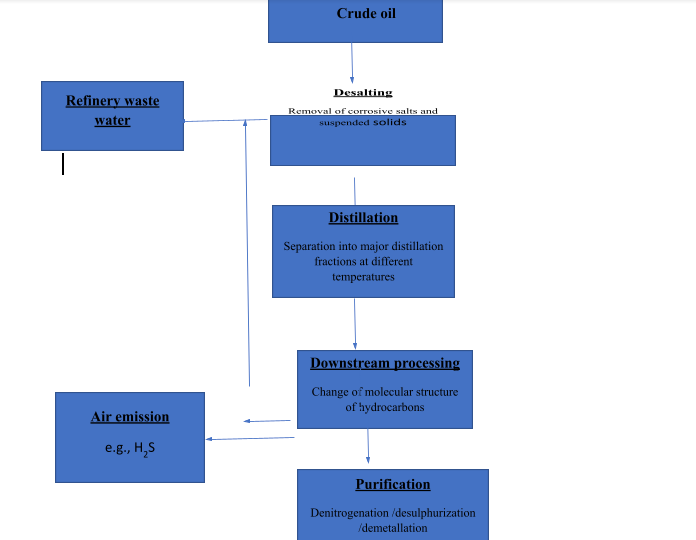
Different constituents of petroleum like gas, diesel, kerosene, etc. have different properties, therefore it is important to separate them. The process of separating different constituents of petroleum is referred to as petroleum refinery.
Definition of Petroleum Refinery
The separation of different constituents of petroleum is done in oil refineries in three steps.
In the initial stage, the crude oil is separated into its different components by the distillation process. The heavier constituents settle at the bottom and the lighter constituents rise up as vapour, or float in the liquid.
In the second step, the constituents are converted into gas, gasoline, and diesel. This step is known as conversion.
The last step known as treating the impurities is treated to obtain different products.
Petroleum Extraction (separation of petroleum)
The most common way of separating oil into different components (called fractions) is to do it using the boiling temperature differences. In petroleum refining, the method of separation used is “fractional distillation”.
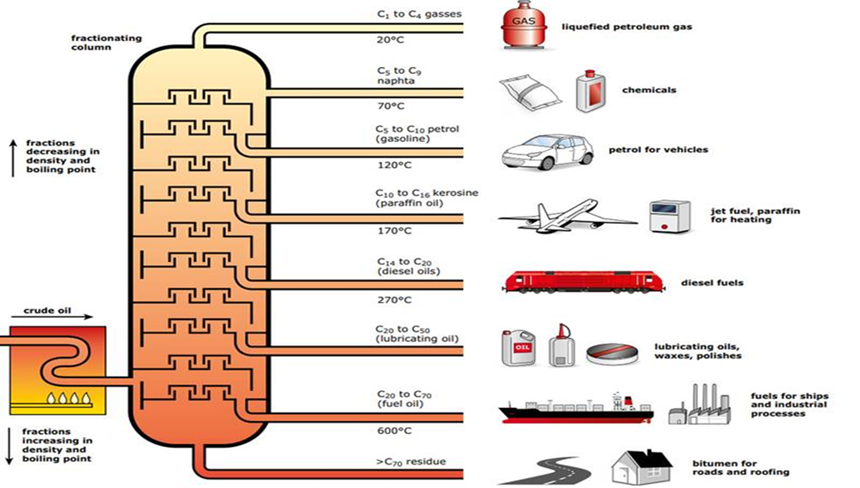
New methods, called conversion, use Chemical processing on certain fractions to produce others. For example, different chemical processing may split lengthier chains into shorter chains. This allows converting diesel fuel into gasoline, depending on the gasoline demand.
Also Read:
Purification of Petroleum
In industry, the refining process is usually called the “downstream” sector, while the “upstream” sector is called the raw crude oil output.
Petroleum refineries in India (crude oil refinery in India)
Gujrat (Jamnagar), Kerala (Kochi), Karnataka, Odisha, Haryana, Maharashtra (Bombay high), Punjab, Tamil Nadu, Assam (Digboi), West Bengal (Haldia).
Few Petrol Industries of India
Petroleum or mineral oil is India’s 2nd biggest source of energy after coal which supplies heat and lighting power, machinery lubricants, and raw materials in different manufacturing industries. Petroleum oil refineries for synthetic textiles, fertilisers, and various chemical industries act as a “nodal industry”. Most of India’s petroleum is found under the anticlines, or domes, where oil is trapped in the unfolding crest along with natural gas.
petroleum shares
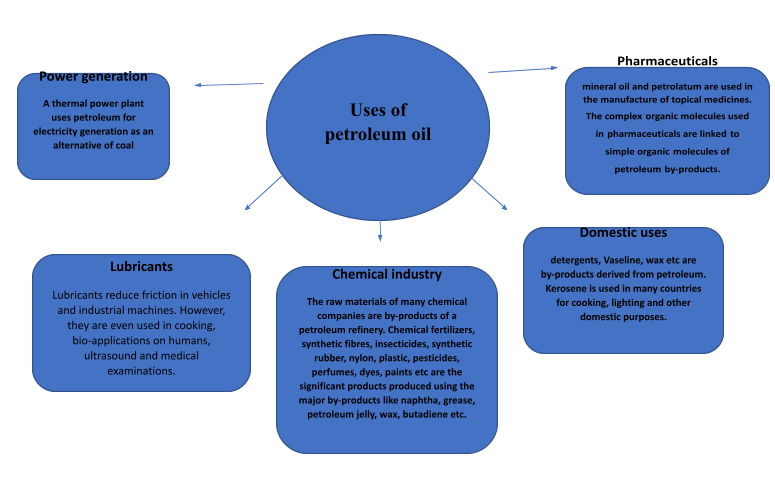
Importance of Petroleum
What are Petrochemicals?
Petrochemicals are the combination of different chemical compounds which are formed from hydrocarbons that are extracted from petroleum.
Also check-
- NCERT Exemplar Class 11th Chemistry Solutions
- NCERT Exemplar Class 12th Chemistry Solutions
- NCERT Exemplar Solutions for All Subjects
NCERT Chemistry Notes:
Questions related to
On Question asked by student community
Dear Student,
Choosing between merchant navy , petroleum engineering and CSE Cybersecurity depend on your career goal because each of these fields has completely different lifestyles.
- If you want global travel then choose Merchant Navy . The starting salary can range somewhere between Rs 40,000 and Rs 80,000 per month.
Dear Student,
Choosing the best between Petrochemical or Petroleum Engineering depends on your career goals. Both fields have their own benefits and offer different career opportunities.
Choose Petroleum Engineering if you want to learn the production and extraction of hydrocarbons, such as natural gas and crude oil.
Choose Petrochemical Engineering
Petroleum is a versatile raw material, and many products are obtained from it after refining, for example, Fuels, Lubricants, construction material and household consumer products.
Fuels:
- Petrol
- Diesel
- Kerosene
Lubricants:
- Motor oil
- Greases
Consumer products:
- Paraffin wax
- Petroleum jelly
- Synthetic fibres
Construction Material:
- Bitumen
- Tar
Hello,
Yes, you are eligible for the nautical science. However, having 60% marks in 12th or B Ed can give you a strong foundation for the diploma in nautical science. Moreover, you have to acquire strong speech and writing skills in English.
Thank you. Hope this information helps you.
UPES is generally considered a Tier-2 university. It is well-known for industry-focused courses, especially in petroleum, energy, engineering, law and management, and offers good campus facilities and placement support. Top companies do visit the campus, but placements and salary packages vary by branch and student performance. If you are interested