


Indeterminate Forms of Limits
When evaluating limits, we often come across expressions that do not give a clear numerical result. For example, if we try to find the limit $\lim_{x \to 2} \frac{x^2 - 4}{x - 2}$, direct substitution gives $\frac{0}{0}$, which is not a valid answer. This is known as an indeterminate form. Indeterminate forms commonly appear in algebraic, trigonometric functions, and exponential functions, especially in differentiation using L’Hospital’s Rule in mathematics. In this article, we will explain the different types of indeterminate forms, show easy techniques to evaluate them, and provide solved examples and exam-oriented tips to help students master limits efficiently.
This Story also Contains
- What Are Indeterminate Forms?
- Limit of Indeterminate Form and Algebraic Limit
- L’Hospital’s Rule
- Indeterminate Forms of Limits: Complete List with Conditions, Transformations, and Examples
- Methods to Evaluate Indeterminate Forms
- Indefinite Forms of limits
- Solved Examples Based On Limits on Indeterminate Forms:
- List of topics related to Limits
- NCERT Resources
- Practice Questions based on Indeterminate forms
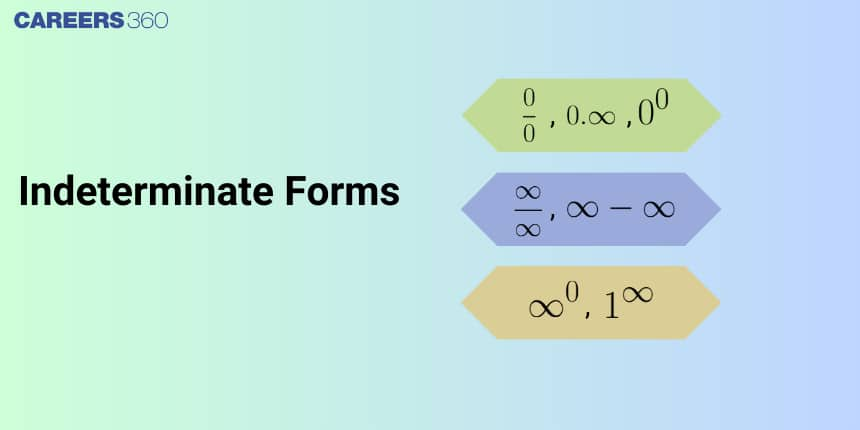
What Are Indeterminate Forms?
When we try to calculate a limit and direct substitution doesn’t give a clear result, we encounter an indeterminate form. In simple words, these are expressions where the value of the limit cannot be directly determined. For example, the limits $\lim_{x \to 0} \frac{\sin x}{x}$ or $\lim_{x \to 2} \frac{x^2 - 4}{x - 2}$ initially give expressions like $\frac{0}{0}$. Such cases are called indeterminate forms of limits because they can take different values depending on how the function behaves near that point.
Common signs of indeterminate forms include:
$\frac{0}{0}$: Both numerator and denominator approach 0
$\frac{\infty}{\infty}$: Both numerator and denominator grow very large
$0 \cdot \infty$: One factor goes to 0, the other to infinity
$\infty - \infty$: Difference of two very large numbers
$0^0$, $1^\infty$, $\infty^0$: Indeterminate exponential forms
Recognizing these common indeterminate forms in calculus is the first step to solving limit problems effectively. Once identified, we can apply techniques like L’Hospital’s Rule, algebraic simplification, or rationalization to find the exact limit.
Limit of Indeterminate Form and Algebraic Limit
Indeterminate forms arise when evaluating limits and direct substitution does not give a specific value. If we try to evaluate $\lim\limits _{x \rightarrow a} f(x)$ and get one of the following forms:
$\frac{0}{0}, \frac{\infty}{\infty}, \infty - \infty, 1^\infty, 0^0, \infty^0, 0 \cdot \infty$
then the limit is called an indeterminate form.
Examples:
$\lim\limits _{x \rightarrow 2} \frac{x^2-4}{x-2} = \frac{0}{0}$
$\lim\limits _{x \rightarrow 0} \frac{\sin x}{x} = \frac{0}{0}$
$\lim\limits _{x \rightarrow \pi / 2} (\tan x)^{\cos x} = \infty^0$
Note:
The $\frac{0}{0}$ form means both numerator and denominator approach 0, but not necessarily exactly 0.
Example: $\lim\limits _{x \rightarrow 0^+} \frac{[x]}{x}$ → here the denominator tends to 0, but numerator is exactly 0, so it is not a $\frac{0}{0}$ form.One indeterminate form can sometimes be converted into another.
L’Hospital’s Rule
Definition: If $\lim\limits _{x \rightarrow a} \frac{f(x)}{g(x)}$ is of $\frac{0}{0}$ or $\frac{\infty}{\infty}$ form, then:
$\lim\limits _{x \rightarrow a} \frac{f(x)}{g(x)} = \lim\limits _{x \rightarrow a} \frac{f'(x)}{g'(x)}$
If the indeterminate form still persists after differentiation, differentiate again:
$\lim\limits _{x \rightarrow a} \frac{f(x)}{g(x)} = \lim\limits _{x \rightarrow a} \frac{f'(x)}{g'(x)} = \lim\limits _{x \rightarrow a} \frac{f''(x)}{g''(x)}$
Continue this process until the form is no longer indeterminate. This is the L'Hospital's form.
Applications of L’Hospital’s Rule:
$\lim\limits _{x \rightarrow 0} \frac{\sin x}{x} = \lim\limits _{x \rightarrow 0} \frac{\cos x}{1} = 1$
$\lim\limits _{x \rightarrow \infty} \frac{\ln x}{x} = \lim\limits _{x \rightarrow \infty} \frac{1/x}{1} = 0$
$\lim\limits _{x \rightarrow 0} \frac{\ln(1+x)}{x} = \lim\limits _{x \rightarrow 0} \frac{1/(1+x)}{1} = 1$
Indeterminate Forms of Limits: Complete List with Conditions, Transformations, and Examples
This section provides a complete list of indeterminate forms of limits, explaining their conditions, step-by-step transformations, and solved examples to help students quickly understand and evaluate tricky limit problems.
1. $\frac{0}{0}$ Form
Condition: Occurs when both the numerator and the denominator of a fraction approach zero as the independent variable approaches a certain value.
Transformation: To evaluate a $\frac{0}{0}$ limit, use techniques like:
Factorization: Factor the numerator and/or denominator to cancel common factors.
Rationalization: Multiply by a suitable conjugate or form of 1 to simplify the expression.
L’Hospital’s Rule: Differentiate the numerator and denominator separately, if the limit exists.
Example:
$\lim\limits _{x \rightarrow 0} \frac{\sin x}{x} = \frac{0}{0}$
Applying L’Hospital’s Rule:
$\lim\limits _{x \rightarrow 0} \frac{\sin x}{x} = \lim\limits _{x \rightarrow 0} \frac{\cos x}{1} = 1$
2. $\frac{\infty}{\infty}$ Form
Condition: Occurs when both the numerator and the denominator approach infinity as the variable approaches a certain value.
Transformation: To resolve this form:
L’Hospital’s Rule: Useful when both numerator and denominator are differentiable near the point of interest.
Rewriting/Fraction Simplification: Factor or manipulate terms to convert the fraction into a simpler, solvable form.
3. $0 \cdot \infty$ Form
Condition: Appears when a limit involves the product of a term approaching zero and another approaching infinity.
Transformation: Convert it into a $\frac{0}{0}$ or $\frac{\infty}{\infty}$ form using:
Algebraic Manipulation: Rewrite the product as a fraction or separate terms.
Example:
$\lim\limits _{x \rightarrow 0} x \cdot \frac{1}{x} = 0 \cdot \infty$
Rewriting: $\lim\limits _{x \rightarrow 0} 1 = 1$
4. $\infty - \infty$ Form
Condition: Occurs when a limit involves the difference of two terms, each approaching infinity.
Transformation: Transform the expression to a more manageable form:
Algebraic Manipulation: Combine terms or simplify to get $\frac{0}{0}$ or $\frac{\infty}{\infty}$.
Factorization: Rearrange and factor terms to simplify evaluation.
Example:
$\lim\limits _{x \rightarrow \infty} (x + \sqrt{x}) - x = \infty - \infty$
Simplifying: $\lim\limits _{x \rightarrow \infty} \sqrt{x} = \infty$
5. $0^0$ Form
Condition: Appears when a limit involves an expression like $x^x$ as $x \to 0$.
Transformation: Use logarithmic and exponential techniques:
Rewrite $x^x = e^{x \ln x}$ and evaluate the limit using known limits of $x \ln x$.
6. $\infty^0$ Form
Condition: Occurs when a limit involves an expression like $\infty^0$.
Transformation: Convert the expression using logarithms:
$y = f(x)^{g(x)} \implies \ln y = g(x) \ln f(x)$, then evaluate the limit using L’Hospital’s Rule if needed.
7. $1^\infty$ Form
Condition: Appears when a limit involves an expression like $1^{\infty}$.
Transformation: Use exponential and logarithmic techniques:
Rewrite as $y = f(x)^{g(x)} \implies \ln y = g(x) \ln f(x)$, then solve using L’Hospital’s Rule or standard limit methods.
Methods to Evaluate Indeterminate Forms
This section explains the key methods to evaluate indeterminate forms, including algebraic simplification, factoring, rationalization, and L’Hospital’s Rule, with clear examples for easy understanding and quick problem-solving.
Algebraic Simplification
Simplify fractions, expand expressions, or divide by the highest power.
Example:
$\lim\limits_{x \to \infty} \frac{3x^3 + 2x}{5x^3 - x^2} = \frac{\infty}{\infty}$
Divide numerator & denominator by $x^3$:
$\lim\limits_{x \to \infty} \frac{3 + \frac{2}{x^2}}{5 - \frac{1}{x}} = \frac{3}{5}$
Factoring and Canceling
Factor common terms to cancel and remove $\frac{0}{0}$.
Example:
$\lim\limits_{x \to 3} \frac{x^2 - 9}{x - 3} = \frac{0}{0}$
Factor numerator: $\frac{(x-3)(x+3)}{x-3} = \lim\limits_{x \to 3} x+3 = 6$
Rationalization Techniques
Multiply by conjugate to simplify limits involving roots.
Example:
$\lim\limits_{x \to 1} \frac{\sqrt{x+3} - 2}{x-1} = \frac{0}{0}$
Multiply numerator & denominator by $\sqrt{x+3}+2$:
$\lim\limits_{x \to 1} \frac{x+3 - 4}{(x-1)(\sqrt{x+3}+2)} = \lim\limits_{x \to 1} \frac{1}{\sqrt{4}+2} = \frac{1}{4}$
Using L’Hospital’s Rule
Apply when $\frac{0}{0}$ or $\frac{\infty}{\infty}$ forms appear. Differentiate numerator & denominator.
Example:
$\lim\limits_{x \to 0} \frac{\sin x}{x} = \frac{0}{0}$
Using L’Hospital: $\lim\limits_{x \to 0} \frac{\cos x}{1} = 1$Example 2:
$\lim\limits_{x \to \infty} \frac{e^x}{x^2} = \frac{\infty}{\infty}$
Differentiate: $\lim\limits_{x \to \infty} \frac{e^x}{2x} = \infty$
Indefinite Forms of limits
| Indeterminate Form | Meaning / Situation | Common Method to Resolve | Typical Example |
|---|---|---|---|
| $\frac{0}{0}$ | Numerator and denominator both tend to zero | Factorization, rationalization, algebraic simplification | $\lim_{x \to a} \frac{x^2 - a^2}{x - a}$ |
| $\frac{\infty}{\infty}$ | Both numerator and denominator grow without bound | Divide by highest power of $x$, simplify | $\lim_{x \to \infty} \frac{3x^2 + 1}{5x^2 - 7}$ |
| $0 \cdot \infty$ | Product of zero and infinity | Convert to fraction, then simplify | $\lim_{x \to 0^+} x \ln x$ |
| $\infty - \infty$ | Difference of two infinite quantities | Combine into a single fraction or expression | $\lim_{x \to \infty} (\sqrt{x^2 + x} - x)$ |
| $0^0$ | Base and power both approach zero | Convert to exponential form using logarithms | $\lim_{x \to 0^+} x^x$ |
| $1^\infty$ | Base approaches 1, exponent approaches infinity | Use logarithmic transformation | $\lim_{x \to \infty} \left(1 + \frac{1}{x}\right)^x$ |
| $\infty^0$ | Base approaches infinity, power approaches zero | Convert using logarithms | $\lim_{x \to \infty} x^{1/x}$ |
Solved Examples Based On Limits on Indeterminate Forms:
Example 1: Let $f: R \rightarrow R {\text { be a continuously differentiable function such that }} f(2)=6$ and $f^{\prime}(2)=\frac{1}{48} \int_6^{f(x)} 4 t^3 d t=(x-2) g(x) \lim\limits _6 g(x)$, then $x \rightarrow 2$ is equal to : [JEE Main 2018]
1) $18$
2) $24$
3) $12$
4) $36$
Solution:
L - Hospital Rule -
In the form of $\frac{0}{0}$ and $\frac{\infty}{\infty}$ wedifferentiate $\frac{N^r}{D^r}$ separately.
$
\Rightarrow \lim\limits _{x \rightarrow a} \frac{f(x)}{g(x)}=\lim\limits _{x \rightarrow a} \frac{f^{\prime}(x)}{g^{\prime}(x)}
$
- wherein
$
\lim\limits _{x \rightarrow a} \frac{\frac{d}{d x} f(x)}{\frac{d}{d x} g(x)}
$
Where $f(x)$ and $g(x)=0$
Evaluation of limits : (algebraic limits) : (Method of direct substitution) -
$\lim\limits _{x \rightarrow a} f(x)$ defines by direct substituting $x=a$
$
e x: \lim\limits _{x \rightarrow 1} \frac{x^2+x+1}{x^2+x-1}=3
$
- wherein
Means at $x=a, f(x)$ defined.
$
\begin{aligned}
f: R \rightarrow R \quad f(2)=6 \\
\begin{aligned}
\lim\limits _{x \rightarrow 2} g(x) & =\lim\limits _{x \rightarrow 2} \frac{\int_6^{f(x)} 4 t^3 d t}{x-2} \\
& =\lim\limits _{x \rightarrow 2} \frac{4 \cdot f^3(x) \cdot f^{\prime}(x)}{1} \\
& =4 f^3(2) f^{\prime}(2)=\frac{1}{48} \\
& =4 \times(6)^3 \times \frac{1}{48} \\
& =6 \times 36 \times \frac{1}{12}=18
\end{aligned}
\end{aligned}
$
Hence, the answer is the option (1).
Example 2: $\lim\limits _{x \rightarrow 1} \frac{\int_0^{(x-1)^2} t \cdot \cos \left(t^2\right) d t}{(x-1) \sin (x-1)}$ is equal to? [JEE Main 2020]
1) $-\frac{1}{2}$
2) $\frac{1}{2}$
3) Does not exist
4) $0$
Solution:
Given,
$
\lim\limits _{x \rightarrow 1} \frac{\int_0^{(x-1)^2} t \cdot \cos \left(t^2\right) d t}{(x-1) \sin (x-1)}
$
Apply L'Hôpital's rule
$
\begin{aligned}
& \Rightarrow \lim\limits _{x \rightarrow 1} \frac{\int_0^{(x-1)^2} t \cdot \cos \left(t^2\right) d t}{(x-1) \sin (x-1)}=\lim\limits _{x \rightarrow 1} \frac{2(x-1)^3 \cos \left((x-1)^4\right)}{\sin (x-1)+(x-1) \cos (x-1)} \\
& \Rightarrow \lim\limits _{x \rightarrow 1} \frac{\int_0^{(x-1)^2} t \cdot \cos \left(t^2\right) d t}{(x-1) \sin (x-1)}=\lim\limits _{x \rightarrow 1} \frac{2(x-1)^2 \cos (x-1)^4}{\frac{\sin (x-1)}{(x-1)}+\cos (x-1)}=0
\end{aligned}
$
Hence, the answer is the option (4).
Example 3:
$\lim _{x \rightarrow 0} \frac{\sin ^2 x}{\sqrt{2}-\sqrt{1+\cos x}}$ equals
1) $
4 \sqrt{2}
$
2) $
\sqrt{2}
$
3) $
2 \sqrt{2}
$
4) $
4
$
Solution:
$
\lim _{x \rightarrow 0} \frac{\sin ^2 x}{\sqrt{2}-\sqrt{1+\cos x}}
$
normalizing :
$
\begin{aligned}
& : \frac{\left(\sin ^2 x\right)(\sqrt{2}+\sqrt{1+\cos x})}{(2-1-\cos x)} \\
& =\left(\sin ^2 x\right)=1-\cos ^2 x=(1-\cos x)(1+\cos x) \\
& \lim _{x \rightarrow 0} \frac{(1-\cos x)(1+\cos x)(\sqrt{2}+\sqrt{1+\cos x})}{(1-\cos x)} \\
& =\lim _{x \rightarrow 0}(1+\cos x)(\sqrt{2}+\sqrt{1+\cos x}) \\
& =(1+1)(\sqrt{2}+\sqrt{1+1}) \\
& =2(2 \sqrt{2}) \\
& =4 \sqrt{2}
\end{aligned}
$
Hence, the answer is the option 1.
Example 4: Which of the following is not indeterminate form when $x$ tends to zero?
$\frac{x+1}{x+2}$
2) $\frac{\sin x}{x}$
3) $\frac{\tan x}{x}$
4) $\frac{1-\cos x}{x^2}$
Solution: On direct substitution (A) gives $1 / 2$ while (B),(C).(D) are of form $\frac{0}{0}$
So $(A)$ is correct
Hence, the answer is the option 1.
Question 5 : Which of the following is not an indeterminate form when $x$ approaches zero?
1) $(1+x)^{1 / x}$
2) $(\cos x)^{1 / x^2}$
3) $(\tan (\pi / 4+x))^{1 / x}$
4) $(1+x)^{x+2}$
Solution:
(1). (2) and (3) all are of the form $1^{\infty}$, while (D) is directly known approaching i.e 1
So (4) is correct
Hence, the answer is the option 4.
List of topics related to Limits
This section provides a list of important limit topics, helping students focus on key concepts and prepare efficiently for exams and competitive tests.
NCERT Resources
Explore NCERT notes, exemplar solutions, and step-by-step solved examples to master limits and indeterminate forms in a structured and exam-oriented way.
NCERT Notes for Class 11 Maths Chapter 13 - Limits and Derivatives
NCERT Solutions for Class 11 Maths Chapter 13 - Limits and Derivatives
NCERT Exempar Solutions for Class 11 Maths Chapter 13 - Limits and Derivatives
Practice Questions based on Indeterminate forms
This section offers practice problems and solved examples on indeterminate forms, enabling students to apply concepts, improve problem-solving speed, and gain confidence for exams.
Limit Of Indeterminate Form And Algebraic Limit - Practice Question MCQ
We have shared the links below to practice questions on the related topics of limits:
Frequently Asked Questions (FAQs)
Indeterminate forms in limits occur when substituting a value into a function does not directly give a meaningful result. Common types include $0/0$, $\infty/\infty$, $0 \cdot \infty$, $\infty - \infty$, $0^0$, $1^\infty$, and $\infty^0$. These forms require special techniques like L’Hospital’s Rule or algebraic manipulation to evaluate.
The $0/0$ form can often be solved using algebraic simplification, factorization, rationalization, or L’Hospital’s Rule. By simplifying the numerator and denominator or differentiating, you can often find the exact limit of the function.
Yes. Some indeterminate forms can be resolved using algebraic techniques such as factoring, rationalization, or trigonometric identities. L’Hospital’s Rule is a convenient method, but alternative approaches can be more intuitive in certain problems.
Yes. Even though these forms appear to suggest a fixed value, their limits depend on the behavior of the function near the point of interest. Careful analysis or logarithmic transformation is needed to evaluate such limits.
There are seven indeterminate forms; and they are: $\frac{0}{0}, \frac{\infty}{\infty}, \infty-\infty, 1^{\infty}, 0^0, \infty^0, \infty \times 0$