


Teaching India to read, write and learn
| LITERACY IMPRINTS: Teaching children to read and write |
FAST FACTS
Name: Pratham
Domain: Teaching children from under-served communities to read, write and learn
Date of beginning of activities: 1994
No of beneficiaries: 3 million children
Infrastructure: Started with an office in Mumbai. Now has offices in New Delhi, UK, USA and Canada
Investment: NA
Biggest achievements: Initiated efforts to help children lagging behind due to social and economic constraints, put learning outcomes on map and the Annual Status of Education Report
Some times a response to a letter could fundamentally change a lot of lives. Dr Madav Chavan wrote one such letter. In 1988 he wrote a letter to the then Prime Minister Rajiv Gandhi. The PM asked him to meet Dr Anil Bordia, his Secretary, Education. Bordia was heading the National Literacy Mission, which aimed at imparting functional literacy to 80 million Indians. Chavan recalls an interview about Dr. Bordia asking him what was the point of printing pamphlets if people it was meant for, could not read it. It made Chavan think, and the result was Pratham.
Chavan’s life changed and he actually began participating in education rather than preaching about it. Though active work began from 1988, Pratham as a public charitable trust took shape in 1994 in Mumbai. Within two decades the movement has managed to reach around three million children, belonging to the most backward districts of the country as well as urban slums.
Over the years, the network has been expanded to other cities where like-minded people are working towards replicating the Pratham experience. They have managed to introduce a new way of approaching the education problem in India and a new way of implementing programmes to create a national impact. “I wouldn’t say we had it easy. Most believed that NGOs can’t be very ambitious or be successful in large-scale quality work. In addition, there was State government involvement. People were skeptical of our efficacy,” adds Dr. Chavan. However, when Pratham managed to carry out a survey of 900 schools in Mumbai with the help of more than 300 volunteers at an immensely low cost, that too in a short time span, they struck the right chords.
 |
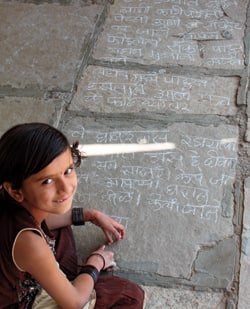
| GROUND ZERO: Pratham volunteers teach children to read and write |
The people
The core team of Pratham is a mix of people from all walks of life including academicians, MBAs, CAs, civil servants, bankers, corporate professionals and consultants. “Prior to 1998, there was no provision in India to help children, who were lagging behind owing to social and economic situations. One of the biggest achievements of Pratham has been of initiating efforts in this direction,” says, Dr Chavan, who is the Founder and CEO of Pratham.
They constantly work towards ensuring that enrollment in schools increases, learning in schools and communities increases, the education net reaches children who are unable to attend school and their models are replicated and scaled up to serve large numbers of children to achieve a large-scale impact.
Read India
Pratham’s flagship programme, Read India, helps to improve the reading, writing and basic arithmetic skills of children in the age group of 6-14 years. It was launched in 2004 and by 2008-09, the campaign reached 33 million children across 19 States. It covered 305,000 out of the 600,000 villages in India and mobilised 450,000 volunteers. Over 600,000 teachers/officials/government workers have been trained. In most States, out of the children who were a part of the intervention, the proportion of those not able to read alphabets is down to zero. Likewise, the proportion of children able to read simple sentences is up by almost 20 percent.
Urban Learning Centres
Pratham establishes Learning Centres in communities where it is possible to find a space to start one as well as get children who can pay a nominal fee. These learning centres are a one or two-room structure on a rental basis, where classes run from morning to evening at regular hours. In communities where there is a lack of space, satellite centres (space available for conducting 1 or 2 classes of 2 to 3 hours each) are set up. These centres provide classes for the Pre-Primary children, learning support to students from Standard I to VII, classes for Standard 10 children who are dropouts and help them to appear for exams and English classes for children as well as adults. The classes are conducted by teachers who are trained by Pratham Master Trainers.
 |
| “Our biggest achiement is the creation of a provision for assisting young childern” DR MADHAV CHAVAN, Founder & CEO, PRATHAM |
The Annual Status of Education Report (ASER)
The Annual Status of Education Report (‘ASER’ means ‘impact’ in Hindi), brought out by Pratham, is the largest household survey undertaken in India by people outside the government. It annually measures the enrolment and the reading and arithmetic levels of children in the 6-14 age group. In order to take such a detailed report, Pratham involves local organisation or institution in each rural district. ASER has become an important input in the educational policies of both the Central and State governments. In 2008, ASER reached over 704,000 children in 16,198 villages in 564 rural districts in India. More than 32,000 volunteers from NGOs, colleges and universities and youth groups participated in this.
Computer-aided literacy and vocational skills programme
Computer-aided literacy programme caters to school-going children from 6-18 age group and imparts basic learning levels using IT and relevant IT knowledge and skills. Pace, the Skills Training programme, is targeted at the economically disadvantaged youth in the 18-30 year age group. It tries to train youth in market-relevant skills such as banking, agriculture, hospitality and help them start their own businesses.
Till date more than 7000 youth have been trained. Pratham has partnered with Larsen & Turbo to provide training in the construction industry; with Taj Hotels to provide training in the hospitality industry; with Godrej Agrovet to provide training in Agriculture; with Deutsche Bank to provide training in Banking and Financial Services and is about to start a partnership with Landmark Group to provide Retail Training.
Conclusion
Pratham’s mission is to ensure “Every Child in School and Learning Well”, based on the firm belief that education is the fundamental right of every child and that no one should be deprived of this basic right for any reason. They are guided by the belief that solutions to fill the gaps in the education system should be available even in the remotest part of the country, from the toughest terrains to violence-affected regions. These models should be low-cost so that they can be implemented anywhere and scaled up to achieve large-scale impact. After almost 18 years of existence, Pratham has become a pan-Indian movement reaching millions of children.
Website: http://www.pratham.org/
