


Area - Definition, Area of Shapes Formula
Area is one of the most fundamental concepts in geometry that measures the amount of space occupied by a two-dimensional shape or surface. Whether it is finding the floor space of a room, the size of a playground, or the surface covered by a piece of land, area calculations are used extensively in daily life. Understanding area helps students solve problems related to squares, rectangles, triangles, circles, polygons, and other geometric figures. This topic is frequently covered in school mathematics, mensuration, SSC, Banking, CUET, CAT, Railways, Defence, and other competitive examinations. In this article, we will explore the definition of area, area formulas for different shapes, properties, solved examples, and practical applications.
This Story also Contains
- What is Area?
- Units of Area
- Area Formula for Different Shapes
- Area of Common Geometric Shapes
- How to Calculate Area?
- Properties of Area
- Applications of Area
- Area Formula Chart
- Best Books for Area and Mensuration
- Shortcut Tips and Tricks for Area Questions
- Important Area Formula Table
- Solved examples based on Areas
- List of Topics Related to Area
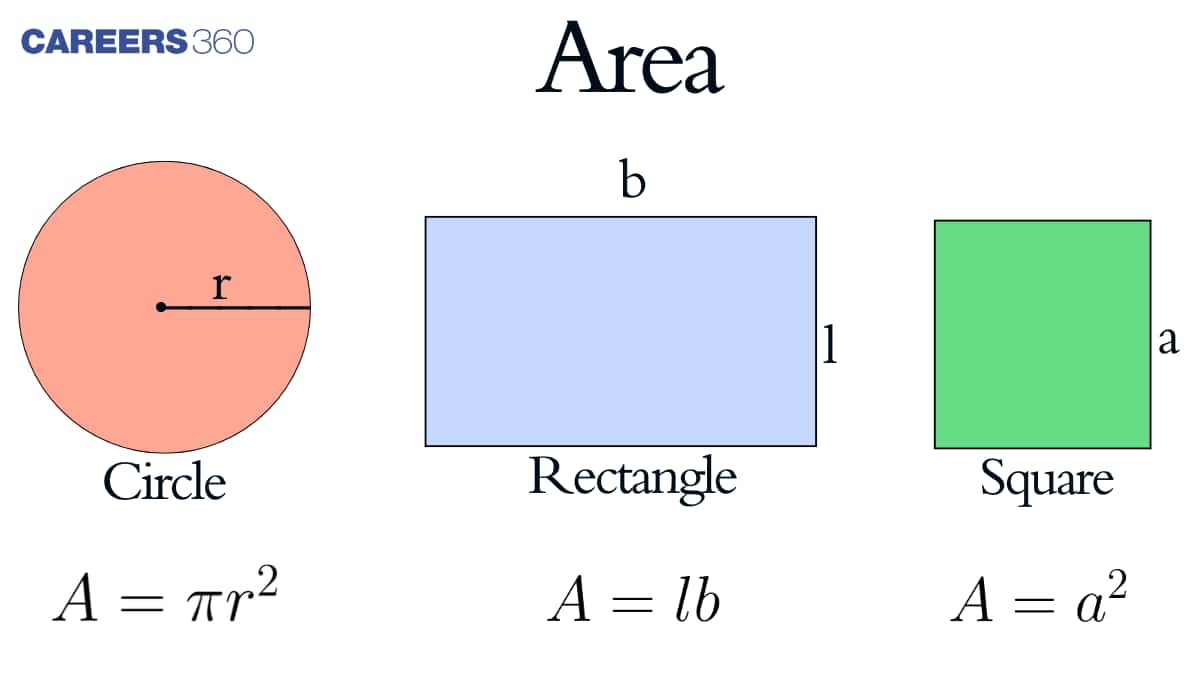
What is Area?
Area is one of the most important concepts in geometry and mensuration. It measures the amount of surface occupied by a two-dimensional shape or figure. Whether calculating the size of a room, a piece of land, a playground, or a geometric figure, area helps determine the space enclosed within its boundaries. Understanding area formulas is essential for school mathematics, competitive exams, engineering, architecture, and everyday measurements.
Area Meaning in Simple Words
In simple words, area is the amount of space covered by a flat shape or surface.
For example:
- The floor of a room has an area.
- A garden occupies a certain area.
- A sheet of paper covers a specific area.
The larger the surface covered by a shape, the greater its area.
Definition of Area
Area is defined as the measure of the region enclosed by the boundary of a two-dimensional figure.
It is expressed in square units because both length and width are involved in the measurement.
For example:
- Area of a square of side 5 units is $5\times5=25$ square units.
- Area of a rectangle of length 8 units and width 4 units is $8\times4=32$ square units.
Why Area is Important in Mathematics
Area is a fundamental concept that connects geometry, mensuration, algebra, and real-world measurements.
Importance of Area
- Helps measure surfaces and regions.
- Used in geometry and mensuration calculations.
- Essential for architecture and construction.
- Useful in land surveying and agriculture.
- Helps compare sizes of different shapes.
- Frequently appears in school and competitive examinations.
- Forms the basis for advanced topics in mathematics and engineering.
Real-Life Examples of Area
Area calculations are used in many practical situations.
| Situation | Use of Area |
|---|---|
| Flooring a room | Calculating floor space |
| Painting a wall | Finding paint coverage |
| Buying land | Measuring plot size |
| Designing gardens | Planning layouts |
| Construction projects | Material estimation |
Examples
- A room measuring 6 m by 5 m has an area of $30 m^2$.
- A rectangular field measuring 100 m by 50 m has an area of $5000 m^2$.
- A circular garden of radius 7 m has an area of $154 m^2$ approximately.
Units of Area
Since area measures a two-dimensional region, its units are expressed as square units.
Standard Units of Area
The standard unit of area in the International System of Units (SI) is the square metre.
Common units include:
- Square millimetre ($mm^2$)
- Square centimetre ($cm^2$)
- Square metre ($m^2$)
- Square kilometre ($km^2$)
Square Units Explained
Area involves multiplying two dimensions.
For example:
If a square has side length 4 cm,
Area $=4\times4=16 cm^2$
The notation $cm^2$ means 16 squares, each measuring 1 cm by 1 cm.
Metric Units of Area
| Unit | Symbol |
|---|---|
| Square Millimetre | $mm^2$ |
| Square Centimetre | $cm^2$ |
| Square Metre | $m^2$ |
| Square Kilometre | $km^2$ |
| Hectare | ha |
| Acre | acre |
Conversion of Area Units
| Conversion | Value |
|---|---|
| $1 m^2$ | $10,000 cm^2$ |
| $1 cm^2$ | $100 mm^2$ |
| $1 km^2$ | $1,000,000 m^2$ |
| 1 hectare | $10,000 m^2$ |
| 1 acre | Approximately $4047 m^2$ |
Area Formula for Different Shapes
Different geometric shapes have different area formulas based on their dimensions.
Area of a Square
A square has four equal sides.
Formula:
$A=s^2$
where $s$ is the side length.
Example
If side = 8 cm,
Area $=8^2=64 cm^2$
Area of a Triangle
The area of a triangle depends on its base and height.
Formula:
$A=\frac{1}{2}bh$
Example
If base = 12 cm and height = 8 cm,
Area $=\frac{1}{2}\times12\times8=48 cm^2$
Area of an Equilateral Triangle
From our previous knowledge we know that it is a triangle in which all the sides are equal. The perpendicular line that is drawn from the vertex of the triangle to the base divides the base into two equal parts as usual. Formula for area of equilateral triangle :
$A= \frac{(\sqrt{3})}{4} \times$ side $^2$

Area of an Isosceles Triangle
This type of triangle has two sides equal and the angles opposite to the equal sides are also equal. Formula for area of isosceles triangle used:
$A=\frac{1}{2} \times$ base $\times$ height
Rectangle
A rectangle is a four sided shape where opposite sides are equal and the diagonals are equal. The vertices of the rectangle makes $90^\circ$ with each other.
Area of a Rectangle
A rectangle has opposite sides equal.
Formula:
$A=l\times b$
where:
- $l$ = length
- $b$ = breadth
Example
If length = 10 cm and breadth = 6 cm,
Area $=10\times6=60 cm^2$

Area of a Rectangle Formula
Area $=$ Length $\times$ Breadth
$\mathrm{A}=\mathrm{lb}$
How to Calculate the Area of Rectangle
We follow the below steps to find the area of rectangle:
Step 1: We write dimensions of length, width as given in the question to us.
Step 2: Next, we multiply length, width values.
Step 3: At last, we write answer in square units along with the calculated numeric value of area.
Circle
A circle is a round shape with no corners or edges.
Area of Circle

It is the space covered by the circle in an x-y plane. Or the other way around, the space occupied within the boundary/circumference of a circle.
Area of Circle Formula
We can find the area of circle once we know the diameter from which we find radius.
We use the following formulas:
- Area of circle $=\pi \times \mathrm{r}^2$, (r=radius)
- Area of circle in terms of diameter $=(\frac{\pi}{ 4}) \times \mathrm{d}^2, (\mathrm{~d}=$ diameter $)$
- Area of circle in terms of circumference $=\frac{C^2 }{4} \pi$, (C=circumference $)$
Square
A square is a four sided shape where all the sides are equal and the diagonals are equal. The vertices of the square makes $90^\circ$ with each other.
Area of Square
Generally, area of square is stated as the number of square units required to fill the shape. In other words, the area of a square is the region within its boundary. It can also be calculated with the help of other dimensions, for example the diagonal and the perimeter of the square.

Area of Square Formula
For finding area of square, we multiply the length of its two sides, which are always equal in measurement and so the unit of the area is given in square units.
Area of square $=$ Side $\times$ Side $=\mathrm{S}^2$
Area of square using diagonals $= \frac{Diagonal ^2}{ 2}$.
Trapezium
A trapezium is a four sided shape with two parallel sides and two non parallel sides.
Area of Trapezium
We know from previous knowledge that a trapezium is a quadrilateral, which is defined as a shape with four sides and one set of parallel sides. Area of a trapezium depends upon the length of parallel sides and height of the trapezium. It is measured in square units.

Area of Trapezium Formula
Formula used to find the area of trapezium:
Area $=(\frac{1}{2}) h(a+b)$
where,
- a and b are the length of parallel sides/bases of the trapezium
- h is the height or distance between parallel sides.
How to Calculate Area of Trapezium?
We take help from below mentioned steps to find area of trapezium:
- Step 1: First, we find the dimensions trapezium, that is., length of parallel sides and height.
- Step 2: Next we add the length of parallel sides.
- Step 3: Now we multiply the sum of parallel sides with the height of trapezium.
- Step 4: At last, we multiply the above value by $\frac{1}{2}$ to get the final result .
Parallelogram
A parallelogram is a four sided shape with parallel and equal opposite sides.
Area of Parallelogram
Area of parallelogram is the region covered by the parallelogram in a x-y plane. If we try to recall, a parallelogram is a special type of quadrilateral that has the pair of opposite sides as parallel. The opposite sides are always of equal length and opposite angles are of equal measures.

Area of Parallelogram Formula
To find the area of parallelogram, we simply multiply the base of the perpendicular by its height. These both quantities are always perpendicular to each other, whereas the lateral side of the parallelogram is not perpendicular to the base.
Hence,
Area $=\mathrm{b} \times \mathrm{h}$ Square units(b=base, h=height)
How to Calculate the Area of Parallelogram?
We calculate area of parallelogram by using its base and height. It can also be calculated if its two diagonals are known along with any of their intersecting angles or if the length of the parallel sides is known, along with any of the angles between the sides.
Area of Parallelogram Using Sides
Let us suppose p and q are the set of parallel sides of a parallelogram and h is the height, then based on the length of sides and height of it, formula for the area is :
Area $=$ Base $\times$ Height
$\mathrm{A}=\mathrm{p} \times \mathrm{h} \quad$ [sq.unit]
Area of Parallelogram Without Height
If the height of the parallelogram is unknown to us, then we use the concepts of trigonometry to achieve our aim.
Formula used :
Area $=a b \sin (x)$
Where a , b are the length of adjacent sides of the parallelogram and x is the angle between them.
Area of Parallelogram Using Diagonals
It can also be calculated using its diagonal lengths. There are two diagonals for a parallelogram, which always intersect each other. Suppose the diagonals intersect each other at an angle p, then the area of the parallelogram is given by:
Area $=\frac{1}{2} \times d_1 \times d_2 \sin (p)$
Rhombus
A rhombus is a four sided shape with parallel and equal sides.
Area of Rhombus
Area of Rhombus is defined as the amount of space covered by a rhombus in a two-dimensional space.It has four sides that are equal in length and are always congruent. It is also a type of a quadrilateral.
How to Calculate Area of Rhombus?

There exist three methods to find the area of a rhombus:
- Method 1: By using Diagonals
- Method 2: With the help of Base and Height
- Method 3: By using Trigonometry (using side and angle)
Area of Rhombus Using Diagonals: Method 1
We consider a rhombus ABCD, that has two diagonals, AC & BD.
Step 1: First we find the length of diagonal $1, d_1$. It is the distance between $A$ and $C$. The diagonals of a rhombus are perpendicular to each other.
Step 2: Next , we find the length of diagonal 2, $d_2$, the distance between $B$ and $D$.
Step 3: Then, we multiply both the diagonals, $d_1$, and $d_2$.
Step 4: Finally we divide the result by 2 and get answer.
Area of Rhombus Using Base and Height: Method 2
Step 1: We start by finding the base and height of the rhombus. The base of the rhombus is one of its sides, and the height is the altitude which is perpendicular distance from the chosen base to the opposite side.
Step 2: Then we multiply the base and the calculated height to get result.
Area of Rhombus Using Trigonometry: Method 3
We use this way when the side and one of its internal angles are given.
- Step 1: We square the length of any of the sides.
- Step 2: Next, we multiply it by Sine of one of the angles.
Cylinder
A cylinder is simply a three-dimensional structure having circular bases which are parallel to each other. It does not possess any vertices. It has 2 main values involved which are radius and its height.

Area of Cylinder
Area of cylinder is defined as the sum of the curved surface and the area of two circular bases.
The Surface Area of Cylinder = Curved Surface + Area of Circular bases
S.A. (in terms of $\pi)=2 \pi r(h+r)$ sq.unit
$\pi(\mathrm{Pi})=3.142$ or $=\frac{22}{7}$
$r=$ Radius
h = Height
Area of a Cylinder Formula
Surface Area of Cylinder: Surface area of cylinder is defined as the area of the curved surface of any cylinder having a base radius ‘r’, and height ‘h’, generally known as Lateral Surface Area (LSA). Formula for surface area of cylinder:
CSA or LSA $=2 \pi \times r \times h$ Square units
Base Area of Cylinder: It is a circular shape. Area of the circular bases of cylinder = $=2\left(\pi r^2\right)$
Total Surface Area of Cylinder: It is equal to the sum of the areas of all its faces. The total surface area with radius ‘r’, and height ‘h’ is equal to the sum of the curved area and circular areas of the cylinder.
TSA $=2 \pi \times r \times h+2 \pi r^2=2 \pi r(h+r)$ Square units
Sphere
It is a solid curved surface in such a way that every point on the surface is the same distance from the centre. We can say that it is a 3D representation of a circle and cover areas in all x,y,z planes in geometry. We can find it in various forms around us like celestial bodies, football, basketball, etc.
Area of Sphere
Area of Sphere is the region covered by a surface of a spherical object in a three-dimensional space. As we have discussed earlier, if we try to spin a circle around a fixed axis and visualize this in our mind, we will find that we obtain the figure of a sphere.
How to Find Area of Sphere?
Now to find the area of the sphere, we follow the steps:
- First we find the radius of the sphere.
- Then we mention the value of radius in the surface area formula, i.e. ($4πr^2$).
- After this we solve the expression and evaluate the final value.
Surface Area of Sphere
Surface area of sphere is the area occupied by the curved surface of the sphere. Circular shapes take the shape of a sphere when we observe them as three-dimensional structures. For example, a globe, cricket ball or a soccer ball.

Formula of Surface Area of Sphere
The formula for surface area of sphere just depends on the radius of the sphere.
Surface Area of Sphere $=4 \pi r^2 ; r=$ radius
In terms of diameter, $\mathrm{S}=4 \pi(\frac{\mathrm{d}}{2})^{2 }$, d=diameter
Cube
A cube is a 3 dimensional shape with equal sides. A cube is made up of 6 squares as their faces.
Surface Area of Cube
The definition of surface area of a cube states that if the total surface area is equal to the sum of all the areas of the faces of the cube. Since the cube has six faces, therefore, the total surface area of a cube will be equal to sum of all six faces of cube.

Surface Area of Cube Formula
Total Surface Area of Cube (TSA) Formula
TSA of the cube is obtained by multiplying the square of its side length by 6 . Thus, the formula becomes " $6 \mathrm{a}^2$ ".
Total Surface Area of a Cube $=\left(6 \times\right.$ side $\left.^2\right)$ square units
Lateral Surface Area of Cube (LSA) Formula
LSA of the cube is obtained by multiplying the square of its side length by 4 . Thus, the formula becomes " $4 \mathrm{a}^2$ ".
Lateral Surface Area of a Cube $=\left(4 \times\right.$ side $\left.^2\right)$ square units.
Area of Common Geometric Shapes
Area formulas vary depending on the nature and structure of the geometric figure.
Area of Two-Dimensional Shapes
Two-dimensional shapes have length and width but no thickness.
Examples include:
- Square
- Rectangle
- Triangle
- Circle
- Rhombus
- Trapezium
- Polygon
Area of Regular Shapes
Regular shapes have equal sides and equal angles.
Examples:
- Square
- Equilateral Triangle
- Regular Pentagon
- Regular Hexagon
Their area formulas are fixed and straightforward.
Area of Irregular Shapes
Irregular shapes do not have equal sides or angles.
Their area can be found by:
- Dividing into smaller regular shapes
- Using coordinate geometry
- Applying approximation methods
Comparison of Area Formulas
| Shape | Area Formula |
|---|---|
| Square | $s^2$ |
| Rectangle | $lb$ |
| Triangle | $\frac{1}{2}bh$ |
| Circle | $\pi r^2$ |
| Parallelogram | $bh$ |
| Rhombus | $\frac{1}{2}d_1d_2$ |
| Trapezium | $\frac{1}{2}(a+b)h$ |
| Kite | $\frac{1}{2}d_1d_2$ |
How to Calculate Area?
Finding area involves identifying the shape and applying the appropriate formula.
Step-by-Step Method
Step 1
Identify the geometric shape.
Step 2
Measure the required dimensions.
Step 3
Select the appropriate area formula.
Step 4
Substitute the values into the formula.
Step 5
Simplify and write the answer in square units.
Choosing the Correct Formula
Always identify the shape before selecting a formula.
For example:
- Square → $s^2$
- Rectangle → $lb$
- Triangle → $\frac{1}{2}bh$
- Circle → $\pi r^2$
Solved Examples
Example 1
Find the area of a square of side 9 cm.
Area $=9^2=81 cm^2$
Example 2
Find the area of a rectangle with length 15 cm and breadth 4 cm.
Area $=15\times4=60 cm^2$
Common Mistakes to Avoid
- Using perimeter formulas instead of area formulas.
- Forgetting square units.
- Using incorrect dimensions.
- Mixing units during calculations.
- Incorrect substitution of values.
Properties of Area
Area possesses several important mathematical properties.
Additive Property of Area
If a figure is divided into non-overlapping parts, the total area equals the sum of the areas of the individual parts.
Area of whole figure = Sum of areas of all parts.
Area and Dimensions Relationship
Area depends on two dimensions.
If a length doubles while the width remains unchanged, the area doubles.
Area vs Perimeter
| Area | Perimeter |
|---|---|
| Measures surface covered | Measures boundary length |
| Measured in square units | Measured in linear units |
| Two-dimensional concept | One-dimensional concept |
Conservation of Area
When a shape is cut and rearranged without stretching or overlapping, its area remains unchanged.
This principle is widely used in geometry proofs and mensuration.
Applications of Area
Area calculations are widely used across mathematics, science, engineering, and everyday life.
Applications in Geometry
Area helps compare shapes, solve geometric problems, and derive mathematical formulas.
Applications in Architecture
Architects use area calculations while designing:
- Buildings
- Rooms
- Parks
- Floor plans
Applications in Engineering
Engineers calculate areas for:
- Structural designs
- Material estimation
- Surface analysis
Applications in Daily Life
Common applications include:
- Flooring
- Painting
- Gardening
- Land measurement
- Construction planning
Area Formula Chart
The following area chart provides a quick revision guide for commonly used geometry formulas.
Quick Area Formula Table
| Shape | Formula |
|---|---|
| Square | $s^2$ |
| Rectangle | $lb$ |
| Triangle | $\frac{1}{2}bh$ |
| Circle | $\pi r^2$ |
| Parallelogram | $bh$ |
| Rhombus | $\frac{1}{2}d_1d_2$ |
| Trapezium | $\frac{1}{2}(a+b)h$ |
| Kite | $\frac{1}{2}d_1d_2$ |
Shape-Wise Area Formulas
| Shape | Dimensions Required |
|---|---|
| Square | Side |
| Rectangle | Length, Breadth |
| Triangle | Base, Height |
| Circle | Radius |
| Rhombus | Diagonals |
| Trapezium | Parallel Sides, Height |
Area Conversion Chart
| From | To |
|---|---|
| $1 m^2$ | $10,000 cm^2$ |
| $1 cm^2$ | $100 mm^2$ |
| $1 km^2$ | $1,000,000 m^2$ |
| 1 hectare | $10,000 m^2$ |
| 1 acre | Approximately $4047 m^2$ |
Best Books for Area and Mensuration
A strong understanding of area formulas and mensuration concepts is essential for solving geometry and quantitative aptitude questions. The following books provide comprehensive theory, formulas, and practice problems.
| Book Name | Best For | Why It Helps |
|---|---|---|
| Quantitative Aptitude for Competitive Examinations R.S. Aggarwal | SSC, Banking, Railways | Covers mensuration and area formulas extensively |
| NCERT Mathematics Textbooks | School Students | Strong conceptual foundation |
| Mathematics for Class 9 & 10 R.D. Sharma | Board Exams | Detailed explanations with examples |
| Objective Mathematics Arihant Publications | Competitive Exams | Topic-wise geometry and mensuration questions |
| Fast Track Objective Arithmetic Rajesh Verma | Aptitude Preparation | Shortcut methods for mensuration problems |
Shortcut Tips and Tricks for Area Questions
Learning a few important shortcuts can help solve area-based questions faster and reduce calculation errors in examinations.
| Trick | Explanation |
|---|---|
| Square Area Shortcut | Area = side × side |
| Rectangle Area Shortcut | Area = length × breadth |
| Triangle Area Shortcut | Area = $\frac{1}{2} \times$ base $\times$ height |
| Circle Area Shortcut | Area = $\pi r^2$ |
| Parallelogram Shortcut | Area = base × height |
| Rhombus Shortcut | Area = $\frac{1}{2}d_1d_2$ |
| Trapezium Shortcut | Area = $\frac{1}{2}(a+b)h$ |
| Always use square units | Write answers in $cm^2$, $m^2$, etc. |
Important Area Formula Table
This formula table provides a quick revision guide for the most commonly used area formulas in geometry and mensuration.
| Shape | Area Formula |
|---|---|
| Square | $s^2$ |
| Rectangle | $lb$ |
| Triangle | $\frac{1}{2}bh$ |
| Circle | $\pi r^2$ |
| Parallelogram | $bh$ |
| Rhombus | $\frac{1}{2}d_1d_2$ |
| Trapezium | $\frac{1}{2}(a+b)h$ |
| Kite | $\frac{1}{2}d_1d_2$ |
| Regular Polygon | $\frac{1}{2}\times\text{Perimeter}\times\text{Apothem}$ |
Solved examples based on Areas
Example 1: Find the area of a square with a side of 2 cm.
Solution:
Area of a square $=$ side $\times$ side
Given, side $= 2\ \mathrm{cm}$
Substituting the value in the formula:
Area $= 2 \times 2$
Area $= 4\ \mathrm{cm}^2$
Hence, the area of the square is $4\ \mathrm{cm}^2$.
Example 2: The dimensions of a rectangle are 10 cm and 8 cm. Find the area of the rectangle.
Solution:
The area of a rectangle is given by:
Area $=$ length $\times$ width
Given,
Length $= 10\ \mathrm{cm}$
Width $= 8\ \mathrm{cm}$
Substituting the values:
Area $= 10 \times 8$
Area $= 80\ \mathrm{cm}^2$
Hence, the area of the rectangle is $80\ \mathrm{cm}^2$.
Example 3: Can you find the area of a circle with a radius of 6 cm?
Solution:
Given,
Radius $= 6\ \mathrm{cm}$
Area of a circle $= \pi r^2$
Substituting the values:
Area $= \frac{22}{7} \times 6 \times 6$
Area $= \frac{792}{7}$
Area $= 113.14\ \mathrm{cm}^2$ (approximately)
Hence, the area of the circle is $113.14\ \mathrm{cm}^2$.
Example 4: The length of a rectangular field is 11 m and its width is 5 m. Find the area of the rectangular field.
Solution:
Given,
Length $= 11\ \mathrm{m}$
Width $= 5\ \mathrm{m}$
Area of a rectangle $=$ length $\times$ width
Substituting the values:
Area $= 11 \times 5$
Area $= 55\ \mathrm{m}^2$
Hence, the area of the rectangular field is $55\ \mathrm{m}^2$.
Example 5: Find the area of a triangle with base $b = 2\ \mathrm{cm}$ and height $h = 4\ \mathrm{cm}$.
Solution:
Area of a triangle $= \frac{1}{2} \times b \times h$
Given,
$b = 2\ \mathrm{cm}$
$h = 4\ \mathrm{cm}$
Substituting the values:
Area $= \frac{1}{2} \times 2 \times 4$
Area $= 4\ \mathrm{cm}^2$
Hence, the area of the triangle is $4\ \mathrm{cm}^2$.
List of Topics Related to Area
Understanding area becomes easier when you explore related geometry and mensuration concepts that build a strong mathematical foundation. The following topics cover important formulas, properties, and problem-solving techniques frequently used in school mathematics and competitive examinations.
Frequently Asked Questions (FAQs)
Area of a shape is a 2-D quantity that is measured in square units like square inches or $\left(\right.$ in $\left.^2\right)$, etc.
The area of irregular shapes can be found by dividing the shape into unit squares. We can also approximate and find its value.
If a circle is folded into a triangle, the radius becomes the height of the triangle and the perimeter becomes its base which is $2 \times \pi \times r$. We know that the area of the triangle is found by multiplying its base and height and then dividing by 2 , which is: $\frac{1}{2} \times 2 \times \pi \times r \times r$. Therefore, the area of the circle is $\pi r^2$.
The total length of the boundary of a closed shape is called its perimeter. The perimeter of the triangle is the sum of three sides of the triangle.
The formulas for the area and perimeter of a square and a rectangle are as follows. Area of a square $=$ side $\times$ side. The perimeter of a square $=4 \times$ side. Area of a rectangle $=$ length $\times$ breadth. Perimeter of a rectangle $=2 \times$ (length + width )
Questions related to
On Question asked by student community
Hello Student, aapne college ke campus, laboratories, Wi-Fi, classrooms, hostel, sports facilities aur parking ke baare mein feedback diya hai, lekin statement incomplete hai. Agar aap chahte hain ki main ise proper college review ya student feedback ke format mein rewrite karun, to remaining text/question share kar dein.
Hello Student, please poora question ya college ka naam share karein.
SRM Institute of Science and Technology, Delhi-NCR Campus (Ghaziabad) has several student-friendly spaces where students can relax, meet friends and spend time between classes.
Commonly preferred spots can include:
Sitting areas around the basketball court
Cafeteria areas such as Café Di Leta
Canteen and food areas
Open sitting spaces in
Please provide the name of the college you are referring to. I can then tell you the city, locality/common area and nearby well-known landmarks so that you can easily identify the location.
Hello, if you want to build a career in research, all three fields can be good options. Microbiology is suitable if you are interested in microorganisms, diseases and laboratory work. Genetics is a good choice if you are interested in DNA, genes and genetic research. Epidemiology is suitable if you