KCC Institute of Legal and Higher Education, Greater Noida
Law Admissions 2026 Open | Avail Merit-Based Scholarships


Archaebacteria definition in biology refers to the ancient prokaryotic microorganism found in extreme environments such as hot springs, salt lakes and deep-sea vents. The word Archeabacteria is formed from two roots - “Archea” meaning primitive and “Bacteria” referring to microscopic single-celled prokaryotic organisms. The term archaea was introduced in the 1970s when scientists discovered that these microorganisms were very different from true bacteria.
This Story also Contains
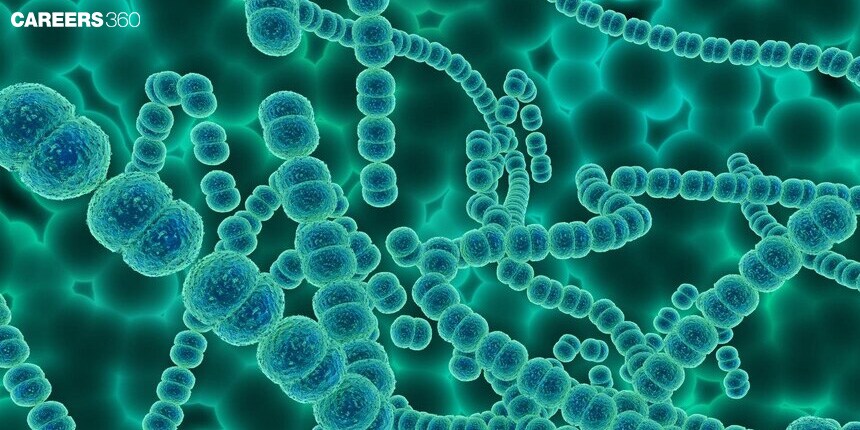
There are different types of archaebacteria, each adapted to specific habitats. It includes methanogens, halophiles, thermophiles, and acidophiles. Archaebacteria are a unique group of microorganisms in the Biological Classification that are different from bacteria and eukaryotes. Examples of archaebacteria such as Methanobrevibacter smithii and Halobacterium salinarum show their ecological diversity. The importance of archaebacteria is their role in nutrient cycling, biotechnology, and evolutionary studies.
Archaebacteria form a domain of single-celled microorganisms that have emerged and developed differently from bacteria and eukaryotes. Due to the peculiarity of cell-membrane lipids and unique genetic sequences not found anywhere else in any form of life, these microbes can dwell and survive under conditions that are mostly unbearable to all other forms of life. This means that they exist in particular extreme environments like hot springs, salt lakes, and deep-sea hydrothermal vents.
Law Admissions 2026 Open | Avail Merit-Based Scholarships
BBA/MBA/PGDM Early Bird Applications Deadline 19th Oct '26. Apply now using coupon code CAREER250 and get ₹250 off the application fee
Archaebacteria were discovered through the work of Carl Woese and George Fox on the ribosomal RNA in the 1970s. They indicated that these microbes were of importance not only in biogeochemical cycles but also in biotechnology applications. Their unique metabolic pathways and consequently their resilience have now become a focus in research in terms of both their importance in evolutionary biology as well as industrial processes.
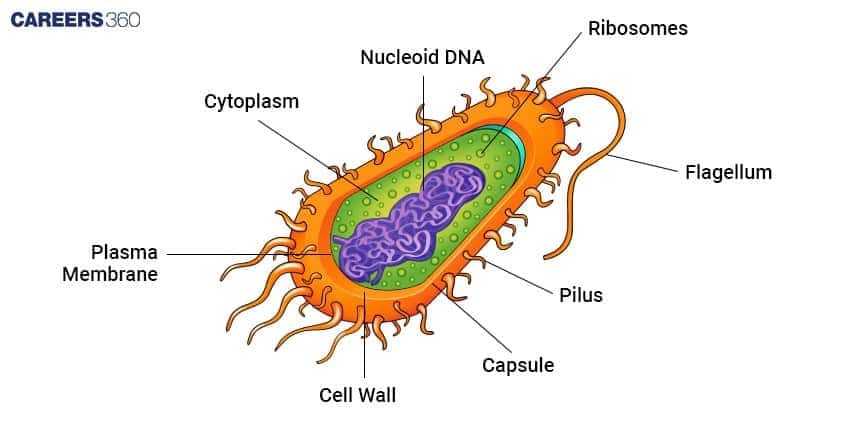
The characteristics of archaebacteria highlight their unique cell structure, genetic material, and metabolic pathways. These features allow them to survive in extreme environments where most organisms cannot live.
Absence of peptidoglycan is found in bacterial cell walls.
It contains unique polysaccharides and proteins.
Ether-linked lipids rather than ester-linked as in bacteria and eukaryotes.
However, sometimes branched isoprenoid chains also form monolayers and provide stability under extreme conditions.
It has circular DNA like bacteria but with unique sequences.
Histone-like proteins associated with DNA.
Its RNA polymerase and ribosomes are more similar to eukaryotic than to bacterial RNA polymerase and ribosomes.
Use of unique enzymes and cofactors.
Capable of methanogenesis, a process not found in bacteria or eukaryotes.
Ability to metabolise a variety of compounds, including sulfur and ammonia.
The diagram below shows the cell of archaebacteria and its components.
Archaebacteria are classified into distinct groups based on their genetic sequences, habitats, and metabolic adaptations. The archaebacteria classification highlights their diversity in extreme environments such as hot springs, salt lakes, and deep‑sea vents. These organisms are classified into the following types:
Methanogens: These microbes generate methane as a metabolic byproduct under anoxic conditions.
Halophiles: can survive in high-salt, salt-laden antibiotic-resistant organisms as in the case of salt lakes.
Thermophiles: Live in extremely hot environments like hydrothermal vents.
Hyperthermophiles: Optimum growth at extremely high temperatures; usually above 80°C.
Acidophiles: Survive highly acidic environments, for instance in sulfuric springs.
Established in a variety of environments, both in the sea and in soils.
Mesophiles: Its natural habitat should be at a middle range of temperature, unlike several other archaea.
Ammonia-oxidising: Its role is to oxidise ammonia to nitrite in the nitrogen cycle.
These are widespread in marine and soil environments.
Very tiny archaea that exist in symbiosis with other archaea.
Known from hydrothermal vent areas.
Example-Nanoarchaeum equitans was attached to the host Ignicoccus.
Known from DNA sequences found in high-temperature environments.
It is considered to represent an ancient lineage of archaea.
Rarely occur as isolates; very little information is available concerning aspects of their biology.
Archaebacteria differ from bacteria in their cell wall, membrane lipids, genetics, and habitats. Archaebacteria thrive in extreme environments (hot springs, salt lakes, acidic soils), while bacteria are found everywhere from soil to the human body.
Feature | Archaebacteria | Bacteria |
Cell Wall | Pseudopeptidoglycan (no peptidoglycan) | Peptidoglycan present |
Membrane Lipids | Ether‑linked | Ester‑linked |
Habitat | Extreme environments (hot springs, salt lakes, acidic soils) | Found everywhere (soil, water, plants, humans) |
Genetics | Introns present, multiple RNA polymerases | No introns, single RNA polymerase |
Pathogenicity | Non‑pathogenic (no known diseases) | Many pathogenic species |
Examples | Methanobrevibacter, Halobacterium, Sulfolobus | E. coli, Streptococcus, Lactobacillus |
Archaebacteria are classified into different types based on their habitat and metabolic adaptations. The archaebacteria types highlight their ability to survive in extreme conditions where most organisms cannot live. The various types of archaebacteria are-
These are archaebacteria found in marshy areas.
These uses of archaebacteria include decomposition of carbon dioxide and formic acid into methane.
E.g. Methanobacterium, Methanococcus etc.
These archaebacteria are found in salty areas.
They can live in high salt conditions because of the presence of special lipids in their membranes, the presence of mucilage covering, the absence of sap vacuole and high internal salt content.
E.g. Halobacterium, Halococcus.
These archaebacteria can tolerate high temperatures and high acid conditions.
Thermoacidophiles contain enzymes that can operate at high temperatures.
E.g. Thermoplasma, Thermoproteus.
Archaebacteria mainly use asexual means to reproduce. The most common means is that of binary fission, in which one cell simply divides into two identical daughter cells. Some archaebacteria will reproduce via budding, growing a new organism attached to but off the body of the parent, or by fragmentation, where the parent simply breaks apart into pieces with each piece, or fragment thereof, able to grow into a new organism. Because their means to reproduce are so effective, archaebacteria can colonise extreme environments quickly.
Several environmental factors act as the main determinants of archaebacteria's growth. They thrive in a range of temperatures from hyperthermophiles that live in extremely hot habitats to psychrophiles that dwell in cold. pH is another key aspect of their optimum growth and survival. Acidophiles are found in highly acidic habitats, while alkaliphiles thrive in totally basic ones. Finally, salinity acts as an equally important determinant for halophiles, who require high salt concentrations. The most striking fact about the growth conditions of archaebacteria is their versatility and adaptability.
Archaebacteria have an application in either ecosystems or biotechnology.
Ecologically, they are key players in biogeochemical cycles, such as the carbon cycle and nitrogen cycle, in which they act as mediators to produce methane and oxidise ammonia. They also form symbiosis with a wide array of organisms that increase nutrient exchange and environmental adaptability.
Biotechnologically, they have great use in providing methods of producing industrial enzymes that could work under extreme conditions. They can be used to produce biofuels through the production of methane, and in bioremediation, they can clean pollutants in hostile environments.
Frequently Asked Questions (FAQs)
Archaebacteria are ancient prokaryotes that thrive in extreme environments and differ from bacteria in cell wall and genetic makeup.
They survive in extreme conditions, have unique lipids, pseudomurein cell walls, and reproduce asexually.
Methanogens, halophiles, thermophiles, acidophiles, and other groups like Crenarchaeota.
Examples include Methanobrevibacter smithii, Halobacterium salinarum, and Sulfolobus acidocaldarius.
They play roles in ecology, biotechnology, and evolutionary studies.


Law Admissions 2026 Open | Avail Merit-Based Scholarships
BBA/MBA/PGDM Early Bird Applications Deadline 19th Oct '26. Apply now using coupon code CAREER250 and get ₹250 off the application fee
Ranked #36 amongst institutions in Management by NIRF | 100% Placement
Globally Recognized by AACSB (US) & AMBA (UK) | 18 LPA Avg. CTC for PGPM 2026
Leading Design College | 95% Placement Record | Merit-cum-Means Scholarships for Deserving Students
NEET PG All India & State College Predictor with Admission Process Guide