KCC Institute of Legal and Higher Education, Greater Noida
Law Admissions 2026 Open | Avail Merit-Based Scholarships


Have you ever wondered how nitriles can be converted into aldehydes without affecting other functional groups? What reaction allows chemists to selectively reduce a nitrile to an aldehyde using mild conditions? The answer lies in the Stephen Reaction, an important named reaction in organic chemistry that is frequently asked in board exams, JEE, NEET, and other competitive examinations.
This Story also Contains
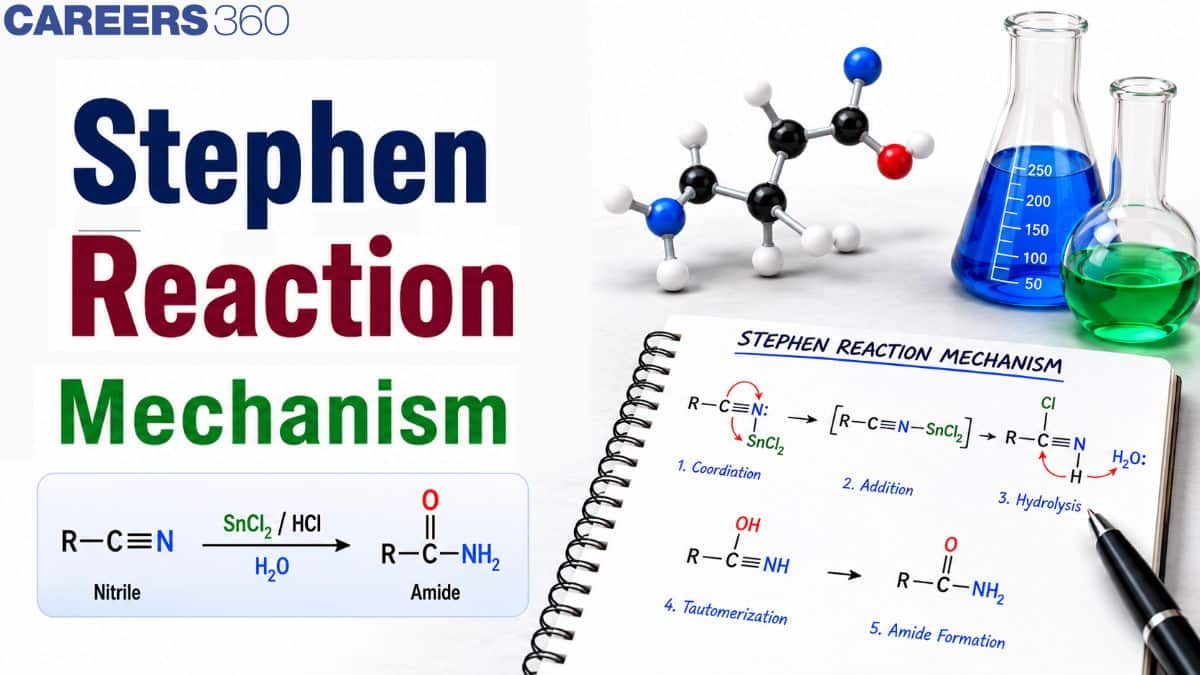
The Stephen Reaction, also known as the Stephen Aldehyde Synthesis, is a chemical reaction used to prepare aldehydes from nitriles. In this reaction, a nitrile (R-CN) is reduced using stannous chloride (SnCl₂) and hydrochloric acid (HCl) to form an iminium salt, which on hydrolysis yields the corresponding aldehyde (R-CHO).
$R-CN (\xrightarrow{\mathrm{SnCl_2/HCl}}) R-CH=NH·HCl
(\xrightarrow{\mathrm{H_2O}}) R-CHO + NH₄Cl$
Steps followed by the Stephen reaction mechanism:
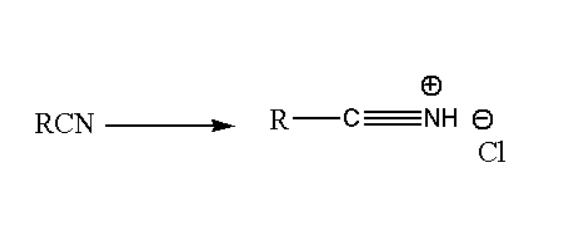
Step1. In the first step of Stephen reaction the gaseous hydrogen chloride is being added to the nitrile, which reacts to give its correlated salt as shown below in the reaction.
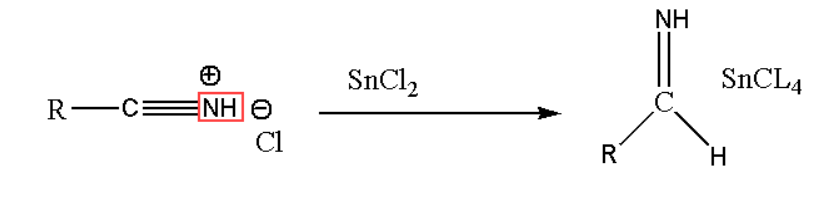
Step2. In the next second step of the Stephen reaction single electron transfer occur in Stannous(II) chloride to form its salt. The reaction is:
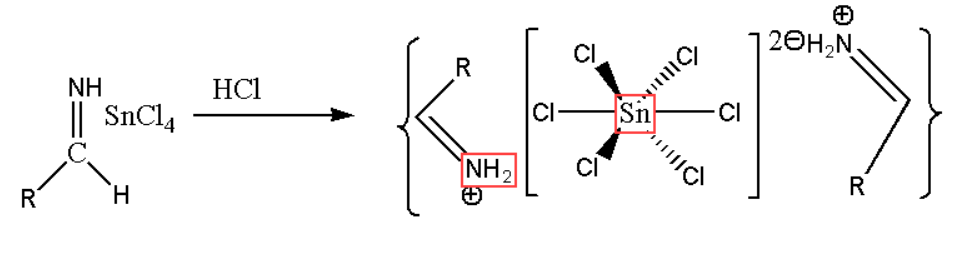
Step3. In the third step of Stephen reaction the obtained salt gets precipitates. The salt is aldimine tin chloride shown in the reaction.
Step4. In this step hydrolysis of the obtained salt is done which gives us amide. This end product is the r5equired aldehyde as shown below:
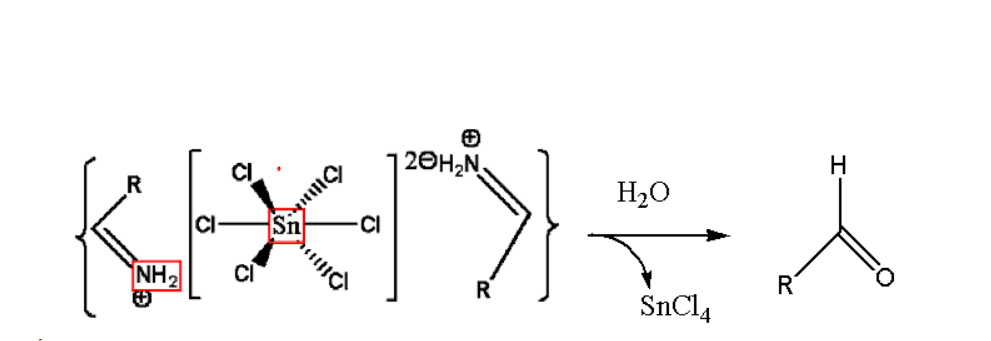
By the above steps we get the end product as aldehyde in Stephen reaction mechanism. One important key point is to note that instead of using aliphatic nitrile, aromatic nitrile is more efficient to be used. Substitutes that are added which improves the electron density also improves the formation of salt of tin chloride. Amide chloride formation can also be promoted by electron withdrawing substitutes.
Related Topics Link,
Law Admissions 2026 Open | Avail Merit-Based Scholarships
BBA/MBA/PGDM Early Bird Applications Deadline 19th Oct '26. Apply now using coupon code CAREER250 and get ₹250 off the application fee
An Imine is defined as a chemical compound that contains the atom of carbon and nitrogen with double bond. Imine is the functional group used in many reactions of organic chemistry. The Nitrogen atom of Imine can be attached to any organic group or with hydrogen easily. The term Imine first used in 1883 by German Chemist named Albert Ladenburg.
Imines will easily undergo to hydrolysis with their correlated compounds of amine or carbonyl. Imines may get precipitated when reacted under aldehydes and ketones. In the reaction mechanism of heterocycles imines are widely used as the intermediate product. Formation Imines ca be possible by the condensation of primary amines and aldehydes. Synthesis of Imines can be predicted as shown below.
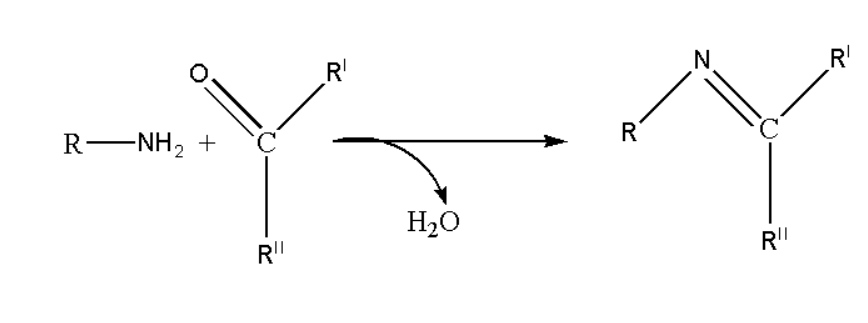
The important point is Iminium cation is functional group in which nitrogen has fourth bond, which gives iminium cation to positive charge.
Also Read:
Question 1: The product formed in the following reaction is:
$\mathrm{CH}_3 \mathrm{CH}_2 \mathrm{CN} \xrightarrow{\mathrm{SnCl}_2 / \mathrm{HCl}} X \xrightarrow{\mathrm{H}_2 \mathrm{O}} \text { ? }$
A. $\mathrm{CH}_3 \mathrm{CH}_2 \mathrm{CH}_2 \mathrm{NH}_2$
B. $\mathrm{CH}_3 \mathrm{CH}_2 \mathrm{CHO}$
C. $\mathrm{CH}_3 \mathrm{CH}_2 \mathrm{COOH}$
D. $\mathrm{CH}_3 \mathrm{CH}_2 \mathrm{CH}_2 \mathrm{OH}$
Solution:
Stephen reduction converts a nitrile ( $\mathrm{R}-\mathrm{CN}$ ) into an aldehyde ( $\mathrm{R}-\mathrm{CHO}$ ).
$\mathrm{CH}_3 \mathrm{CH}_2 \mathrm{CN}$ (Propanenitrile)
Stephen Reduction
$\mathrm{CH}_3 \mathrm{CH}_2 \mathrm{CHO}$ (Propanal)
Therefore, the product is Propanal.
Hence, the correct answer is option (B)
Question 2: Benzonitrile on Stephen reduction followed by hydrolysis gives:
A. Benzyl alcohol
B. Benzaldehyde
C. Benzoic acid
D. Aniline
Solution:
$C₆H₅CN (\xrightarrow{\mathrm{SnCl_2/HCl}}) C₆H₅CH=NH \cdot HCl (\xrightarrow{\mathrm{H_2O}}) C₆H₅CHO$
The final product is benzaldehyde.
Hence, the correct answer is option (B)
Question 3: Which intermediate is formed during Stephen's reduction?
A. Amide
B. Carbanion
C. Imine hydrochloride
D. Alcohol
Solution:
The nitrile is first partially reduced to an imine hydrochloride (iminium salt).
$R-CN (\xrightarrow{\mathrm{SnCl_2/HCl}}) R-CH=NH·HCl$
Hydrolysis then converts it into an aldehyde.
Hence, the correct answer is option (C)
Question 4: Which reagent is most suitable for the following conversion?
$\mathrm{C}_6 \mathrm{H}_5 \mathrm{CN} \rightarrow \mathrm{C}_6 \mathrm{H}_5 \mathrm{CHO}$
A. $\mathrm{LiAlH}_4$
B. $\mathrm{SnCl}_2 / \mathrm{HCl}$ followed by hydrolysis
C. $\mathrm{NaBH}_4$
D. $\mathrm{H}_2 / \mathrm{Ni}$
Solution:
LiAlH₄ and H₂/Ni reduce nitriles completely to primary amines.
Stephen's reaction specifically converts nitriles into aldehydes.
Hence, the correct answer is option (B)
Practice More Questions With the link given below:

Law Admissions 2026 Open | Avail Merit-Based Scholarships
BBA/MBA/PGDM Early Bird Applications Deadline 19th Oct '26. Apply now using coupon code CAREER250 and get ₹250 off the application fee
Ranked #36 amongst institutions in Management by NIRF | 100% Placement
Globally Recognized by AACSB (US) & AMBA (UK) | 18 LPA Avg. CTC for PGPM 2026
Leading Design College | 95% Placement Record | Merit-cum-Means Scholarships for Deserving Students
NEET PG All India & State College Predictor with Admission Process Guide