KCC Institute of Legal and Higher Education, Greater Noida
Law Admissions 2026 Open | Avail Merit-Based Scholarships


The human digestive system is the process of breaking down food into nutrients. The digestive system's function is to give energy, support growth, and maintain body functions. It includes the alimentary canal and accessory digestive glands, working together for digestion, absorption, and elimination. It explains how food changes into simple forms like sugars, amino acids, and fatty acids. The human digestive system is vital for daily life. This guide explains the human digestive system definition, digestive system function, major organs, stages of digestion, common disorders, labelled diagrams, and NEET/Class-focused MCQs.
This Story also Contains

The digestive system function explains how organs work together. It includes the mouth and buccal cavity, stomach, intestine, liver, pancrease and gall bladder. Carbohydrates become glucose for energy. Proteins become amino acids for growth. Fats become fatty acids for storage and protection. The digestive system function shows how digestion and absorption of food occur. This makes the human digestive system one of the most important topics in biology.
The Human Digestive System breaks it down into simpler forms like nutrients that power and lead to vital functions in your body. The human digestive system transforms the food we consume into energy and building blocks that are vital for growth, repair, and survival. The human digestive system consists of:
Accessory organs.
It is essential for digestion, absorption, and excretion. The human digestive system definition explains why food must be broken down before the body can use it. Without this system, energy cannot reach cells.
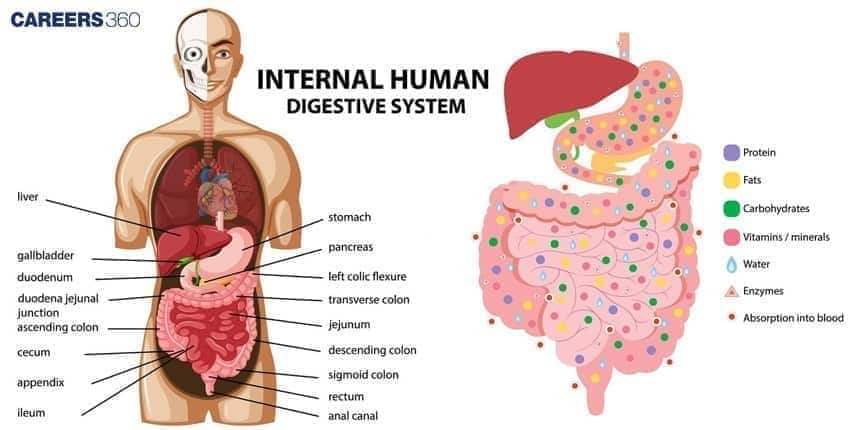
The human digestive system definition includes two main parts: the alimentary canal and accessory organs. Together, they perform the digestive system function of breaking down food, absorbing nutrients, and removing waste. Major organs of the human digestive system are discussed below:
Mouth: Anterior opening which receives food and breaks it down mechanically and chemically into smaller pieces.
Oesophagus: A muscular tube that transports food from the mouth down to the stomach by peristalsis.
Stomach: A sac-like organ that churns up food and mixes it with digestive juices.
Small Intestine: This is a scroll-like tube and is the site for major digestion and absorption of nutrients.
Large Intestine: Absorbs water and produces faeces.
Rectum and Anus: Stores and egestion of faeces.
Liver: This manufactures bile for fat digestion.
Pancreas: Secretes digestive enzymes and bicarbonate.
Gallbladder: It stores and concentrates the bile.
The human digestive system explains how food passes through different stages. Each stage is part of the digestive system function that gives energy, supports growth, and removes waste. The stages of digestion are divided into:
Ingestion
Food is chewed together with saliva.
It forms a soft, round mass known as the bolus.
Mixing and Movement
The oesophagus moves the bolus into the stomach by peristalsis.
In the stomach, food is mixed with digestive juices.
This semi-fluid substance is known as chyme.
The stomach, pancreas, liver, and small intestine secrete digestive enzymes, bile, and other juices.
Digestion
The carbohydrates, proteins, and fats are converted into smaller molecules, sugars, amino acids, and fatty acids, respectively.
Enzyme action mainly occurs in the small intestine.
Absorption
The nutrients from digested food get absorbed through the walls of the small intestine into the bloodstream.
This enables nutrients to reach other parts of the body for energy and repair.
Excretion
Water is absorbed through the large intestine.
The rest of the waste is compacted into faeces.
Waste is propelled out from the rectum and anus.
The human digestive system explains why digestion is essential for survival. The digestive system function shows how food is broken down, absorbed, and used by the body. This system provides energy for daily activities, supports growth, and repairs tissues. It also removes waste to keep the body healthy. The major functions of the human digestive system are:
Mechanical and chemical digestion
Absorption of nutrients and water
Transportation of nutrients
Removal of undigested waste
The human digestive system also includes common health problems. These disorders affect the digestive system function and can disturb daily life. Students must know them for exams and health awareness. The disorders of the human digestive system are:
Vomiting
Forceful expulsion of stomach contents through the mouth.
Diarrhoea
It is an abnormal, watery bowel movement.
Continued diarrhoea can result in dehydration
Constipation
Faeces remain in the rectum as a result of irregular bowel movements.
Indigestion
A feeling of pain or discomfort in the abdomen due to undigested food, characterised by fullness.
Causes include a deficiency of digestive enzymes, nervous anxiety, overeating, and spicy food.
Important questions asked in NEET from this topic are:
Stages of digestion
Disorders of the digestive system
Q1. Which of the following is not a digestive gland?
Salivary Glands
Pancreas
Liver
Gall bladder
Correct answer: 4) Gall bladder
Explanation:
The GI System is concerned with the processes of digestion and absorption of nutrient substances essential to life. This system includes an alimentary canal, which represents a hollow organ beginning at the mouth and the oesophagus, stomach, and small intestine divided into the duodenum, jejunum, and ileum, the large intestine representing the colon and rectum culminating in the anus. Glands associated with the digestive glands include the salivary gland, pancreas, and liver, but the gall bladder stores bile to be used within the digestive pathway.
Hence, the correct answer is option 4) Gallbladder.
Q2. The GI tract or alimentary canal in humans starts with the ________ and proceeds to the __________, stomach, small intestine, and then to the large intestine (colon), rectum, and terminates at the _________. Fill in the blanks by choosing the correct option.
Tongue, trachea, anus respectively
Mouth , pharynx, duodenum respectively
Mouth, esophagus, anus respectively
Salivary glands, trachea, jejunum respectively
Correct answer: 3) Mouth, oesophagus, anus respectively
Explanation:
The gastrointestinal (GI) tract, also known as the alimentary canal starts with the mouth and proceeds to the esophagus, stomach, small intestine (duodenum, jejunum, ileum), and then to the large intestine (colon), rectum, and terminates at the anus. It has an endodermal origin during embryonic development.
Hence, the correct answer is option 3) Mouth, oesophagus, and anus respectively.
Q3. Lamina propria is
Layer of loose connective tissue
It is a part of Mucosa layer of Alimentary canal
Also contains gland for the secretion of gonadotropin hormones
Both 1 and 2
Correct answer: 4) Both 1 and 2
Explanation:
Mucosa is composed of simple epithelium cells and a thin connective tissue - areolar tissue. The layer of areolar connective tissue is called lamina propria. In addition, the mucosa has a thin, smooth muscle layer, called the muscularis mucosa. Mucosa forms glands in the stomach (gastric glands) and crypts in between the bases of villi in the intestine (crypts of Lieberkuhn).
Hence, the correct answer is option 4) Both 1 and 2
Frequently Asked Questions (FAQs)
The human digestive system definition is the process of breaking food into nutrients that give energy, support growth, and repair the body.
The digestive system function breaks food mechanically and chemically, absorb nutrients, transport them to cells, and remove waste.
The small intestine digests food and absorbs nutrients. The large intestine absorbs water and forms faeces.
Indigestion happens due to overeating, spicy food, a lack of enzymes, or stress. It leads to discomfort and fullness.


Law Admissions 2026 Open | Avail Merit-Based Scholarships
BBA/MBA/PGDM Early Bird Applications Open 2027. Apply now using coupon code CAREER250 and get ₹250 off the application fee
Ranked #36 amongst institutions in Management by NIRF | 100% Placement
Globally Recognized by AACSB (US) & AMBA (UK) | 18 LPA Avg. CTC for PGPM 2026
NEET PG All India & State College Predictor with Admission Process Guide
Top B-School: Ranked #9 in NIRF Management Rankings 2025.