KCC Institute of Legal and Higher Education, Greater Noida
Law Admissions 2026 Open | Avail Merit-Based Scholarships


Basidiomycetes are fungi. They produce reproductive structures in the form of basidia, where sexual spores (basidiospores) develop. Common basidiomycetes are mushrooms, puffballs, bracket fungi, rusts, and smuts. Basidiomycetes are eukaryotic and multicellular organisms. They have a complicated life cycle involving both sexual and asexual reproduction. Basidiomycetes grow well in different environments. Basidiomycetes have a great impact on agriculture, ecology, and biotechnology.
This Story also Contains
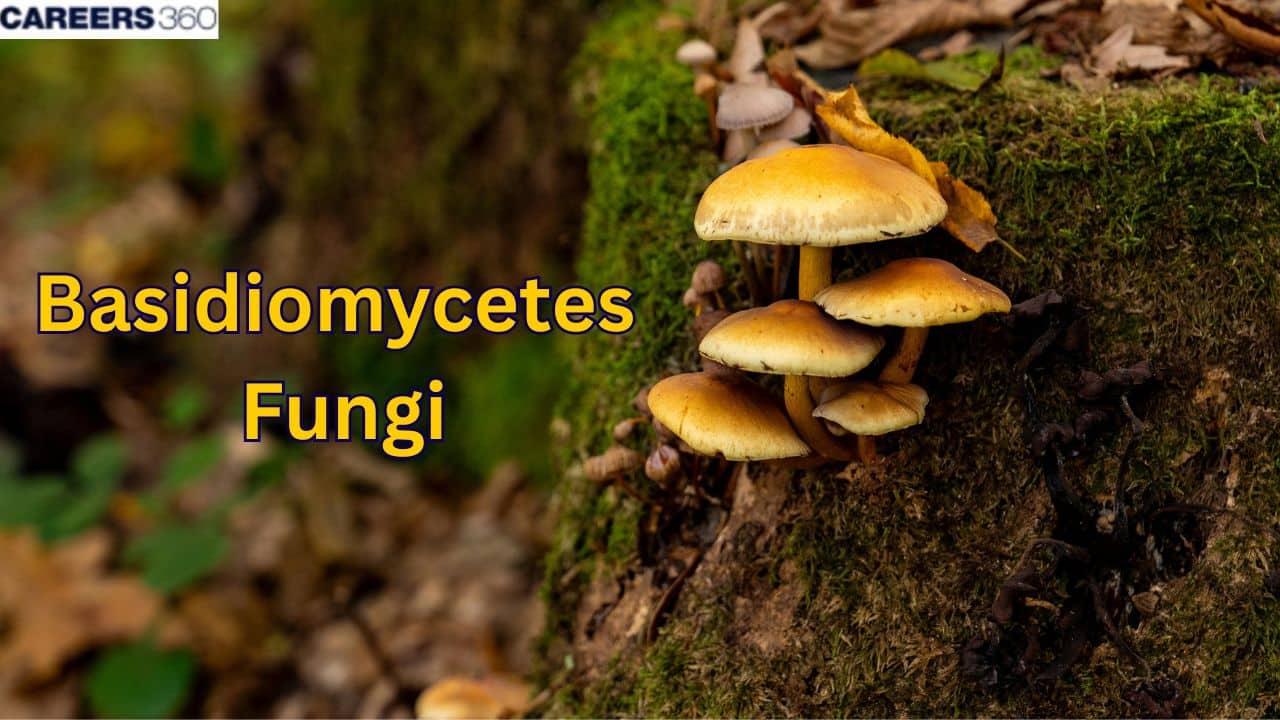
Many basidiomycetes act as decomposers and mycorrhizal symbionts that help plant growth. They mainly decompose organic matter and are an important part of nutrient cycling in ecosystems. Some basidiomycetes, like rusts and smuts, are harmful plant pathogens. They reduce crop yield and threaten food security. Edible basidiomycetes like mushrooms are of economic importance as a foodstuff and as a medicine. Their ligninolytic capacity to degrade other complex organic molecules is also used in bioremediation and industry.
Basidiomycetes include a class of fungi in the phylum Basidiomycota. It forms one of the two large parts of the kingdom of fungi. They are chiefly characterised by the formation of basidiospores on specifically evolved club-shaped cells named basidia in the process of sexual reproduction. Basidiomycetes include a wide range of fungi, such as mushrooms, puffballs, shelf fungi, and plant pathogens such as rusts and smuts.
Law Admissions 2026 Open | Avail Merit-Based Scholarships
BBA/MBA/PGDM Early Bird Applications Deadline 19th Oct '26. Apply now using coupon code CAREER250 and get ₹250 off the application fee
They play an important role in ecosystems as saprotrophs, breaking down complex organic compounds such as lignin and cellulose, and returning nutrients to the soil. Symbiotic associations with plants are formed by most Basidiomycetes, increasing plant nutrient uptake through the formation of mycorrhizal associations. They are economically important as sources of food (e.g., edible mushrooms), pharmaceuticals, and enzymes for industrial biotechnology. Other members, like the smut and rust fungi, are severe plant pathogens that kill crops and result in yield loss.
Basidiomycetes are typically dikaryotic (n + n). Each cell has two nuclei. They both reproduce sexually as well as asexually. Their fruit bodies, often seen as mushrooms, are among the most easily identified fungi in nature.
Basidiomycetes is a wide group of fungi that defines itself by the production of sexual spores or basidiospores on club-shaped structures or basidia. They have a developed, multicellular mycelium with septate hyphae and a long dikaryotic phase in their life cycle. Crops of obvious fruiting bodies, such as mushrooms and puffballs, though some are microscopic plant diseases like rusts and smuts. They have essential ecological roles as decomposers, mutualists, and parasites. Some of the important characteristics are discussed below:
Possess septate hyphae with clamp connections during the dikaryotic phase.
Form complex basidiocarps (fruiting bodies) regularly, e.g., mushrooms.
Possesses a life cycle which includes a protracted dikaryotic phase before karyogamy.
Contain saprophytic, mutualistic (e.g., mycorrhizal), and parasitic taxa.
Classification and taxonomy in Basidiomycetes are founded on morphological characteristics, mode of reproduction, and molecular features. They belong to the Kingdom Fungi and are characterised by the development of sexual spores on basidia. Such classification helps in comprehending fungal diversity, ecological function, and evolutionary progression through ecosystems.
Basidiomycetes are categorised into orders like Agaricales (gilled mushrooms), Polyporales (bracket fungi), and Tremellales (jelly fungi).
Genetic markers such as rRNA sequences are employed for the discrimination of closely related species.
Taxonomic placement takes into account ecological roles, decomposers, mutualists (mycorrhizae), or parasites.
Certain taxa are classified based on microscopic characters such as septal pore morphology and clamp connections.
Molecular phylogenetics has resulted in a large number of traditional groups being reclassified on the basis of evolutionary lineage.
There are several classes of Basidiomycetes. Each class consists of a large group of fungi with different features:
| Class | Common Examples | Key Characteristics | Habitat/Role |
|---|---|---|---|
| Agaricomycetes | Mushrooms, shelf fungi, puffballs |
| Decomposers, some form mycorrhizal associations |
| Ustilaginomycetes | Smut fungi |
| Plant pathogens, particularly in cereals |
| Pucciniomycetes | Rust fungi |
| Plant pathogens, especially on crops |
| Tremellomycetes | Jelly fungi |
| Found on decaying wood, decomposers |
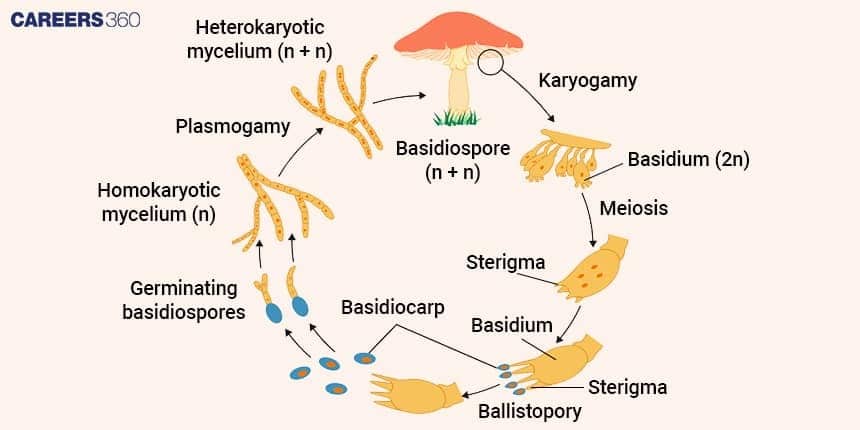
The basidiomycetes life cycle takes place in two modes. They are sexual reproduction and asexual reproduction. It is characterised by the following phases:
Spore Germination: The basidiospore germinates to produce haploid primary mycelium.
Plasmogamy: The fusion of two compatible hyphae from two different mating types forms a dikaryotic secondary mycelium. Besides, its cell contains two nuclei.
Dikaryotic Mycelium: It is a more prolonged stage that forms a massive network. Later, it develops a fruiting body, known as a basidiocarp.
Karyogamy: Nuclei fuse to become a diploid zygote inside basidia.
Meiosis: The same diploid zygote undergoes meiosis and gives haploid basidiospores.
The diagram given below shows the overview of the basidiomycetes life cycle.
Basidiomycetes in Biological Classification reproduce in two ways: sexual and asexual.
In sexual reproduction, two compatible hyphae fuse. This forms a dikaryotic stage, where each cell has two nuclei. Basidiospores then develop on basidia. Clamp connections appear to keep nuclei evenly distributed.
In asexual reproduction, basidiomycetes produce spores like conidia and chlamydospores. These spores spread quickly. They help basidiomycetes survive and colonise new environments.
Examples of basidiomycete fungi clearly explain the diverse functions and importance of Basidiomycetes. It ranges from the kitchen to the environment and also in the industry. Examples of basidiomycete fungi, along with their category, are explained below in the table:
| Category | Fungus | Common Name | Description |
|---|---|---|---|
| Edible Mushrooms | Agaricus bisporus | Button Mushroom |
|
| Pleurotus ostreatus | Oyster Mushroom |
| |
| Poisonous Mushrooms | Amanita phalloides | Death Cap |
|
| Pathogenic Fungi | Puccinia graminis | Black Stem Rust |
|
| Industrially Important | Ganoderma lucidum | Reishi or Lingzhi |
|
This is an important NEET topic. Questions on basidiomycete fungi often test classification, life cycle, reproduction, and examples. Types of questions asked about this topic are:
Characteristics of basidiomycetes fungi
Classes of basidiomycetes and their examples
Life cycle of basidiomycetes (dikaryotic stage, basidiospores)
Reproduction in basidiomycetes (sexual and asexual)
Question: After karyogamy followed by meiosis, spores are produced exogenously in
Agaricus
Alternaria
Neurospora
Saccharomyces
Correct Answer: Agaricus
Explanation:
Following karyogamy and meiosis, the basidiomycete fungus Agaricus exogenously (outside the basidium) produces basidiospores.
Instead of following meiosis, Alternaria generates conidia asexually.
Ascomycetes like Neurospora create ascospores endogenously, or within the ascus, as opposed to exogenously.
After meiosis, the yeast Saccharomyces also makes ascospores endogenously rather than exogenously.
Hence, the correct answer is option 1) Agaricus.
Question: Assertion: Basidiospores are produced endogenously in the basidium in basidiomycetes.
Reason: Ascospores are produced exogenously in an ascus in ascomycetes.
The assertion is true, but the reason is false.
Both the assertion and the reason are false.
Both the assertion and the reason are true, but the reason is not the correct explanation of the assertion.
Both the assertion and the reason are true, with the reason being the correct explanation of the assertion.
Correct Answer: Both the assertion and the reason are false.
Explanation:
Option 2) is correct because both the given assertion and reason are false. The basidiospores are produced exogenously in basidiomycetes at the tips of fine outgrowths known as sterigmata. Ascospores are produced internally in ascomycetes in each ascus sporangial sac. Each ascus is formed by four to eight meiospores (ascospores) that are endogenous.
Option 1) is incorrect because the given assertion is not true. It is false
Option 3) is also incorrect because the given assertion and reason are both false.
Option 4) is also wrong because the given assertion and reason both are false, and the reason is not the correct explanation of the assertion.
Hence, the correct answer is option 2) Both the assertion and the reason are false.
Question: Which one of the following has a haplontic life cycle?
Polytrichum
Ustilago
Wheat
Funaria
Correct Answer: Ustilago
Explanation:
Basidiomycetes / Club fungi -
Mycelium is septate and branched.
Sexual reproduction is somatogamy.
They decompose cellulose and lignin.
Basidiospores formed exogenously on sterigmata
The fruiting body is the basidiocarp.
Eg. Agaricus, Ustilago, Puccinia.
Hence, the correct answer is option 2) Ustilago
Frequently Asked Questions (FAQs)
Basidiomycetes are fungi that produce sexual spores called basidiospores on club‑shaped cells known as basidia. Examples include mushrooms, puffballs, rusts, and smuts.
Edible basidiomycetes include Agaricus bisporus (button mushroom) and Pleurotus ostreatus (oyster mushroom). They are rich in protein and widely cultivated.
Basidiomycetes act as decomposers. They break down lignin and cellulose, recycle nutrients, and form mycorrhizal associations that help plants absorb minerals.
This cycle of life of the fungus includes the following: spore germination, mycelium formation, plasmogamy fusion of hyphae, dikaryotic stage, karyogamy nuclear fusion, meiosis and produce new basidiospores.
Basidiomycetes produce spores externally on basidia, while ascomycetes produce spores internally in asci. Both are fungi but differ in spore structures and life cycles.

Law Admissions 2026 Open | Avail Merit-Based Scholarships
BBA/MBA/PGDM Early Bird Applications Deadline 19th Oct '26. Apply now using coupon code CAREER250 and get ₹250 off the application fee
Ranked #36 amongst institutions in Management by NIRF | 100% Placement
Globally Recognized by AACSB (US) & AMBA (UK) | 18 LPA Avg. CTC for PGPM 2026
Leading Design College | 95% Placement Record | Merit-cum-Means Scholarships for Deserving Students
NEET PG All India & State College Predictor with Admission Process Guide