


Parts of Human Excretory system: Organs, Functions, Diagrams
The human excretory system removes nitrogenous wastes, excess salts, and water using a coordinated network of kidneys, ureters, urinary bladder, and urethra. Kidneys form urine through filtration, reabsorption, and secretion inside millions of nephrons. This guide covers the structure and functions of each part, urine formation, GFR regulation, disorders, diagrams, FAQs, and NEET MCQs.
This Story also Contains
- What is the Human Excretory System?
- List of Major Excretory Organs
- Structure & Function of Kidneys
- Structure & Function of Ureters
- Structure & Function of Urinary Bladder
- Structure & Function of Urethra
- Mechanisms of Urine Formation
- Disorders of the Excretory System
- Human Excretory System NEET MCQs (With Answers & Explanations)
- Recommended Video on Parts of Human Excretory System
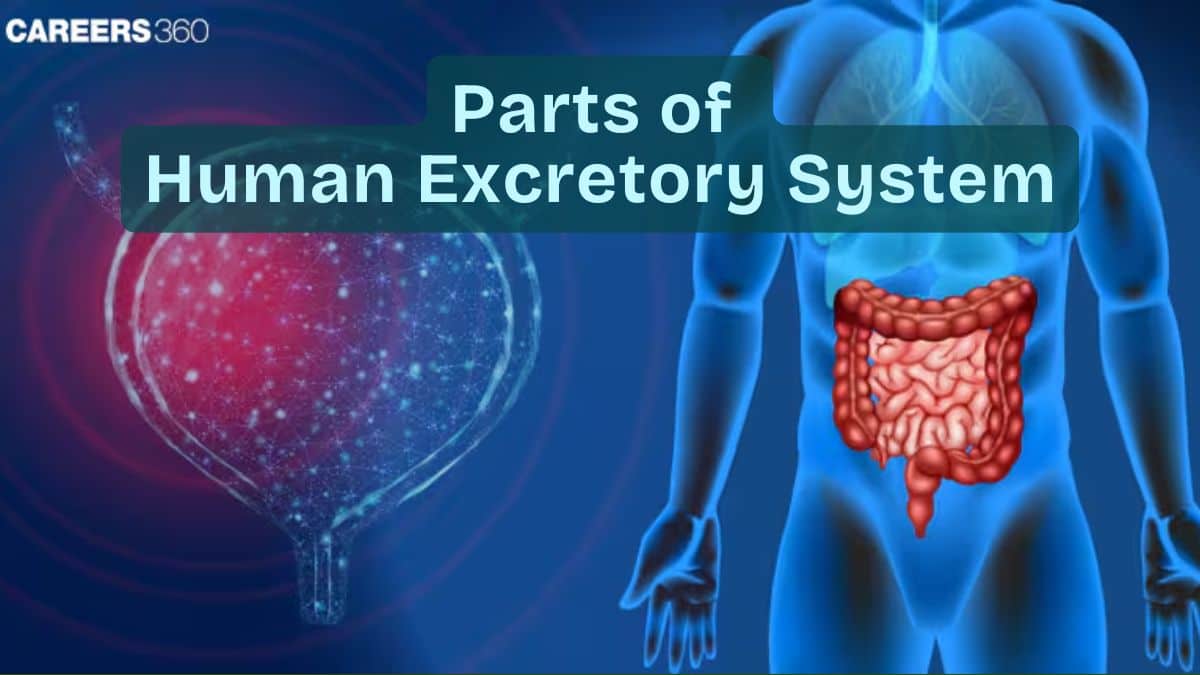
What is the Human Excretory System?
The human excretory system is a network of organs and structures that play a role in the removal from the bloodstream of avoidable products and extra amounts of substances, thereby ensuring balance in the components of the body. This includes the kidneys, ureters, urinary bladder, and urethra.
In its regulatory role over the composition of the blood, the levels of electrolytes, and the amount of fluid, it helps in the proper functioning of cells and organs, thereby maintaining proper health and stability of the body.
List of Major Excretory Organs
The human excretory system removes waste products from the body. It has several major parts, including:
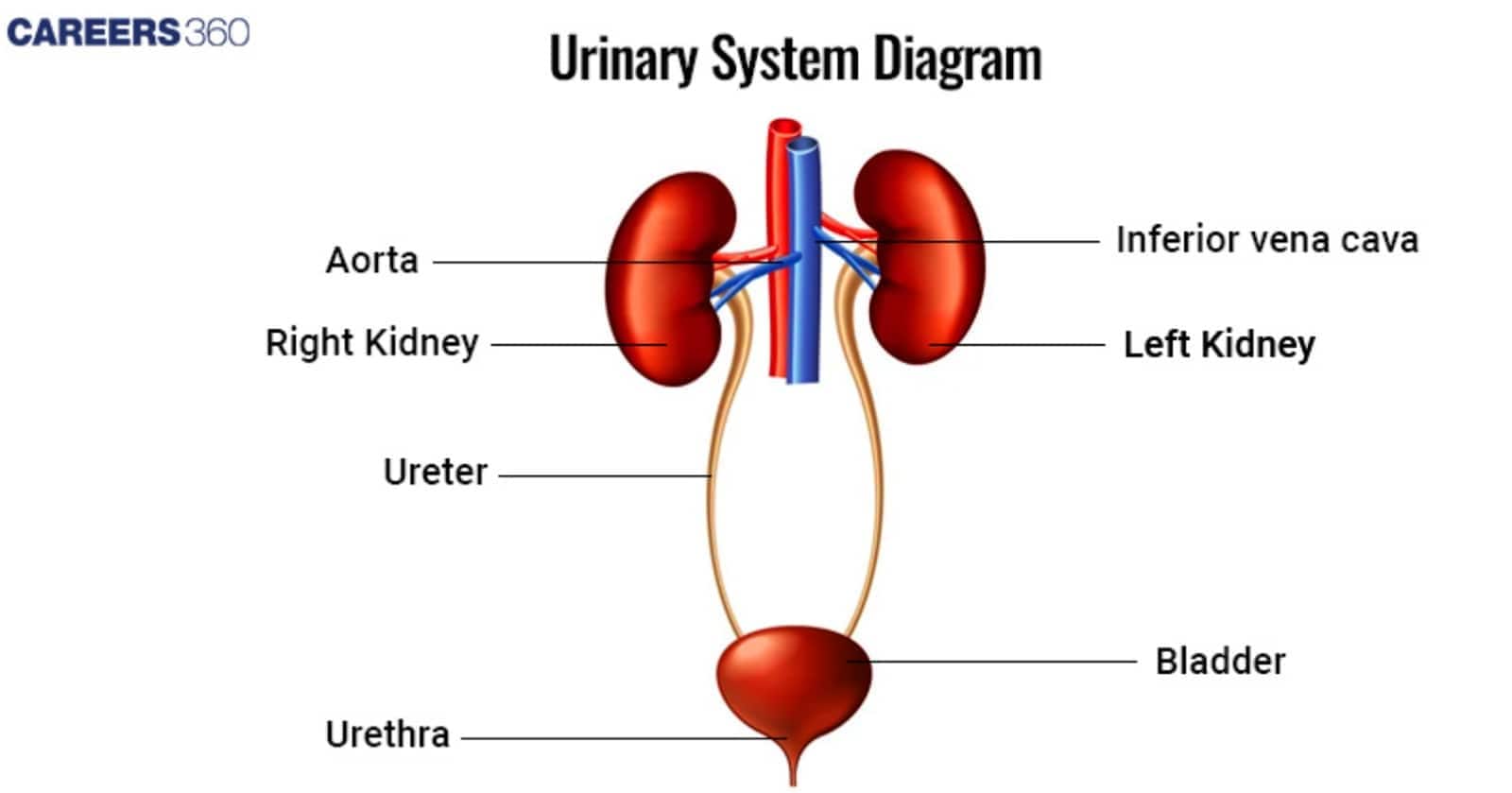
Kidneys: These are bean-shaped organs that filter blood to remove waste, excess salts, and water, which is converted into urine.
Ureters: Thin tubes that carry urine from each kidney to the bladder.
Urinary Bladder: A muscular sac that stores urine until it is ready to be excreted.
Urethra: It is a tube that conveys urine from the body outside during urination out of the bladder.
Together, these organs regulate water balance, eliminate waste products, and ensure overall homeostasis in the body.
Structure & Function of Kidneys
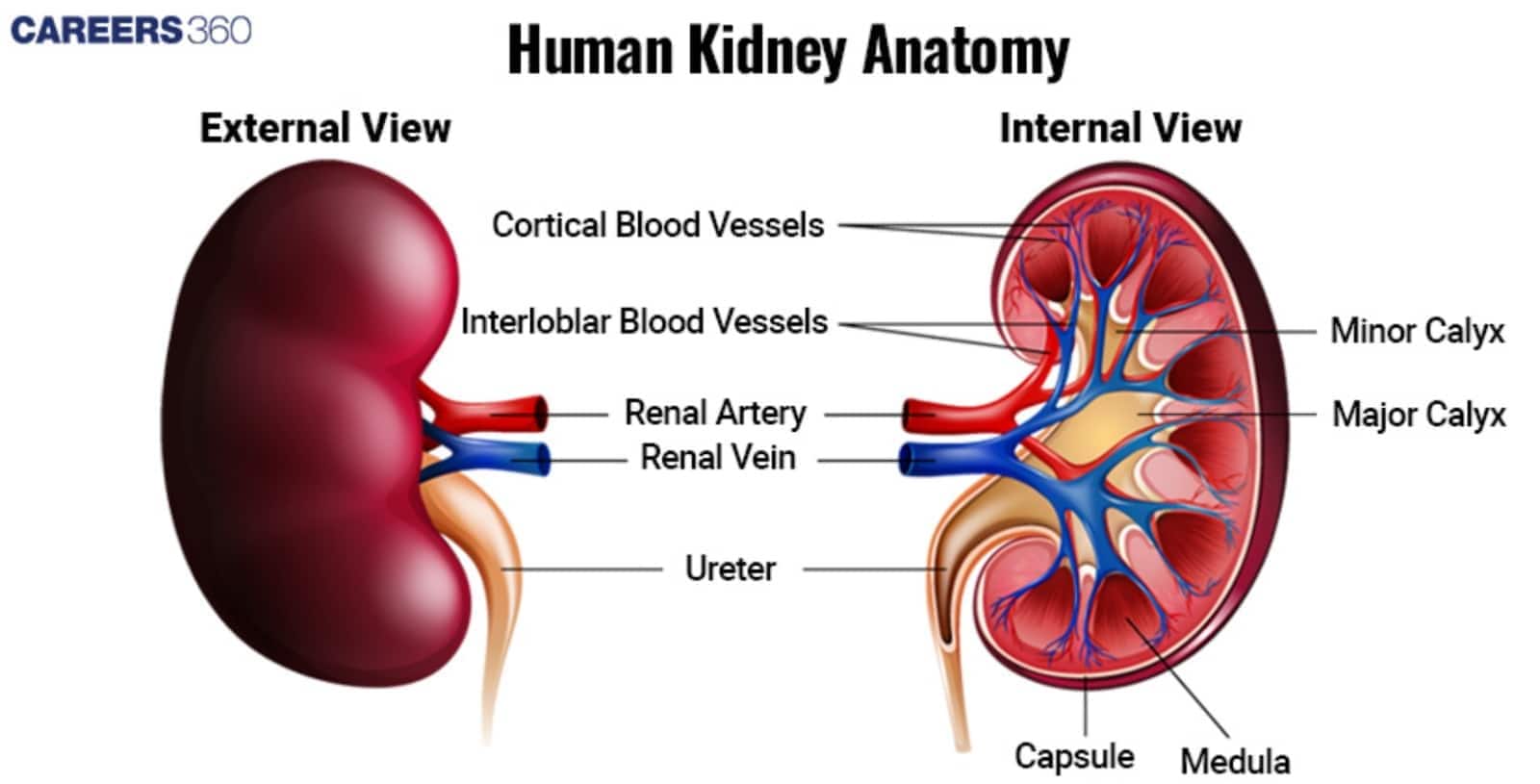
The kidneys are a pair of bean-shaped organs, sitting on either side of the spine between the rib cage. Each of the kidneys measures about 11-14 cm in length and 150 grams in weight.
The following three important parts differentiate in the kidney:
Renal Cortex: It is the outer layer comprising glomeruli with their convoluted tubules and hence forms the commencement site for blood filtration.
Renal Medulla: The inner region of the kidney is composed of renal pyramids. These pyramids include the loops of Henle and collecting ducts, which are significant for the concentration of urine.
Renal Pelvis: Funnel-shaped cavity collecting the urine from renal pyramids and channels into the ureter.
Functions of the Kidney
The functions of the kidney are:
Filtration of blood
The kidneys filter around 180 litres of blood every day. Waste products, and excess substances, along with water, are removed from the blood in the glomeruli to result in urine.
Reabsorption and secretion
During the passage of filtrate through renal tubules, important nutrients, ions, and water are reabsorbed into the bloodstream from it.
Production of urine
The filtrate, now called urine, is collected in the renal pelvis. Through the ureters, this urine is whisked away to be stored in the bladder before being excreted out of the body.
Nephron – Functional Unit
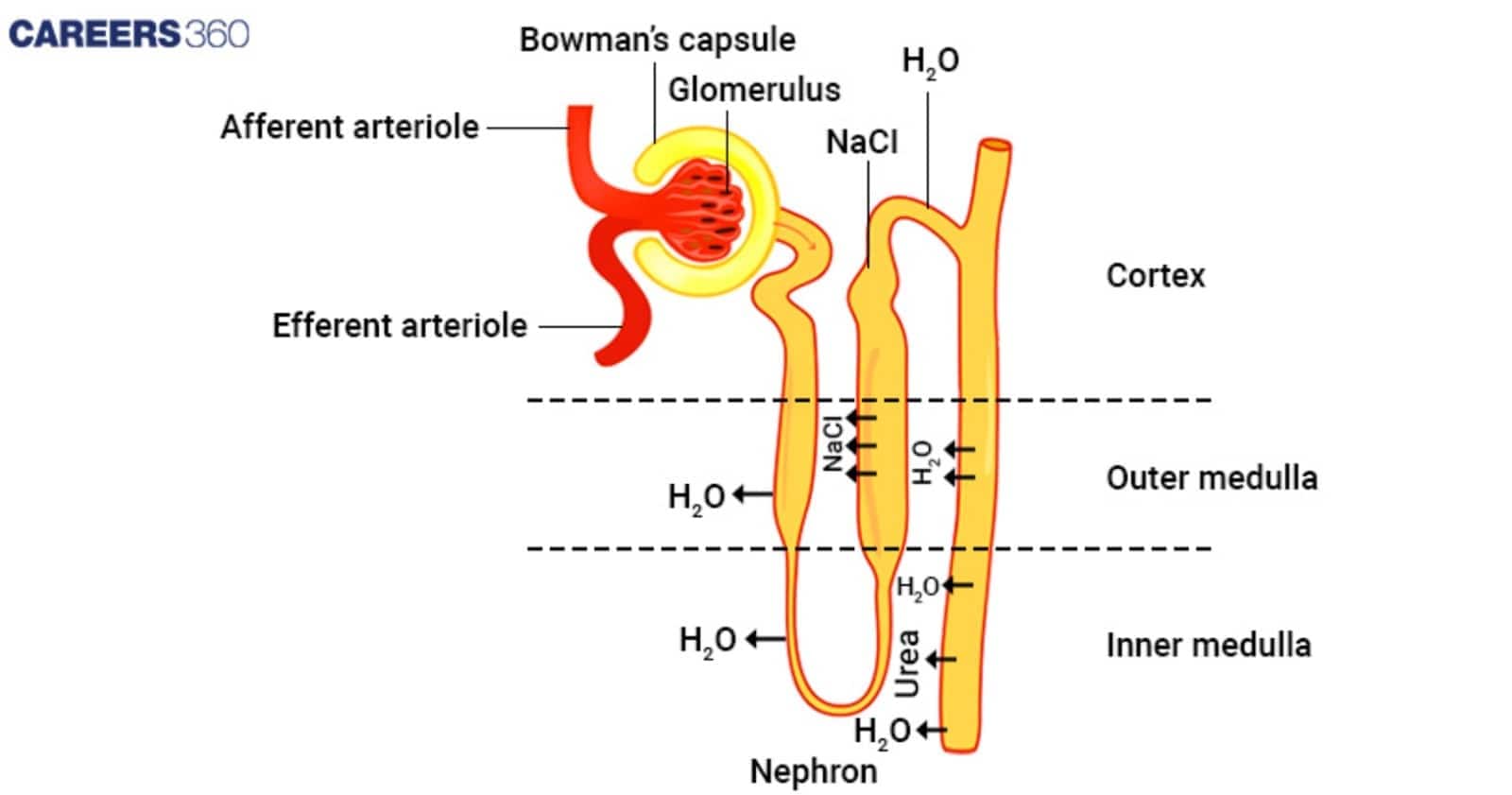
The nephron is the microscopic functional unit of the kidney, and its structural counterpart is a million such units in each kidney. Each nephron consists essentially of a renal corpuscle to which is attached a renal tubule.
Renal Corpuscle
Bowman's Capsule: A cup that covers the glomerulus, it acts as the site of primary blood filtration, where all the water and small molecules get filtered into the renal tubule.
Glomerulus: A network of capillaries within the Bowman's capsule, responsible for filtering the blood. It allows only water, ions, and small molecules through while letting large molecules such as proteins and blood cells remain behind.
Renal Tubule
Proximal Convoluted Tubule (PCT): The part of the nephron that lies immediately distal to Bowman's capsule. Huge reabsorption of water, ions, and nutrients is done. PAlso, it secretes waste products into the filtrate.
Loop of Henle: This is a U-shaped segment that extends into the renal medulla. It contains descending and ascending limbs, viewed as most important for concentrating urine by reabsorption back both water and sodium chloride.
Distal Convoluted Tubule: The part beyond the loop of Henle that calls forth selective reabsorption and secretion of ions, recognized as being very vital for maintaining correct acid-base balance and levels of various electrolytes within the body.
Collecting Duct: The last portion that collects the urine from several nephrons and discharges it via the renal medulla to the renal pelvis. It is a key site for the regulation of water reabsorption under the influence of antidiuretic hormone (ADH).
Function of the Nephron
The following are the main functions of the nephron:
Filtration
As blood enters the glomerulus, it is filtered across the glomerular capillaries into Bowman's capsule, forming the glomerular filtrate. This filtrate contains water, ions, glucose, and small molecules but does not include large proteins and blood cells.
Reabsorption
While passing through the renal tubule, useful substances such as water, glucose, amino acids, and ions are reabsorbed into the bloodstream.
Secretion
The nephron processes and secretes more waste products and extra ions from the blood into the tubular fluid. Most of the tubular secretion takes place in the proximal and distal convoluted tubules, where final adjustments in the filtrate's composition occur.
Excretion
The collecting ducts gather the final product or urine and pass it down to the renal pelvis. The urine then flows, through the ureters, into the bladder, at which point it is stored until it is excreted from the body.
Structure & Function of Ureters
The two slender, muscular tubes of the ureters extend from the renal pelvis of each kidney to the bladder. They are approximately 25–30 cm long and about 3–4 mm in diameter.
3 Layers of Ureter Wall
The walls are composed of three layers: an inner mucosal layer, a middle muscular layer, and an outer adventitia layer.
Inner Mucosal layer: This layer is made of transitional epithelium. This kind of epithelium can expand which is essential to the ureters when urine flows through them.
Middle Muscular Layer: The middle layer is composed of smooth muscle fibres aligned circularly and longitudinally in successive layers. The successive muscular layers contract peristaltically, pushing the urine towards the bladder.
Outer Adventitia Layer: The outermost layer is composed of fibrous connective tissue and acts as a framework for support to affix the ureters in position.
Function
The functions of the ureters include:
The movement of urine from the renal pelvis of each kidney down into the bladder is accomplished by the ureters. Each ureter accomplishes this through the countercurrent smooth muscle contractions of its walls.
By these repetitive contractions, urine is effectively squeezed down toward the bladder without backflow to interfere with the continual efforts of the kidneys to produce and eliminate urine.
Structure & Function of Urinary Bladder
The urinary bladder is a sac-like muscular organ located inside the pelvis, behind the pubic bone. It is a temporary reservoir for urine. Its shape is triangular when empty and becomes more spherical as it fills with urine. The bladder's capacity in adults generally varies between 400 to 600 millilitres.
Layers
Mucosa: The innermost layer of the bladder wall, and is lined with transitional epithelium. Transitional epithelium can stretch a significant amount; therefore, it permits the bladder to stretch as it fills with urine. The mucosa also has rugae, or folds, which also allow for stretching.
Muscularis (Detrusor Muscle): This layer comprises a thick smooth muscle with fibres directed into three planes (inner longitudinal, middle circular, and outer longitudinal). This muscle is responsible for squeezing the bladder empty.
Serosa: Superficial to the muscularis is a serosa or an adventitia over areas of the urinary bladder that are not coated with the peritoneum. The serosa holds the shape and structure of the bladder.
Functions
The main functions of the urinary bladder are:
Storage of urine
The auxiliary function of the urinary bladder is to store urine produced by the kidneys, where it is stored until finally being excreted. The bladder can hold quite large quantities of urine due to its expandable nature, allowing urine release to be regulated and timed in intervals.
Mechanism of urine release (micturition)
The mechanism of urination is a cooperative arrangement of involuntary and voluntary mechanisms. When the urinary bladder is filling up with urine, stretch receptors develop in the bladder wall. Impulses are sent to the brain, which initiates the general sensation of needing to micturate. At the same time, the detrusor muscle contracts, and the internal (involuntary) and external (voluntary) urethral sphincters relax, allowing the flow of urine from the bladder through the urethra into the outside world.
Structure & Function of Urethra
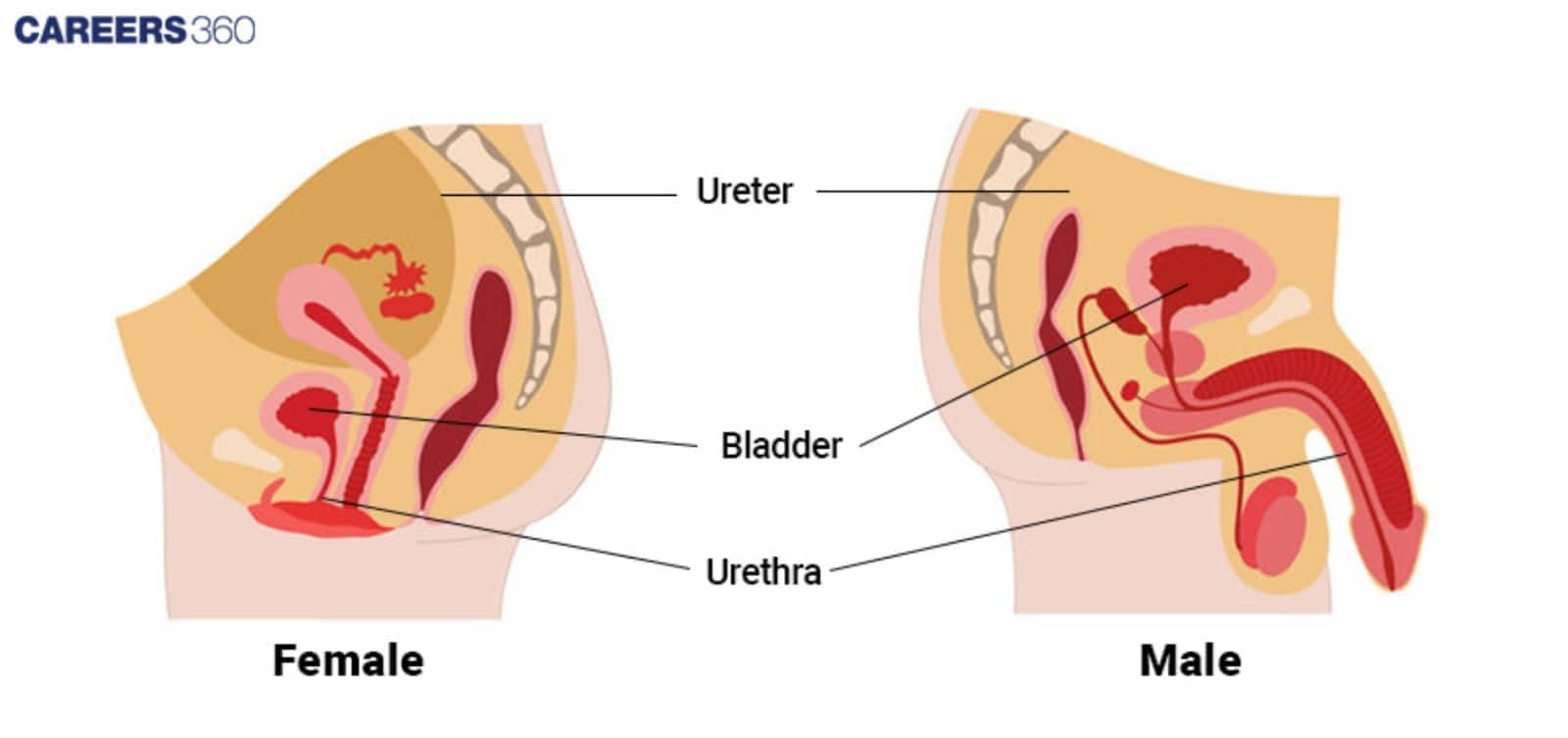
The membranous urethra is a tubular organ that transmits urine from the urinary bladder to the outside of the body. It is different in terms of length and its anatomical course between males and females.
Male Urethra
The male urethra is approximately 20 cm long. In males, it performs the dual function of a passage for both urine and sperm.
It becomes partitioned into three portions:
Prostatic Urethra: It courses through the prostate gland.
Membranous Urethra: The shortest and narrowest portion, which runs through the urogenital diaphragm.
Spongy (Penile) Urethra: It courses along the entire length of the penis and opens at the external urethral orifice.
The internal urethral sphincter surrounds the male urethra at the neck of the bladder to prevent reflux of semen into the bladder at ejaculation.
Female Urethra
The female urethra is about 4 cm long and functions only as a tube for the urinary passage.
It passes the length parallel to the wall of the vagina and opens into an orifice, that is the external urethral orifice lying in front of and separate from the vaginal orifice.
The length of the urethra in women is relatively short.
Thus, this increases the risk by which bacteria might reach the bladder and cause an infection, also known as a urinary tract infection or UTI.
Mechanisms of Urine Formation
The overall processes concerned with urine formation within the kidneys can be summarized as glomerular filtration, tubular reabsorption, tubular secretion, and excretion. Through these mechanisms, all waste products and excess substances are removed from the circulatory blood effectively while all essential nutritive factors and water are conserved.
Glomerular Filtration
Blood enters under high pressure within the glomerulus via the afferent arteriole, the vessel that perfuses the glomerulus.
It is the increased pressure in the glomerulus that forces out water, ions, and small molecules across the glomerular capillaries and into Bowman's capsule to form the glomerular filtrate.
This process clears waste products and excess substances from the blood, which then contribute to excretion. Thus urine formation begins
Factors Affecting Glomerular Filtration Rate (GFR)
Blood Pressure: An increase in blood pressure will increase GFR, while a decrease in it lowers it.
Afferent and Efferent Arteriolar Tone: alters these arterioles significantly alter GFR by giving rise to constriction or dilatation of these arterioles.
Plasma Protein Levels: The concentration of plasma proteins may alter the osmotic pressure responsible for drawing water and its contents back into the blood from the filtrate, thus affecting GFR.
Health of Glomerular Capillaries: Damage to or disease of the glomeruli will decrease filtration and lower GFR.
Tubular Reabsorption
Tubular reabsorption mainly occurs in the PCT, loop of Henle, DCT, and the collecting duct.
Proximal Convoluted Tubule: In the PCT, about 65-70% of the glomerular filtrate, water, ions, glucose, and amino acids get reabsorbed.
Henle's Loop: Here, water and sodium chloride are reabsorbed. It has a very vital role in concentrating urine.
PCT and Collecting Duct: The last adjustment in the amount of reabsorption of ions and water is according to body requirements due to aldosterone, antidiuretic hormone, and other hormones.
Tubular Secretion
Tubular secretion primarily takes place in the proximal convoluted tubule and the distal convoluted tubule.
Proximal Convoluted Tubule: There, it secretes waste products, such as hydrogen ions, ammonia, and certain drugs into the tubular fluid.
Distal Convoluted Tubule: Extra secretion of ions into Kramer, such as potassium and hydrogen, contributes to the maintenance of the body's acid-base balance.
Disorders of the Excretory System
The disorders of the excretory system inhibits the proper clearance of wastes and continued homeostasis.
Kidney Stones
These are caused by low fluid intake, high salt consumption, and genetics.
Symptoms include severe pain, blood in urine, and frequent urination.
Treatment are increased fluid intake, medications, and surgery.
Urinary Tract Infections (UTIs)
Caused by bacterial infection, poor hygiene, and use of a catheter.
Symptoms include painful urination, an urge to urinate frequently, and cloudy urine.
Treatment options are antibiotics and increased fluid intake.
Chronic Kidney Disease (CKD)
Stages 1 to 5, based on GFR
Caused by diabetes, blood pressure, glomerulonephritis.
Symptoms include fatigue, swelling, nausea, and decreased urine output.
Treatment options include behavioural changes, medications, dialysis, and kidney transplants.
Human Excretory System NEET MCQs (With Answers & Explanations)
Important questions asked in NEET from this topic are:
Major organs in excretory system
Mechanism of urine formation
Practice Questions for NEET
Q1. With its anatomical positioning and the surrounding peritoneum, what distinct characteristic defines the retroperitoneal kidney?
Kidney of a fish
Kidney covered by Peritoneum on ventral side
Kidney covered by Peritoneum on Dorsal side
Kidney uncovered by Peritoneum on ventral Side
Correct answer: 2) Kidney covered by Peritoneum on ventral side
Explanation:
In the retroperitoneal position, the kidney is located behind the peritoneum, specifically covered by it on the ventral side. This distinguishes it from other options where the kidney is either covered by the peritoneum on the dorsal side (option 3) or not covered by the peritoneum on the ventral side (option 4). The retroperitoneal positioning of the kidney is common in mammals, including humans.
Hence, the correct answer is option 2) The Kidney is covered by the Peritoneum on the ventral side.
Q2. What is the function of the renal pelvis in the human excretory system?
To filter waste from the blood
To store urine temporarily
To transport urine from the kidneys to the bladder
To collect urine from the nephrons and direct it to the ureters
Correct answer: 4) To collect urine from the nephrons and direct it to the ureters
Explanation:
The primary purpose of the renal pelvis, a funnel-shaped organ in the centre of the kidney, is to collect urine that has been produced by the nephrons. The tiny kidney structure known as a nephron filters waste and extra water from the blood. The nephrons also create urine, which is then transported through a network of tiny tubes known as collecting ducts and excreted into the renal pelvis. The ureters, which are muscular tubes that carry urine from the kidneys to the bladder for momentary storage before eventual elimination from the body, are then directed to receive the urine by the renal pelvis.
Hence, the correct answer is option 4) To collect urine from the nephrons and direct it to the ureters.
Q3. Select the incorrect pair and write the role of organs in excretion:
Lungs - a large amount of CO2
Skin - sweat, urea, lactic acid, etc
Sweat gland - facilitates cooling effect on body surface
None of these
Correct answer: 4) None of these
Explanation:
The skin and lungs play significant roles in excretion. Sweat glands in the skin produce sweat, a watery fluid containing NaCl, urea, lactic acid, and other substances, facilitating the removal of metabolic wastes while primarily aiding in cooling the body's surface. Sebaceous glands also contribute by eliminating certain substances through their secretions. The lungs complement this process by expelling large amounts of carbon dioxide, approximately 200 mL per minute, along with significant quantities of water vapor daily, underscoring their critical role in maintaining homeostasis and excretory balance.
Hence, the correct answer is option 4) None of these.
Also Read:
Recommended Video on Parts of Human Excretory System
Frequently Asked Questions (FAQs)
Blood is filtered by the kidneys using glomerular filtration.
A good excretory system is maintained by keeping the body well-hydrated, consuming a healthy diet with low levels of sodium and processed foods, working out regularly, avoiding excessive alcohol and caffeine consumption, and not smoking at all.
The ureters are muscular tubes that carry urine from the kidneys to the urinary bladder. In this way, the peristaltic contractions of the walls make the ureters propel the urine downwards and hence make its way very smooth and also prevent backflow.
Common pathologies to the excretory system include renal calculi, UTIs, CKD, AKI, and disorders of the bladder like interstitial cystitis and incontinence. These pathologies can further result in damage to its role of filtering wastes and regulating fluid balance.
The main constituents of the human excretory system are the kidneys, ureters, urinary bladder, and urethral passage. The kidneys filter blood to produce urine that afterwards passes into the ureters, enters the urinary bladder, and in due time gets excreted out of the body via the urethra.
