KCC Institute of Legal and Higher Education, Greater Noida
Law Admissions 2026 Open | Avail Merit-Based Scholarships


Have you ever wondered how much material is needed to cover the entire outer surface of a football, a globe, or a spherical water tank? The answer lies in the concept of the surface area of a sphere. Surface area measures the total area covered by the curved outer surface of a three-dimensional spherical object and is one of the most important topics in mensuration and geometry. Understanding the surface area of a sphere helps students solve practical problems involving covering, painting, coating, and manufacturing spherical objects. This concept is widely used in mathematics, engineering, architecture, physics, and competitive examinations. In this article, we will explore the surface area of a sphere, its formula, derivation, properties, examples, and real-world applications.
This Story also Contains
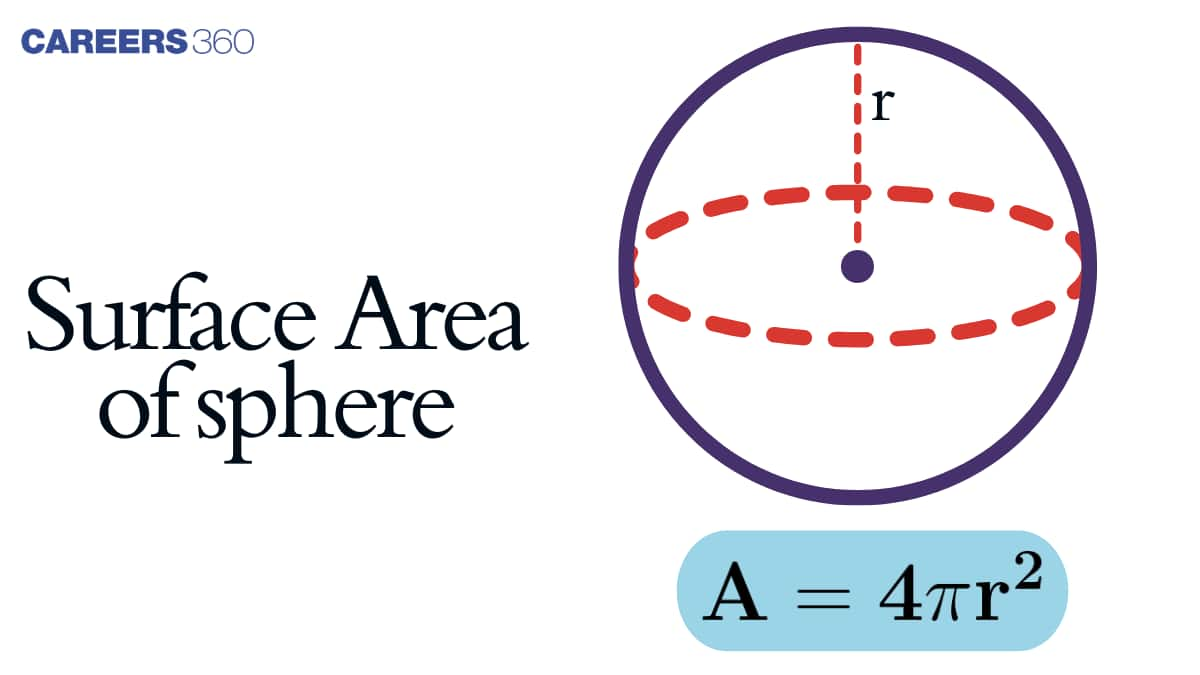
"Many students ask: What exactly is the surface area of a sphere?
The surface area of a sphere is the total area covered by its outer curved surface. It tells us how much material would be needed to cover the entire sphere."
The surface area of a sphere refers to the total area covered by the outer curved surface of a spherical object. It measures the amount of material required to cover the entire surface of a sphere and is an important concept in mensuration and geometry. Understanding the surface area of a sphere helps students solve problems related to painting, coating, wrapping, and manufacturing spherical objects.
"Can I find the surface area of a sphere if only the diameter is given?
Yes. First find the radius using $r=\frac{d}{2}$ and then substitute the value into the formula $4\pi r^2$."
The surface area of a sphere is the total area occupied by its outer boundary.
For example, if a football, basketball, or globe is covered with a thin sheet, the amount of sheet required represents the surface area of that sphere.
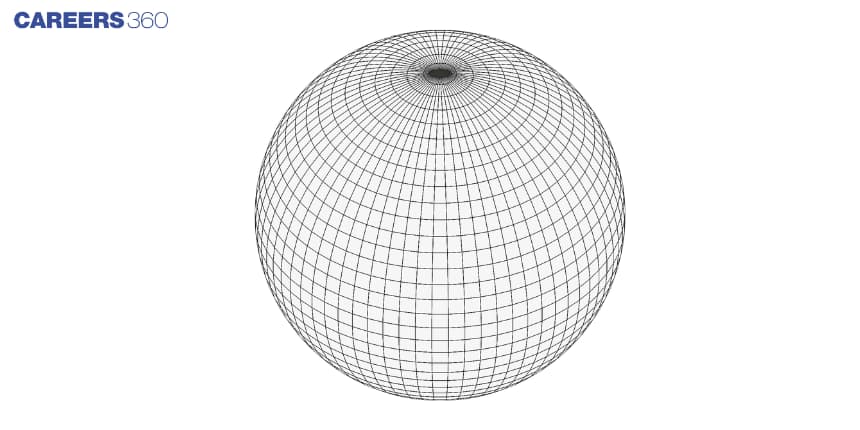
In simple terms, surface area tells us:
"How much area covers the outside of a sphere?"
The surface area of a sphere is defined as the total area of its curved outer surface.
Mathematically, it is given by:
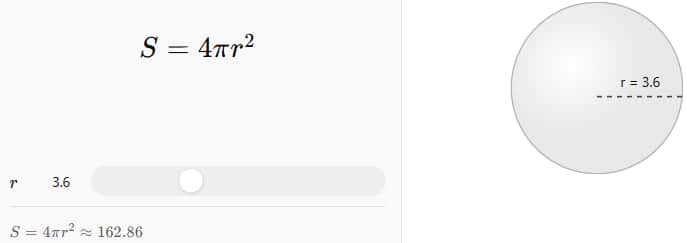
where:
$S$ = Surface Area
$r$ = Radius of the sphere
$\pi \approx 3.14159$
Law Admissions 2026 Open | Avail Merit-Based Scholarships
BBA/MBA/PGDM Early Bird Applications Deadline 06th Nov'26. Apply now using coupon code CAREER250 and get ₹250 off the application fee
The formula shows that the surface area depends entirely on the radius of the sphere.
"Does doubling the radius double the surface area of a sphere?
No. Since the radius is squared in the formula, doubling the radius increases the surface area by four times."
The concept of surface area is important because it helps determine the amount of material needed to cover spherical objects.
Applications include:
Painting spherical tanks.
Manufacturing balls and globes.
Designing domes.
Packaging spherical products.
Engineering and construction calculations.
It is also a commonly tested topic in school examinations, SSC, Banking, Railways, NDA, and other competitive exams.
Many objects around us have a spherical shape.
Examples include:
Footballs
Basketballs
Globes
Marbles
Water droplets
Ball bearings
Planets and stars
Calculating their surface area helps in practical design and measurement tasks.
"Can a sphere have edges, corners, or vertices?
No. A sphere has a completely curved surface and contains no edges, corners, or vertices."
Before studying the surface area formula, it is important to understand the basic structure of a sphere.
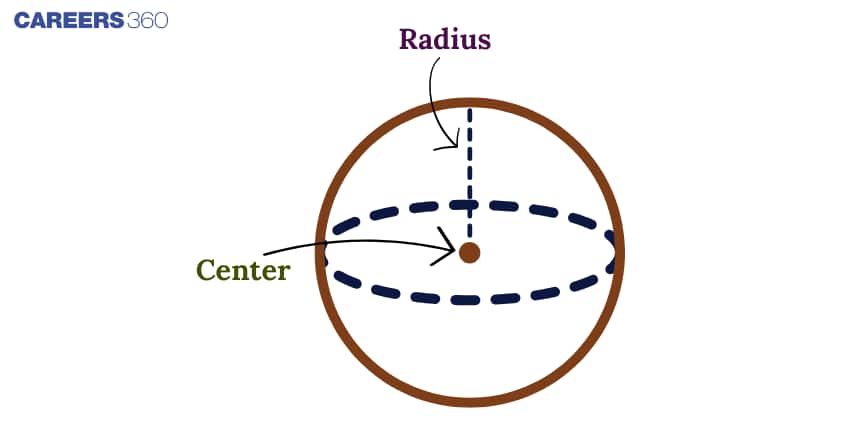
A sphere is a perfectly round three-dimensional object in which every point on the surface is at the same distance from the center.
Examples:
Earth
Tennis ball
Soap bubble
Orange
A sphere has no edges, no vertices, and no flat surfaces.
A sphere consists of several important components.
The fixed point inside the sphere from which all surface points are equally distant.
The distance from the center to any point on the surface.
A line segment passing through the center and joining two points on the sphere.
The largest possible circle that can be drawn on the sphere.
The radius and diameter are closely related.
Formula:
$r=\frac{d}{2}$
or
$d=2r$
where:
$r$ = radius
$d$ = diameter
Example:
If the diameter is $12$ cm,
then:
$r=\frac{12}{2}=6$ cm
"Can the surface area of a sphere ever be negative?
No. Surface area represents a physical measurement and is always positive."
Important properties of a sphere include:
Perfectly symmetrical shape.
Every point on the surface is equidistant from the center.
No edges or corners.
Infinite lines of symmetry.
Constant curvature throughout the surface.
These unique characteristics distinguish spheres from other three-dimensional shapes.
The surface area formula is the most important mathematical expression related to a sphere.
The standard formula for the surface area of a sphere is:
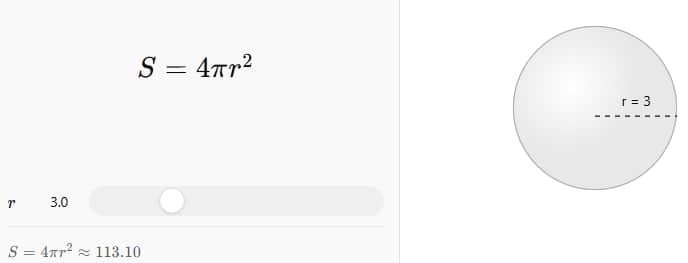
This formula is used whenever the radius of the sphere is known.
In the formula:
$S=4\pi r^2$
$S$ = Surface area of sphere
$r$ = Radius of sphere
$\pi$ = Mathematical constant approximately equal to 3.14159
The radius is the most important quantity because the surface area depends directly on it.
When the radius is known:
$S=4\pi r^2$
Example: If $r=5$ cm, then: $S=4\times\pi\times5^2$
$S=100\pi$ square cm
Since: $r=\frac{d}{2}$ the formula can also be written as: $S=\pi d^2$
where: $d$ is the diameter of the sphere.
This form is useful when the diameter is given directly.
The surface area formula has a fascinating mathematical history.
The relationship between the surface area and radius of a sphere was first studied by the ancient Greek mathematician Archimedes.
He showed that the surface area of a sphere is exactly equal to the curved surface area of the cylinder that just encloses it.
This discovery is considered one of his greatest achievements.
Using advanced geometric methods, mathematicians divide the sphere into infinitely small surface elements.
Adding all these tiny areas together gives:
$S=4\pi r^2$
Modern derivations often use integral calculus to establish the formula rigorously.
The area of a circle is:
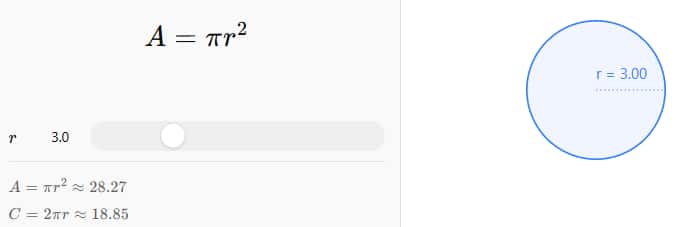
Interestingly:
$4\times(\text{Area of Circle})=4\pi r^2$
Therefore, the surface area of a sphere is four times the area of its largest circular cross-section.
The formula shows that:
Surface area depends on the square of the radius.
Doubling the radius increases the area by four times.
Tripling the radius increases the area by nine times.
This square relationship is fundamental to understanding spherical geometry.
Since a sphere has no flat faces, its entire surface is curved.
The curved surface area is the area occupied by the curved outer boundary of a three-dimensional object.
For a sphere, the entire surface is curved.
For a sphere:
Curved Surface Area = Surface Area
Therefore:
$CSA=4\pi r^2$
For many solids:
Total Surface Area includes flat faces.
Curved Surface Area excludes flat faces.
However, for a sphere:
No flat surfaces exist.
Both values are identical.
If a spherical water tank needs painting, the paint covers only the curved outer surface.
Thus, the required paint area equals: $4\pi r^2$
The surface area formula exhibits several important mathematical properties.
Surface area depends entirely on the radius.
Formula: $S\propto r^2$
A small increase in radius produces a much larger increase in surface area.
If: $r\rightarrow2r$
then: $S\rightarrow4S$
If: $r\rightarrow3r$
then: $S\rightarrow9S$
Thus, surface area grows with the square of the radius.
The volume of a sphere is:
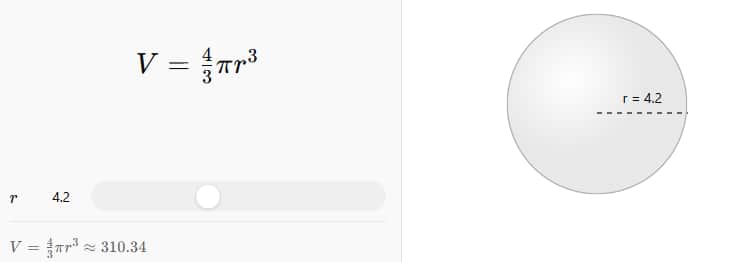
Both volume and surface area depend on the radius but grow at different rates.
Surface Area:
$\propto r^2$
Volume:
$\propto r^3$
Important properties include:
Always positive.
Depends on radius squared.
Increases rapidly with radius.
Symmetric in all directions.
Since surface area measures a two-dimensional quantity, it is expressed in square units.
Examples:
$\text{cm}^2$
$\text{m}^2$
$\text{km}^2$
The exponent 2 indicates area measurement.
Common metric units include:
| Unit | Meaning |
|---|---|
| $\text{mm}^2$ | Square millimetre |
| $\text{cm}^2$ | Square centimetre |
| $\text{m}^2$ | Square metre |
| $\text{km}^2$ | Square kilometre |
Some common conversions are:
$1\text{ m}^2=10,000\text{ cm}^2$
$1\text{ km}^2=1,000,000\text{ m}^2$
Correct unit conversion is essential for accurate answers.
Students often:
Forget to square the units.
Use radius instead of diameter incorrectly.
Substitute incorrect values into the formula.
Ignore unit conversions.
The surface area formula has many practical uses.
Engineers use it for:
Pressure vessels.
Storage tanks.
Ball bearings.
Aerospace components.
Architects use spherical surface calculations while designing:
Domes.
Decorative structures.
Curved roofs.
Manufacturers calculate surface area when:
Coating products.
Applying paint.
Estimating material requirements.
Examples include:
Covering sports balls.
Wrapping spherical gifts.
Estimating paint requirements.
Measuring decorative objects.
Although both concepts relate to spheres, they measure different quantities.
Surface area measures the outer covering.
Volume measures the space enclosed inside.
Surface Area:
$S=4\pi r^2$
Volume:
$\frac{4}{3}\pi r^3$
Surface Area:
Painting
Coating
Wrapping
Volume:
Capacity
Storage
Liquid measurement
| Surface Area of Sphere | Volume of Sphere |
|---|---|
| Measures outer surface | Measures enclosed space |
| Unit is square units | Unit is cubic units |
| Depends on $r^2$ | Depends on $r^3$ |
| Used for covering calculations | Used for capacity calculations |
| Formula: $4\pi r^2$ | Formula: $\frac{4}{3}\pi r^3$ |
A strong understanding of mensuration and three-dimensional geometry is essential for mastering sphere-related formulas and applications. The following books provide comprehensive coverage of surface area and volume concepts.
| Book Name | Best For | Why It Helps |
|---|---|---|
| NCERT Mathematics Class 9 & 10 | School Students | Covers mensuration fundamentals clearly |
| Mathematics – R.D. Sharma | Board Exams | Detailed geometry and mensuration examples |
| Quantitative Aptitude – R.S. Aggarwal | Competitive Exams | Practical mensuration questions |
| Objective Mathematics – Arihant | Entrance Exams | Conceptual and application-based problems |
| Fast Track Objective Arithmetic – Rajesh Verma | Aptitude Preparation | Quick problem-solving techniques |
Understanding a few geometric relationships can help solve sphere questions quickly and accurately.
| Trick | Explanation |
|---|---|
| Remember Radius First | Most sphere formulas depend on radius |
| Diameter to Radius | Use $r=\frac{d}{2}$ |
| Surface Area Depends on Radius Squared | Small changes in radius significantly affect area |
| Learn Sphere-Hemisphere Relations | Frequently asked in exams |
| Use $\pi=\frac{22}{7}$ When Needed | Simplifies calculations |
| Keep Units Consistent | Convert units before calculation |
| Square the Radius Carefully | Common source of errors |
These formulas are essential for solving sphere and mensuration problems.
| Concept | Formula |
|---|---|
| Surface Area of Sphere | $4\pi r^2$ |
| Curved Surface Area of Hemisphere | $2\pi r^2$ |
| Total Surface Area of Hemisphere | $3\pi r^2$ |
| Volume of Sphere | $\frac{4}{3}\pi r^3$ |
| Volume of Hemisphere | $\frac{2}{3}\pi r^3$ |
| Diameter | $2r$ |
| Radius from Diameter | $\frac{d}{2}$ |
Example 1: What is the surface area of a sphere whose radius is 10 ft? (Use $\pi=3.14$)
Solution: Given, the radius of the sphere $r=10$ feet.
Surface area of a sphere $=4\pi r^2$
$=4\times3.14\times10^2$
$=4\times3.14\times100$
$=1256\ \text{ft}^2$
$\therefore$ The surface area of the sphere is $1256\ \text{ft}^2$.
Example 2: What is the curved surface area of a sphere if its radius is 2 units?
Solution: Given, the radius of the sphere $r=2$ units.
Surface area of a sphere $=4\pi r^2$
$=4\times3.14\times2^2$
$=4\times3.14\times4$
$=50.24\ \text{units}^2$
$\therefore$ The surface area of the sphere is $50.24\ \text{units}^2$.
Example 3: Find the surface area of a sphere of diameter 21 cm.
Solution: Given, diameter $d=21\ \text{cm}$.
Radius,
$r=\frac{d}{2}=\frac{21}{2}=10.5\ \text{cm}$
Surface area of a sphere $=4\pi r^2$
$=4\times3.14\times10.5\times10.5$
$=1384.74\ \text{cm}^2$
$\therefore$ The surface area of the sphere is $1384.74\ \text{cm}^2$.
Example 4: Find the volume of a sphere of diameter 10 m, rounding your answer to two decimal places (use $\pi=3.14$).
Solution: Given, diameter of the sphere $d=10\ \text{m}$.
Radius,
$r=\frac{d}{2}=\frac{10}{2}=5\ \text{m}$
Volume of a sphere $=\frac{4}{3}\pi r^3$
$=\frac{4}{3}\times3.14\times5^3$
$=\frac{4}{3}\times3.14\times5\times5\times5$
$=\frac{4}{3}\times3.14\times125$
$=523.33\ \text{m}^3$
$\therefore$ The volume of the sphere is $523.33\ \text{m}^3$.
Example 5: A plane passes through the centre of a sphere and forms a circle with a radius of 14 feet. What is the total surface area of the sphere?
Solution: Since the plane passes through the centre of the sphere, the radius of the circle formed is equal to the radius of the sphere.
Radius of the sphere $r=14$ feet.
Surface area of a sphere $=4\pi r^2$
$=4\times3.14\times14^2$
$=4\times3.14\times196$
$=2461.76\ \text{ft}^2$
$\therefore$ The total surface area of the sphere is $2461.76\ \text{ft}^2$.
Mensuration concepts are closely interconnected. Exploring related three-dimensional geometry topics can help develop a deeper understanding of surface area, volume, and geometric measurements.
| Area of Circle | Area of Isosceles Triangle |
| Area of Rectangle | Area of Square |
| Area | Area of Quadrilateral |
| Area of Parallelogram | Area and Perimeter |
| Area of Equilateral Triangle | cm to inches converter |
Frequently Asked Questions (FAQs)
The formula to find the surface area of sphere is 4 times of $\mathrm{pi}(\pi)$ and radiussquared $\left(r^2\right)$.
Surface area of sphere $=4 \pi r^2$
Surface area is measured in square units because it represents a two-dimensional measurement. Common units include cm², m², ft², and in².
If radius $=2 \mathrm{~cm}$
Area of sphere $=4 \pi r^2=4 \pi(2)^2$
$
=16 \pi \mathrm{sq} . \mathrm{cm} .
$
The distance from the centre to the outermost surface is called the radius of the sphere.
Since surface area is proportional to the square of the radius, doubling the radius increases the surface area by four times.

Law Admissions 2026 Open | Avail Merit-Based Scholarships
BBA/MBA/PGDM Early Bird Applications Deadline 06th Nov'26. Apply now using coupon code CAREER250 and get ₹250 off the application fee
Ranked #36 amongst institutions in Management by NIRF | 100% Placement
Globally Recognized by AACSB (US) & AMBA (UK) | 18 LPA Avg. CTC for PGPM 2026
NEET PG All India & State College Predictor with Admission Process Guide
Top B-School: Ranked #9 in NIRF Management Rankings 2025.