


VSAT-based learning: Learn with faculty across the country!
SITTING in the Leap Studio in Gurgaon, Physics teacher Gaurav Singh coaches engineering aspirants at 13 study centres located across the country, including Surat, Patna, Sonepat and Amristar. Leap Studio, the coaching division of education company Educomp is linked to these centres using Very Small Aperture Terminal (VSAT) technology.
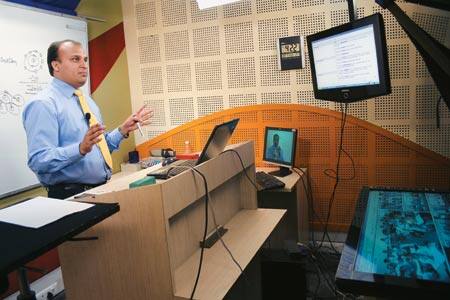
Gaurav’s class today is on the concept of Kinematics. ”If a ball is thrown at a certain angle from the ground it moves along a curve path,” he explains Projectile Motion to his students, demonstrating the concept using the visual of a football match from the recent FIFA World Cup. Big screens across centres light up and a player kicks the ball. Students are instantly attentive; thereafter, explaining Kinematics is a breeze.
At another studio by global networking company, Hughes, management classes for working professionals are being monitored by a team of engineers in a similar set-up. It’s 6.45 p.m., and the Hughes Education Studio in Gurgaon is active.
“But faculty members are seated at four locations i.e., IIM Lucknow, Kozhikode, Mumbai and Kolkata from where they would take the class,” Ranjeet Passi, the centre head in Gurgaon informs us. Hughes began VSAT education in 2001 and has tied up with Institutes such as the IIMs, XLRI, IIFT, MICA and IIT Delhi, to disseminate distance education.
VSAT, is a two-way communication technology with multimedia capabilities. The technology enables communication in real time amongst individuals located in different geographical locations (view image for details).
Is it for you?
Ankur Tandon has headsets on, and his computer flashes a lecture by a professor from IIT Bombay. The lecture is heard clearly. Ankur types out his query from his terminal, which is beamed to the lecturer and 58 other enrollees of the programme. The professor answers his query, and the answer pops up, along with the queries by students at other centres. Ankur is pursuing Advanced Certificate Programme in Business Management, a specialised programme offered by IIT Bombay through Hughes Education. “My classes are on Sunday and I can do my specialised Business Analytics programme, available in IIT Bombay, sitting in Delhi taught by the best of IIT professors,” says Ankur, Management Consultant.
If not for this technology, Ankur could not have tapped and gained this relevant expertise. “This medium allows working professionals to study without having to take a break and that too with the best faculty,” says Ranjeet. Back in Leap Studio, a 24” computer screen captures the students’ activities. The screen flashes 9-10 classrooms at a time of the total 13. The cameras zoom in and out of the classes of all the centers; and then pan out to a student who is asking a question. “Students can’t risk napping or remaining inattentive in the class,” says Riju Gupta, Director, Educomp, Leap. Meanwhile, Gaurav has moved on to white board, to explain a few formulae and their derivation.
| How VSAT works |
| - A satellite technology, VSAT comprises a hub station which has a studio for video-broadcasting. The interactive, real-time, two-way video added with voice and data set-up is increasingly being used for education purposes because of excellent network reliability. - A VSAT studio consists of control server (the mother server that acts as gateway to remote classrooms), agent server (connected to virtual classroom) audio video streaming server, tripod camera, computers and other equipment for interactive communication and archiving the class lectures. - The virtual classrooms have multiple computers and big screens for the students. Each study center has a coordinator and an engineer to help out, should there be any communication breakdown or a query related to the course. |
VSAT-enabled institutions take all the effort to replicate a traditional classroom over and above its technology-oriented offerings like 2-D image, animations, PowerPoint presentations and so on. The pedagogy is designed keeping in view hassle-free information dissemination, interspersed with online assessment of assignments, mock tests and time-bound quizzes, a la conventional style.
“The results are declared in real time that helps students benchmark their competitiveness” says Gaurav. The students can interact freely with the professor; raise questions, and queries, making the interaction as spontaneous and natural as in a regular classroom. There is attendance monitoring system too.
The biggest advantage of VSAT system is that you can archive each session/ lecture, which can be accessed anytime. “So any student who has missed a class can use his login id to access a particular lecture or a test session,” says Riju
But with so many students in logged in at one time, is it difficult to answer all the queries in a class? “One query usually clears the doubts of many students at one go,” says Ankur, suggesting that no chaotic situation arises for asking questions and getting answers for them.
Riju says there’s a cap of 30 students per class at Leap, adding that teacher’s mobile numbers and email ids are with students for clearing any doubt.
Who is using VSAT?
- Everonn Education, a Chennai-based listed education company, through its education arm, Everonn Learning Academy, uses VSAT platform to train students in IT/ITES, management, banking and financial services.
- Leap Centre has 13 locations with 500 enrollments. Plans are on to add 50 more by September.
- Hughes Education has 11 locations and 215 classrooms in 91 cities.
- Banglore-based BASE, an educational training organisation, which trains for IIT-JEE, AIEEE, AIPMT, CET and COMEDK, also uses VSAT platform.In Hughes more than 5000 students, undergo 100 different programmes.
Future of VSAT
VSAT-based learning is a compromise solution between face-to-face learning and web based e-learning. While it almost approximates a class room, it has its own set of disadvantages as well. Cost effective when compared with regular programme, it is expensive when compared with e-learning. But with internet penetration at still very low levels and speed being a major issue, VSAT does offer a via media for millions of student who seek quality teachers but are constrained by access and time.
| RELIABILITY FACTOR |
Pros
Cons
|
