KCC Institute of Legal and Higher Education, Greater Noida
Law Admissions 2026 Open | Avail Merit-Based Scholarships


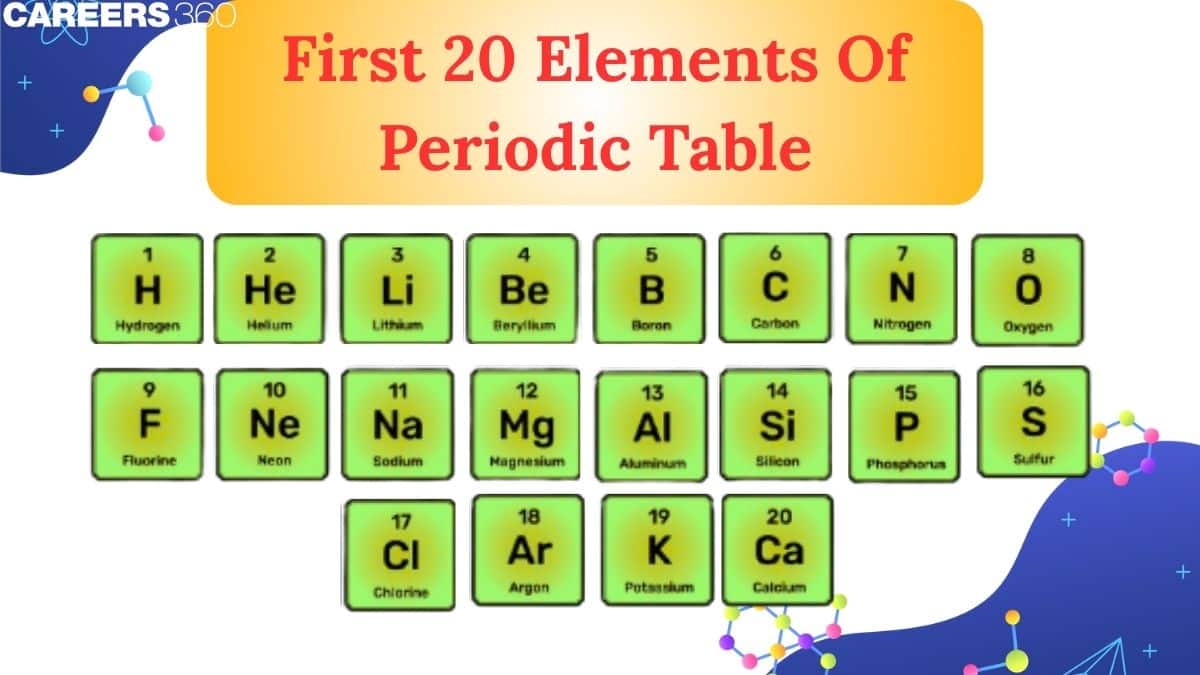
What are the first 20 elements of the periodic table, and why are they so important in chemistry? From hydrogen, the lightest element in the universe, to calcium, an essential component of bones and rocks, these elements are important in our daily lives and research. Studying about the first 20 elements helps to understand atomic structure, chemical properties, periodic trends, and the basis of chemical reactions.
|
Atomic numbers |
Element |
Symbol |
|
|
Hydrogen |
H |
|
|
Helium |
He |
|
|
Lithium |
Li |
|
|
Berilliyum |
Be |
|
|
Boron |
B |
|
|
Carbon |
C |
|
|
Nitrogen |
N |
|
|
Oxygen |
O |
|
|
Fluorine |
F |
|
|
Neon |
Ne |
|
|
Sodium |
Na |
|
|
Magnesium |
Mg |
|
|
Aluminium |
Al |
|
|
Silicon |
Si |
|
|
Phosphorous |
P |
|
|
Sulfur |
S |
|
|
Chlorine |
Cl |
|
|
Argon |
Ar |
|
|
Potassium |
K |
|
|
calcium |
Ca |
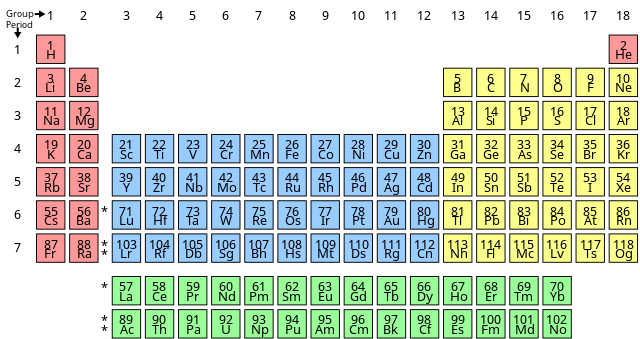
The periodic table is the representation of elements in increasing order of their atomic numbers.
Also Read:
Law Admissions 2026 Open | Avail Merit-Based Scholarships
BBA/MBA/PGDM Early Bird Applications Deadline 06th Nov'26. Apply now using coupon code CAREER250 and get ₹250 off the application fee
The atomic number, element name, or element symbol can all be used to identify elements. A one- or two-letter abbreviation of the name serves as the emblem. Some symbols, on the other hand, allude to old element names. The symbol for sodium for given as Na. This is a reference to the Latin word natrium, which was once used to refer to caustic soda. In Latin, the name of the atomic no of sodium is found to be atrium. Potassium's symbol is K, which is derived from the Latin word kalium, which denoted alkali or potash. An element symbol's initial letter is capitalised. It's lowercase when there's a second letter.
Under normal circumstances, hydrogen is a non-metallic, colourless gas. It transforms into an alkali metal under great pressure. This element has three isotopes, each with a different number of neutrons in its atoms. Protium is the most prevalent isotope. Deuterium and tritium are the other two.
It is a highly reactive solid metal with a silver colour
It is a solid material with a shiny grey- white appearance
Also read -
Question 1: Choose the correct option:
1) (correct)The period of the element is determined by its highest shell
2)The period of the element is determined by its last orbital
3)The period of the element is determined by its valence shell electrons
4)The period of the element is determined by its valency
Solution:
The period of the element is determined by its highest shell.
Hence, the answer is option (1).
Question 2: Which pair of atomic numbers represents s-block elements
1)7,15
2)6,12
3)9,17
4) (correct)3,12
Solution:
Out of the given elements, Z=3 (Li) and Z = 12 (Mg) belong to the s Block of the periodic table.
Hence, the answer is option (4).
Question 3: Newland’s octet law was successful in arranging:
1)Heavier elements
2) (correct)Lighter elements
3)Both
4)None
Solution:
Newland’s octet law was successful in arranging lighter elements. After calcium, this law did not work as expected.
Hence, the answer is option (2).
Question 4: Which of the following pairs of elements among the first 20 elements have the same number of unpaired electrons in their ground-state electronic configurations?
1) N and P
2) O and S
3) C and Si
4) All of these
Solution:
$N(Z=7): 1 s^2 2 s^2 2 p^3 \rightarrow 3$ unpaired electrons
$P(Z=15):[N e] 3 s^2 3 p^3 \rightarrow 3$ unpaired electrons
$\mathrm{O}(\mathrm{Z}=8): 1 \mathrm{~s}^2 2 \mathrm{~s}^2 2 \mathrm{p}^4 \rightarrow 2$ unpaired electrons
$\mathrm{S}(\mathrm{Z}=16):[\mathrm{Ne}] 3 \mathrm{~s}^2 3 \mathrm{p}^4 \rightarrow 2$ unpaired electrons
$\mathrm{C}(\mathrm{Z}=6): 1 \mathrm{~s}^2 2 \mathrm{~s}^2 2 \mathrm{p}^2 \rightarrow 2$ unpaired electrons
Si $(Z=14):[\mathrm{Ne}] 3 s^2 3 p^2 \rightarrow 2$ unpaired electrons
Therefore, all the given pairs have the same number of unpaired electrons.
Hence, the correct answer is option (4)
Question 5: Among the first 20 elements, how many elements have filled valence shells in their ground state?
1) 3
2) 4
3) 5
4) 6
Solution:
Elements with completely filled valence shells are the noble gases:
$\begin{aligned} & \mathrm{He}\left(1 s^2\right) \\ & \mathrm{Ne}\left(2 s^2 2 p^6\right) \\ & \mathrm{Ar}\left(3 s^2 3 p^6\right)\end{aligned}$
Only these three elements among the first 20 elements have completely filled outermost shells.
Hence, the correct answer is option (1)
For more questions to practice, the following MCQs will help in the preparation for competitive examinations
Frequently Asked Questions (FAQs)
Yes, the first 20 elements can be categorized into several groups based on their properties. For example, the first two elements, hydrogen and helium, are gases at room temperature, while lithium, beryllium, sodium, and magnesium are metals. Additionally, carbon, nitrogen, oxygen, and sulfur are essential non-metals. The different categories reflect varying properties, such as reactivity and state of matter.
The properties of the first 20 elements greatly influence their applications in our daily lives. For instance, carbon is a key element in organic chemistry, forming the backbone of biological molecules like proteins and carbohydrates. Oxygen is essential for respiration, while metals like sodium and potassium play crucial roles in physiological functions in living organisms. Moreover, elements like silicon are used in technology, underpinning modern electronics. Understanding these properties can lead to better insights into their practical uses.
The first 20 elements of the periodic table are:
1. Hydrogen (H)
2. Helium (He)
3. Lithium (Li)
4. Beryllium (Be)
5. Boron (B)
6. Carbon (C)
7. Nitrogen (N)
8. Oxygen (O)
9. Fluorine (F)
10. Neon (Ne)
11. Sodium (Na)
12. Magnesium (Mg)
13. Aluminum (Al)
14. Silicon (Si)
15. Phosphorus (P)
16. Sulfur (S)
17. Chlorine (Cl)
18. Argon (Ar)
19. Potassium (K)
20. Calcium (Ca)
These elements represent a range of different properties and are fundamental to many aspects of chemistry.
Each chemical element has a symbol, which is usually derived from its English name or its Latin name. For example, hydrogen is represented by "H" and sodium by "Na," which comes from its Latin name "Natrium." Symbols are used to simplify chemical formulas, equations, and labels for easier communication in science. They help avoid confusion and allow scientists globally to share knowledge efficiently.
Learning about the first 20 elements is crucial because they form the basis of all matter. Understanding these elements helps students grasp fundamental concepts in chemistry, such as bonding, reactions, and the nature of compounds. Many of these elements are vital for life, such as carbon, nitrogen, and oxygen, which are essential components of biological molecules.
In a neutral atom, the number of electrons is equal to the atomic number. For example, Carbon (Atomic number 6) has 6 protons and 6 electrons.

Law Admissions 2026 Open | Avail Merit-Based Scholarships
BBA/MBA/PGDM Early Bird Applications Deadline 06th Nov'26. Apply now using coupon code CAREER250 and get ₹250 off the application fee
Ranked #36 amongst institutions in Management by NIRF | 100% Placement
Globally Recognized by AACSB (US) & AMBA (UK) | 18 LPA Avg. CTC for PGPM 2026
NEET PG All India & State College Predictor with Admission Process Guide
Top B-School: Ranked #9 in NIRF Management Rankings 2025.