


Logarithmic Inequalities: Definition, Problems with Solutions
Imagine comparing the growth of two investments where one doubles rapidly while the other grows much more slowly. Simply comparing the numbers may not reveal the complete picture, especially when logarithms are involved. This is where logarithmic inequalities become useful. They help determine the range of values that satisfy inequalities containing logarithmic expressions and are widely used in algebra, calculus, economics, computer science, and competitive examinations. Solving logarithmic inequalities requires careful attention to the domain of the logarithm and the behavior of logarithmic functions. In this article, we will explore the definition of logarithmic inequalities, the methods to solve them, important properties, solved examples, and practical applications.
This Story also Contains
- What are Logarithmic Inequalities?
- Basics of Logarithms
- Understanding Logarithmic Inequalities
- How to Solve Logarithmic Inequalities?
- Rules and Properties of Logarithmic Inequalities
- Graphical Interpretation of Logarithmic Inequalities
- Common Mistakes While Solving Logarithmic Inequalities
- Applications of Logarithmic Inequalities
- Logarithmic Inequalities vs Logarithmic Equations
- Best Books for Logarithmic Inequalities
- Shortcut Tips and Tricks for Logarithmic Inequalities
- Important Formula Table
- Solved Examples Based On the Logarithmic Inequalities
- Related Topics to Logarithmic Functions
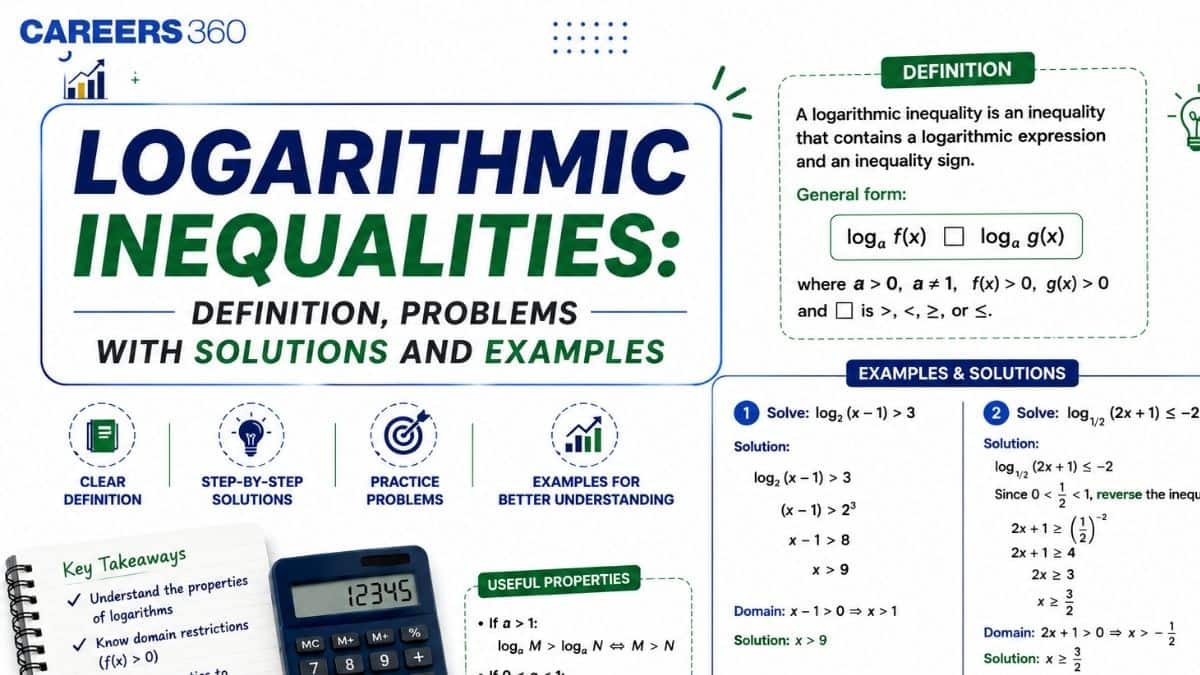
What are Logarithmic Inequalities?
Logarithmic inequalities are mathematical inequalities that contain one or more logarithmic expressions. Instead of finding a single value of the variable, the objective is to determine the set of values that satisfy the inequality. Solving logarithmic inequalities requires understanding logarithmic functions, domain restrictions, and how the value of the logarithmic base affects the direction of the inequality. These inequalities are widely used in algebra, calculus, computer science, economics, and competitive examinations.
Logarithmic Inequalities Meaning in Simple Words
A logarithmic inequality compares logarithmic expressions using symbols such as $>$, $<$, $\geq$, or $\leq$. The goal is to identify all values of the variable that make the inequality true while ensuring that every logarithm involved is defined.
For example,
$\log_2x>3$
means we have to find all values of $x$ whose logarithm to base $2$ is greater than $3$.
Definition of Logarithmic Inequalities
A logarithmic inequality is an inequality involving logarithmic functions, such as
$\log_a(f(x))>\log_a(g(x))$
or
$\log_a(f(x))\le c$
where:
$a>0$
$a\ne1$
$f(x)>0$
$g(x)>0$
The solution consists of all values of $x$ that satisfy both the inequality and the domain conditions of the logarithms.
Why Logarithmic Inequalities are Important
Logarithmic inequalities are important because they help compare exponential quantities and solve problems involving growth and decay. They are useful in:
Solving exponential equations and inequalities.
Studying logarithmic and exponential functions.
Analyzing computer algorithms.
Financial and investment models.
Engineering and scientific calculations.
Competitive examinations such as JEE, CAT, NDA, and CUET.
Real-Life Applications of Logarithmic Inequalities
Logarithmic inequalities appear in many real-world situations, including:
Measuring earthquake intensity using the Richter scale.
Comparing sound intensity using the decibel scale.
Studying bacterial and population growth.
Financial forecasting and compound interest.
Performance analysis of algorithms in computer science.
Basics of Logarithms
Before solving logarithmic inequalities, students should understand logarithms, exponential functions, and the basic logarithmic identities. These concepts make solving inequalities much easier.
What is a Logarithm?
A logarithm tells us the exponent to which a base must be raised to obtain a given number.
Mathematically,
$\log_ab=c\iff a^c=b$
where:
$a$ is the base,
$b$ is the argument,
$c$ is the logarithm.
For example,
$\log_210=3.3219$
because
$2^{3.3219}\approx10$.
Exponential and Logarithmic Forms
Every logarithmic equation can be written in exponential form and vice versa.
For example,
$\log_381=4$
is equivalent to
$3^4=81$
Similarly,
$\log_5100=x$
means
$5^x=100$
Converting between these two forms often simplifies logarithmic inequalities.
Domain and Range of Logarithmic Functions
For the logarithmic function
$y=\log_ax$
the domain is
$x>0$
and the range is
$(-\infty,\infty)$
Since logarithms of zero or negative numbers are undefined, checking the domain is always the first step before solving any logarithmic inequality.
Properties of Logarithms
The most commonly used logarithmic identities are:
Product Rule
$\log_a(MN)=\log_aM+\log_aN$
Quotient Rule
$\log_a\left(\frac{M}{N}\right)=\log_aM-\log_aN$
Power Rule
$\log_a(M^n)=n\log_aM$
Change of Base Formula
$\log_aM=\frac{\log_bM}{\log_ba}$
These identities simplify logarithmic expressions before solving inequalities.
Understanding Logarithmic Inequalities
Logarithmic inequalities behave differently depending on whether the logarithmic function is increasing or decreasing. Therefore, understanding the effect of the logarithm's base is essential for obtaining the correct solution.
Types of Logarithmic Inequalities
Logarithmic inequalities can be classified into several categories:
Simple logarithmic inequalities
Logarithm versus constant inequalities
Logarithm versus logarithm inequalities
Multiple logarithmic inequalities
Compound logarithmic inequalities
Each type follows similar principles but may require different algebraic techniques.
Increasing and Decreasing Logarithmic Functions
If
$a>1$
then
$y=\log_ax$
is an increasing function.
Therefore,
$\log_af(x)>\log_ag(x)$
implies
$f(x)>g(x)$
If
$0<a<1$
then
$y=\log_ax$
is a decreasing function.
Hence,
$\log_af(x)>\log_ag(x)$
implies
$f(x)<g(x)$
Understanding this property is essential because it determines whether the inequality sign remains the same or changes.
Effect of the Base on Inequalities
The value of the logarithmic base directly affects the solution.
If
$a>1$
the inequality sign remains unchanged.
If
$0<a<1$
the inequality sign must be reversed after removing the logarithms.
This is one of the most important rules in logarithmic inequalities.
Domain Restrictions
Every logarithmic expression must satisfy
$\text{Argument}>0$
For example,
$\log_2(x-5)$
requires
$x-5>0$
or
$x>5$
Ignoring the domain often leads to incorrect answers.
How to Solve Logarithmic Inequalities?
Solving logarithmic inequalities involves simplifying logarithmic expressions, applying logarithmic identities, checking the logarithmic base, solving the resulting algebraic inequality, and verifying the final solution.
Step-by-Step Method
The general procedure is:
Determine the domain of every logarithm.
Simplify the logarithmic expressions using identities.
Compare the logarithmic arguments.
Reverse the inequality if the base lies between 0 and 1.
Solve the resulting algebraic inequality.
Verify that the obtained solutions satisfy the original inequality.
Solving When the Base is Greater Than 1
If
$a>1$
then the logarithmic function is increasing.
Hence,
$\log_af(x)\ge\log_ag(x)$
becomes
$f(x)\ge g(x)$
The inequality sign remains unchanged.
Solving When the Base Lies Between 0 and 1
When
$0<a<1$
the logarithmic function decreases.
Therefore,
$\log_af(x)>\log_ag(x)$
becomes
$f(x)<g(x)$
The inequality sign reverses because the function is decreasing.
Verifying the Final Solution
Always substitute the obtained values back into the original inequality.
This eliminates extraneous solutions and ensures that every logarithmic argument remains positive.
Rules and Properties of Logarithmic Inequalities
Logarithmic identities simplify expressions and reduce complicated inequalities into manageable algebraic forms.
Product Rule
The product rule states
$\log_a(MN)=\log_aM+\log_aN$
It combines two logarithmic expressions into one.
Quotient Rule
The quotient rule states
$\log_a\left(\frac{M}{N}\right)=\log_aM-\log_aN$
It is useful when logarithms contain fractions.
Power Rule
The power rule is
$\log_a(M^n)=n\log_aM$
This identity is frequently used to simplify logarithmic inequalities involving exponents.
Change of Base Formula
The change of base formula is
$\log_aM=\frac{\log_bM}{\log_ba}$
It allows logarithms with unfamiliar bases to be converted into common logarithms or natural logarithms.
Graphical Interpretation of Logarithmic Inequalities
Graphs provide a visual understanding of logarithmic inequalities and help identify the intervals where the inequality is satisfied.
Graph of Logarithmic Functions
The graph of
$y=\log_ax$
exists only for
$x>0$
When
$a>1$
the graph increases continuously.
When
$0<a<1$
the graph decreases continuously.
Comparing Two Logarithmic Functions
Plotting two logarithmic functions on the same graph helps determine where one function is greater than or less than the other.
The required solution corresponds to the interval where the desired inequality holds.
Number Line Representation
After solving the inequality, the solution is usually represented on a number line to indicate valid intervals clearly.
This representation makes it easy to interpret the final answer.
Interval Notation
The solution set is commonly written using interval notation.
For example,
$x>3$
is represented as
$(3,\infty)$
Interval notation provides a concise way to describe all possible solutions.
Common Mistakes While Solving Logarithmic Inequalities
Many errors occur because students overlook important logarithmic properties or domain conditions.
Ignoring Domain Restrictions
The argument of every logarithm must always remain positive.
Ignoring this restriction can produce invalid solutions.
Forgetting to Reverse the Inequality
When
$0<a<1$
the inequality sign must be reversed.
Failing to do so results in an incorrect solution.
Incorrect Use of Logarithmic Properties
Students often misuse logarithmic identities or apply them where they are not valid.
Always verify that the required conditions are satisfied before applying any identity.
Not Verifying Solutions
After solving the inequality, every solution should be substituted into the original expression to eliminate extraneous values.
Applications of Logarithmic Inequalities
Logarithmic inequalities are widely used wherever exponential growth or decay occurs.
Applications in Mathematics
They help solve logarithmic and exponential inequalities, analyze functions, and study advanced algebraic models in mathematics.
Applications in Computer Science
Logarithmic inequalities are used in algorithm analysis, binary search, data structures, and computational complexity.
Applications in Economics
Economists use logarithmic models to study inflation, investment growth, and financial forecasting.
Applications in Science
Logarithmic inequalities are applied in chemistry, biology, acoustics, radioactive decay, and earthquake measurements.
Logarithmic Inequalities vs Logarithmic Equations
Although both involve logarithmic expressions, they differ in their objectives and solution methods.
Key Differences
A logarithmic equation requires finding exact values of the variable.
A logarithmic inequality requires finding an interval or range of values that satisfies the inequality.
Similarities
Both require:
Positive logarithmic arguments.
Valid logarithmic bases.
Correct use of logarithmic identities.
Verification of the final answer.
Formula Comparison
A logarithmic equation is written as
$\log_af(x)=\log_ag(x)$
whereas a logarithmic inequality is written as
$\log_af(x)>\log_ag(x)$
or similar inequality symbols.
Comparison Table
| Feature | Logarithmic Equation | Logarithmic Inequality |
|---|---|---|
| Objective | Find exact value(s) | Find a range of values |
| Final Answer | One or more values | Interval or solution set |
| Domain Check | Required | Required |
| Base Condition | Required | Required |
| Inequality Reversal | Not Applicable | Required when $0<a<1$ |
| Verification | Recommended | Essential |
Best Books for Logarithmic Inequalities
Mastering logarithmic inequalities requires a strong understanding of logarithms, exponential functions, and algebraic inequalities. The following books explain these concepts with clear theory and plenty of practice questions.
| Book Name | Best For | Why It Helps |
|---|---|---|
| NCERT Mathematics Class 11 | Beginners | Introduces logarithms and their basic properties |
| Higher Algebra by Hall & Knight | Concept Building | Covers logarithmic equations and inequalities in detail |
| Algebra by Arihant Publications | Competitive Exams | Extensive practice on logarithms and inequalities |
| Cengage Mathematics - Algebra | JEE Preparation | Topic-wise explanations with solved examples |
| Objective Mathematics by R.D. Sharma | School & Entrance Exams | Good collection of objective and subjective questions |
| IIT Mathematics by M.L. Khanna | Advanced Learners | Higher-level logarithmic problem-solving techniques |
Shortcut Tips and Tricks for Logarithmic Inequalities
Logarithmic inequalities often become easier when students remember the properties of logarithms and carefully check the domain before solving.
| Trick | Explanation |
|---|---|
| Check the Domain First | Ensure every logarithm has a positive argument before solving. |
| Identify the Base | If the base is greater than 1, the inequality sign remains unchanged. |
| Reverse the Inequality | If $0<a<1$, reverse the inequality after removing logarithms. |
| Simplify Logarithms | Apply logarithmic identities before solving. |
| Combine Logs | Use product, quotient, and power rules to reduce complexity. |
| Verify Every Solution | Always substitute answers back into the original inequality. |
| Watch for Extraneous Values | Some algebraic steps may introduce invalid solutions. |
Important Formula Table
The following logarithmic identities and formulas are frequently used while solving logarithmic inequalities.
| Concept | Formula |
|---|---|
| Product Rule | $\log_a(MN)=\log_aM+\log_aN$ |
| Quotient Rule | $\log_a\left(\frac{M}{N}\right)=\log_aM-\log_aN$ |
| Power Rule | $\log_a(M^n)=n\log_aM$ |
| Change of Base Formula | $\log_aM=\frac{\log_bM}{\log_ba}$ |
| Exponential Form | $\log_ab=c\iff a^c=b$ |
| Domain Condition | $x>0$ for $\log_a x$ |
| Base Condition | $a>0, a\ne1$ |
Solved Examples Based On the Logarithmic Inequalities
Example 1: What is the value of $x$ satisfying the inequality $\log_5(x+5)>\log_7(x+5)$?
Solution:
First, change the base so that both logarithms have the same base.
Using the change of base formula,
$\log_bx=\frac{\log_ax}{\log_ab}$
we get
$\frac{\log(x+5)}{\log5}>\frac{\log(x+5)}{\log7}$
Since
$\log5<\log7$
the inequality holds only when
$\log(x+5)>0$
Now,
$\log(x+5)>0$
$\Rightarrow x+5>10^0$
$\Rightarrow x+5>1$
$\Rightarrow x>-4$
Hence, the solution is $x>-4$.
Example 2: The number of distinct solutions of the equation
$\log_{\frac{1}{2}}|\sin x|=2-\log_{\frac{1}{2}}|\cos x|$
in the interval $[0,2\pi]$ is ______.
Solution:
Using the logarithmic property,
$\begin{aligned}
\log_{\frac12}|\sin x|+\log_{\frac12}|\cos x|
&=2\
\log_{\frac12}\left(|\sin x||\cos x|\right)
&=2
\end{aligned}$
Since
$2=\log_{\frac12}\left(\frac14\right)$,
we obtain
$\log_{\frac12}\left(|\sin x||\cos x|\right)=\log_{\frac12}\left(\frac14\right)$
Therefore,
$|\sin x||\cos x|=\frac14$
Using
$2\sin x\cos x=\sin2x$,
we get
$|\sin2x|=\frac12$
Hence,
$x=\frac{\pi}{12}+\pi n$
or
$x=\frac{5\pi}{12}+\pi n$
In the interval $[0,2\pi]$, the total number of distinct solutions is 8.
Hence, the answer is 8.
Example 3: Let a complex number $z$, where $|z|\ne1$, satisfy
$\log_{\frac1{\sqrt2}}\left(\frac{|z|+11}{(|z|-1)^2}\right)\le2$.
Find the largest value of $|z|$.
Solution:
Given,
$\log_{\frac1{\sqrt2}}\left(\frac{|z|+11}{(|z|-1)^2}\right)\le2$
Since the base $\frac1{\sqrt2}<1$, the inequality reverses after removing the logarithm.
Thus,
$\frac{|z|+11}{(|z|-1)^2}\ge\frac12$
Multiplying both sides by $2(|z|-1)^2$,
$2|z|+22\ge(|z|-1)^2$
Expanding,
$2|z|+22\ge|z|^2-2|z|+1$
$\Rightarrow |z|^2-4|z|-21\le0$
Factoring,
$(|z|-7)(|z|+3)\le0$
Hence,
$|z|\in[-3,7]$
Since $|z|\ge0$,
$0\le|z|\le7$
Therefore, the largest possible value of $|z|$ is 7.
Hence, the answer is 7.
Example 4: The solution set of the inequality
$1+\log_{\frac13}(x^2+x+1)>0$
is:
Solution:
Given,
$1+\log_{\frac13}(x^2+x+1)>0$
$\Rightarrow\log_{\frac13}(x^2+x+1)>-1$
Since
$-1=\log_{\frac13}3$,
and the base $\frac13<1$, the inequality reverses.
Thus,
$x^2+x+1<3$
$\Rightarrow x^2+x-2<0$
Factoring,
$(x+2)(x-1)<0$
Hence,
$x\in(-2,1)$
Also,
$x^2+x+1>0$
for every real value of $x$.
Therefore, the required solution set is
$x\in(-2,1)$.
Example 5: What is the value of $x$ when
$\log_{\frac12}(x-1)>1$?
Solution:
Given,
$\log_{\frac12}(x-1)>1$
Since the base $\frac12<1$, the inequality reverses.
Therefore,
$x-1<\left(\frac12\right)^1$
$\Rightarrow x-1<\frac12$
Also, the logarithm is defined only when
$x-1>0$
Combining both conditions,
$0<x-1<\frac12$
$\Rightarrow1<x<1.5$
Hence, the solution is $1<x<1.5$.
Related Topics to Logarithmic Functions
Logarithmic inequalities are closely related to logarithms, exponential equations, exponential inequalities, algebraic inequalities, functions, and graphing techniques. Learning these topics helps students solve logarithmic problems more efficiently.
Frequently Asked Questions (FAQs)
The key to working with logarithmic inequalities is the following fact: If a > 1and x > y, then $\log_ax>\log_ay$. Otherwise, if $0 < a < 1$, then $\log_ax<\log_ay$.
You can take the logarithm on both sides of the inequality, if you know the numbers are positive. This produces $log(f(n))≤log(cnk)$
The equality rule says that if you have two logarithms with the same base that are equivalent, then what is inside the logarithms are equivalent to each other.
The base of the logarithm: Can be only positive numbers not equal to 1.
Binary, Natural, Common logarithms.
