KCC Institute of Legal and Higher Education, Greater Noida
Law Admissions 2026 Open | Avail Merit-Based Scholarships


Bacteria are single-celled living organisms that can survive on their own in various environments, like soil, water, or inside living hosts, and can be beneficial or harmful. Viruses, however, are tiny infectious particles that are not truly "alive" on their own; they need to infect a host cell to replicate and spread. On this page, we will learn about the definition of Viruses And Bacteria, their structure and composition, their reproduction, genetic material, metabolism and cellular function, and much more. Bacteria and Viruses is a topic of the chapter Biological Classification in Biology.
This Story also Contains
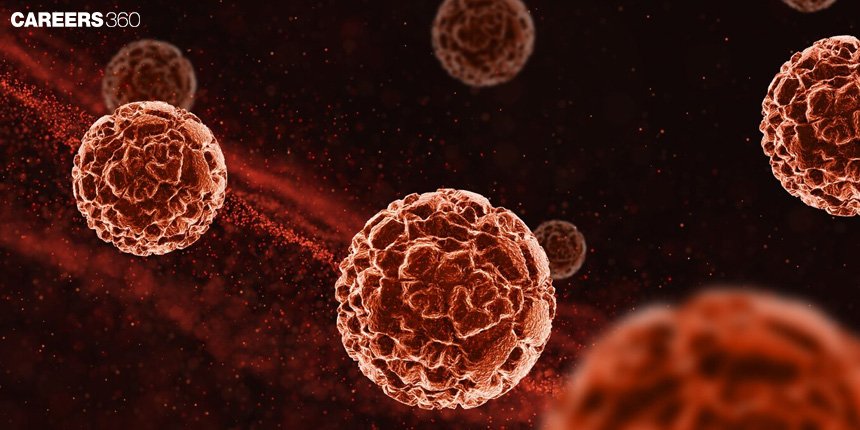
Viruses are small, infective agents that require a host cell to replicate and are mainly composed of genetic material coated with proteins. Bacteria, on the other hand, are single-celled prokaryotic organisms, capable of independent growth and self-reproduction in a wide range of environments.
Knowing the differences between the virus and bacteria is essential for advances in biology and as a foundation for health but more importantly, it identifies proper diagnostic methods, treatment strategies, and prevention measures. Diagnosis will ensure the proper application of antibiotics against bacterial infection or antiviral drugs and vaccines against viral infections guarantees better chances of recovery among patients and helps in the handling conditions concerning public health.
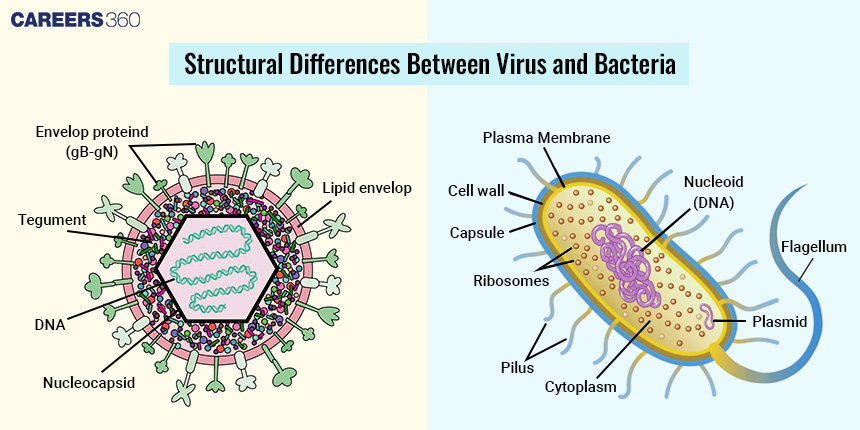
Viruses are mainly composed of genetic material—either DNA or RNA—and their structural components, which only include a capsid covering made of protein. Some virus types have outer lipid envelopes coming from the host cell membrane. The viruses are much smaller than bacteria and eukaryotic cells. They range in size from 20 to 300 nanometers, with most bacteria falling in the size range of about 1 to 5 micrometers.
Law Admissions 2026 Open | Avail Merit-Based Scholarships
BBA/MBA/PGDM Early Bird Applications Deadline 06th Nov'26. Apply now using coupon code CAREER250 and get ₹250 off the application fee
Bacteria are single-celled organisms. Their structure is thus somewhat more complex: they have a rigid cell wall that provides shape, protection, and hence a defined form. They have a plasma membrane controlling the exchange of substances and have cytoplasm where the cellular functions take place. Their genetic material typically consists of a single circular DNA molecule found in the nucleoid region. This makes them many times larger than viruses and visible under light microscopy.
Also read-
It is one of the important differences and comparison articles in biology. The following describes the difference between Virus and Bacteria-
Feature | Virus | Bacteria |
Size | Generally smaller (20-300 nm) | Larger (0.2-10 µm) |
Structure | Simple structure, protein coat (capsid), sometimes with a lipid envelope | More complex, cell wall, cell membrane, cytoplasm |
Cell Type | Acellular (not a cell) | Prokaryotic (single-celled organism) |
Genetic Material | Either DNA or RNA, not both | Both DNA and RNA |
Reproduction | Requires a host cell to reproduce | Reproduces independently through binary fission |
Metabolism | No metabolism on its own | Has metabolic pathways, can generate energy |
Living Status | Considered non-living outside a host | Living organisms |
Treatment | Antiviral drugs and vaccines | Antibiotics |
Diseases Caused | Influenza, HIV, COVID-19, etc. | Tuberculosis, strep throat, urinary tract infections, etc. |
Shape | Various shapes (helical, icosahedral, complex) | Various shapes (cocci, bacilli, spirilla) |
Host Dependency | Obligate intracellular parasites | Can live independently, though some are parasitic |
Examples | HIV, Influenza, Coronavirus | E. coli, Streptococcus, Mycobacterium tuberculosis |
The diagram below shows the structural differences between a virus and a bacteria.
Viruses replicate by binding to the host cell, penetrating the membrane, and injecting their genetic material into the host. In the process of replication, viral components take over the cell machinery of the organisms. This results in the assembly of new virions that exit the cell, generally lysing the host cell in the process. Examples include the influenza virus, targeting respiratory cells, and HIV, which infects the immune cells.
The modes of reproduction of bacteria take place predominantly in the form of binary fission. One cell divides into two identical daughter cells. However, genetic material is also exchanged through conjugation, transformation—the uptake of DNA by a cell from its surroundings—and transduction, mediated through bacteriophages. Examples include Escherichia coli, a gut bacterium, and Staphylococcus aureus, common on skin and in the respiratory tract.
Viruses can have either DNA or RNA as their genetic material, with considerable variety in their genetic content and arrangement. Their genomes can be single-stranded or double-stranded, linear or circular, and can range from a few thousand to over a million base pairs in size, depending on the virus type.
Bacteria exclusively have DNA as their genetic material, typically organised in a single circular chromosome. Additionally, bacteria often contain plasmids—small, circular DNA molecules that carry extra genes and can be transferred between bacteria, enhancing genetic diversity and adaptability.
Viruses lack metabolic machinery and cannot perform cellular functions on their own, relying entirely on a host cell for replication. They hijack the host cell's machinery to produce viral components, often disrupting normal cell functions and leading to cell damage or death, which can result in disease.
Bacteria possess independent metabolic functions, enabling them to produce energy, synthesize proteins, and reproduce on their own. They carry out all necessary life processes within their cells, allowing them to thrive in various environments and form complex communities, some of which can be beneficial or pathogenic to humans.
Infection mechanisms of viruses include the lytic cycle—rapid replication, resulting in cell lysis—and the lysogenic cycle. Viral DNA becomes integrated into the host genome, replicating with it until its probable later reactivation. Viruses have host specificity and tropism—they target specific hosts and cell types.
Interactions between Bacteria and their various hosts make them pathogenic or beneficial. Pathogenic bacteria will, therefore, either evade or induce the host immune response, leading to infections. Whereas the beneficial ones, such as gut microbiome, support good health by ensuring digestion and protection from pathogenic microbes.
Viruses are responsible for many diseases that cause adverse effects on human health, among them are the well-known influenza, HIV/AIDS, and COVID-19. Therefore, a vaccination-based preventive measure against viral infection remains a prime strategy in an attempt to combat virus-caused diseases.
Bacteria are responsible for various infections, ranging from bacterial pneumonia and tuberculosis to very serious health problems. The rise of antibiotic resistance is creating huge problems for treatment, as it limits the use of usual antibiotics. New drugs will have to be developed along with other therapies to fight some resistant strains of bacteria.
Viruses play a vital role in ecosystems, driving the dynamics of microbial populations and contributing to viral ecology and biodiversity. Viruses are also being harnessed in biotechnology and gene therapy, in which viral vectors are used to deliver genetic material for therapeutic purposes and to study gene function.
Bacteria are also crucial for the turnover of nutrients: by degrading organic matter, they keep soil fit and sound. On an industrial scale, bacteria are even applied, such as in bioremediation for the cleaning of environmental pollutants or in food processing for the production of certain foodstuffs, like yoghurt and cheese.
Also Read-
Frequently Asked Questions (FAQs)
Viruses are genetic material, either DNA or RNA, encased by a protein coat or, in some, with a covering envelope; By contrast, bacteria are complex in structure and have a cell wall, plasma membrane, cytoplasm, and circular DNA.
They are both able to cause diseases and are studied in microbiology; however, they are fundamentally very different in terms of structure, replication, and independence from hosts.
Both can cause diseases and are studied in microbiology, but they differ fundamentally in structure, replication, and independence from a host.
Both cause diseases, but viruses do so by hijacking host cells for their replication, thus mostly causing damage to those cells or killing them, while bacteria produce toxins, invade tissues, and provoke an immune response that results in disease.
Viruses are microscopic agents of infection that need living host cells to replicate, while bacteria represent single-celled organisms able to grow and reproduce independently.

Law Admissions 2026 Open | Avail Merit-Based Scholarships
BBA/MBA/PGDM Early Bird Applications Deadline 06th Nov'26. Apply now using coupon code CAREER250 and get ₹250 off the application fee
Ranked #36 amongst institutions in Management by NIRF | 100% Placement
Globally Recognized by AACSB (US) & AMBA (UK) | 18 LPA Avg. CTC for PGPM 2026
NEET PG All India & State College Predictor with Admission Process Guide
Top B-School: Ranked #9 in NIRF Management Rankings 2025.