


Gabriel Phthalimide Synthesis, Mechanism - Reaction with FAQs
How can we efficiently synthesize primary amines from alkyl halides without unwanted side reactions? What makes the Gabriel Phthalimide Synthesis a preferred method in organic chemistry for preparing primary amines? You will understand this after reading this article on Gabriel Phtalimide synthesis. The Gabriel phthalimide synthesis is named after the German chemist Siegmund Gabriel. It is a reaction that involves the conversion of primary alkyl halides into primary amines using alkyl halides. Conventionally, the Gabriel synthesis uses potassium phthalimide.
This Story also Contains
- Gabriel Phthalimide Synthesis
- Gabriel Phthalimide Reaction
- Gabriel Synthesis Mechanism
- Some Solved Examples

Gabriel Phthalimide Synthesis
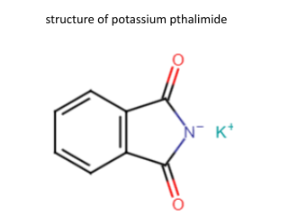
The Gabriel Phthalimide Synthesis is a method for synthesizing primary amines from alkyl halides using phthalimide as a reagent. This reaction is widely used due to its ability to selectively produce primary amines, avoiding the formation of secondary or tertiary amines. The Gabriel phthalimide synthesis has applications in the alkylation of sulfonamides and imides, followed by their deprotection, to obtain amines. The alkylation of ammonia is frequently an extensive and inefficient route to amines. In the Gabriel phthalimide synthesis, phthalimide anion is recruited as a proxy of H2N−.
Gabriel Phthalimide Reaction
The Gabriel Phthalimide Reaction is an important organic reaction used for the preparation of primary aliphatic amines from alkyl halides. In this reaction, potassium phthalimide reacts with an alkyl halide (R–X) to form N-alkyl phthalimide, which on hydrolysis gives a primary amine (R–NH₂).
$\begin{gathered}\mathrm{C}_6 \mathrm{H}_4(\mathrm{CO})_2 \mathrm{NK}+\mathrm{R}-\mathrm{X} \rightarrow \mathrm{C}_6 \mathrm{H}_4(\mathrm{CO})_2 \mathrm{NR}+\mathrm{KX} \\ \mathrm{C}_6 \mathrm{H}_4(\mathrm{CO})_2 \mathrm{NR} \xrightarrow{\text { Hydrolysis }} \mathrm{R}-\mathrm{NH}_2+\text { Phthalic Acid }\end{gathered}$

Related topics link,
Gabriel Synthesis Mechanism
Step 1: Formation of Potassium Phthalimide
Phthalimide is deprotonated by KOH/NaOH to form potassium phthalimide.
.png)
Phthalimide + KOH → Potassium Phthalimide
- The N–H proton of phthalimide is acidic.
- OH⁻ removes this proton.
- Nitrogen acquires a negative charge and becomes nucleophilic.
$\mathrm{C}_6 \mathrm{H}_4(\mathrm{CO})_2 \mathrm{NH}+\mathrm{KOH} \rightarrow \mathrm{C}_6 \mathrm{H}_4(\mathrm{CO})_2 \mathrm{~N}^{-} \mathrm{K}^{+}+\mathrm{H}_2 \mathrm{O}$
Step 2: Alkylation of Potassium Phthalimide (SN2 Step)
.png)
Potassium Phthalimide + R–X → N-Alkyl Phthalimide
- The negatively charged nitrogen attacks the electrophilic carbon of the alkyl halide.
- Halide ion leaves simultaneously.
- The reaction proceeds through an SN2 mechanism.
$\mathrm{C}_6 \mathrm{H}_4(\mathrm{CO})_2 \mathrm{~N}^{-} \mathrm{K}^{+}+\mathrm{R}-\mathrm{X} \rightarrow \mathrm{C}_6 \mathrm{H}_4(\mathrm{CO})_2 \mathrm{NR}+\mathrm{KX}$
Step 3: Nucleophilic Attack by Hydrazine
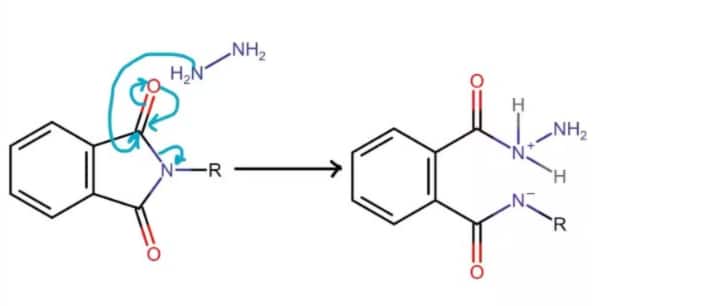
N-Alkyl Phthalimide + NH₂NH₂
- One nitrogen atom of hydrazine attacks the carbonyl carbon.
- A tetrahedral intermediate is formed.
- The carbonyl π-bond shifts to oxygen.
Step 4: Proton Transfer (Deprotonation)
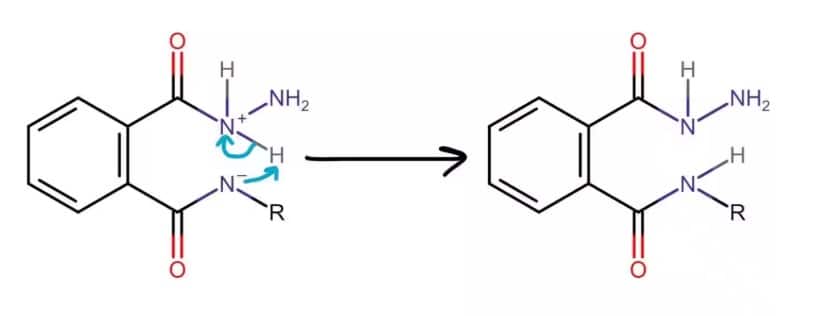
- The phthalimide nitrogen removes a proton from the protonated hydrazine nitrogen.
- An uncharged intermediate is generated.
- This stabilizes the reaction intermediate.
Step 5: Second Nucleophilic Acyl Substitution
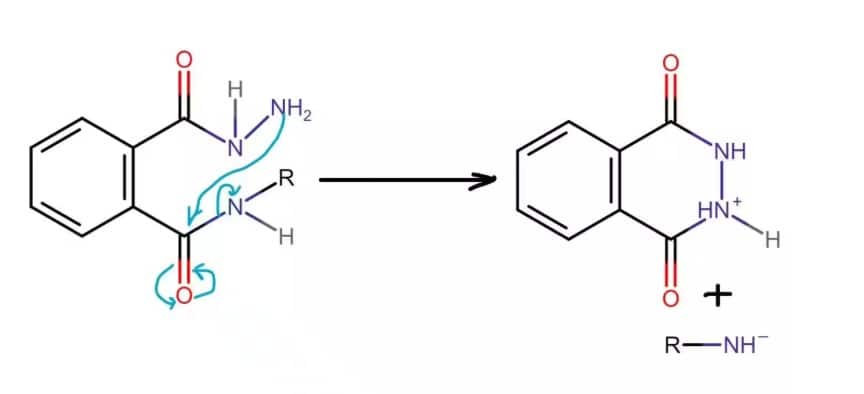
- The remaining NH₂ group of hydrazine attacks the second carbonyl group.
- Ring rearrangement occurs.
- The N–R bond is weakened and cleavage begins.
- The leaving group is RNH⁻.
Step 6: Formation of Primary Amine
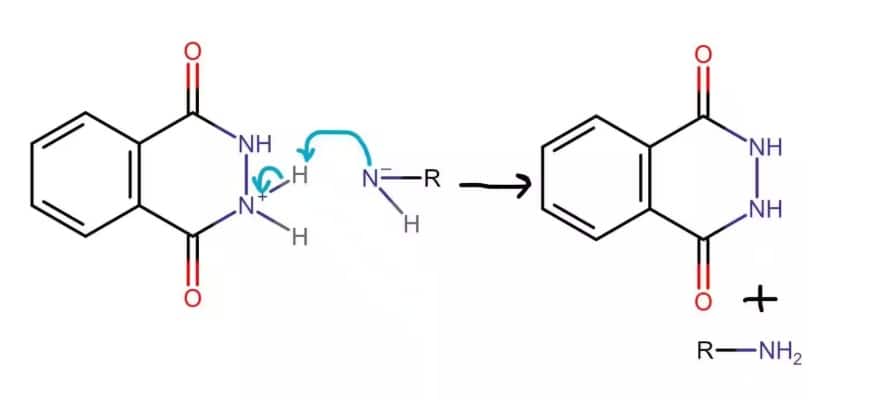
- Proton transfer converts RNH⁻ into RNH₂.
- Phthalhydrazide is formed as a stable by-product.
- Primary amine is liberated.
Also Read
Some Solved Examples
Question 1: Gabriel phthalimide reaction is used in the synthesis of:
1) Primary aromatic amines
2) Secondary amines
3) (correct) Primary aliphatic amines
4) Tertiary amines
Solution:
As we learn
Gabriel phthalimide row is used in the synthesis of primary aliphatic amines.
.png)
Hence, the answer is option (3).
Question 2: Which of the following compounds can be prepared in good yield by Gabriel phthalimide synthesis?
1)

2) $\mathrm{CH}_3-\mathrm{CH}_2-\mathrm{NHCH}_3$
3)
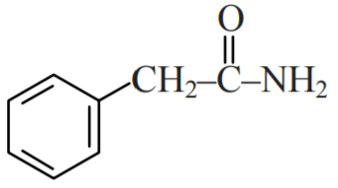
4)
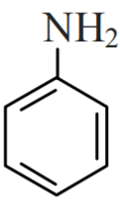
Solution:
Gabriel Phthalimide Synthesis is used for the preparation of 1° Aliphatic amine from an Alkyl halide.

Thus, only Benzylamine can be prepared by Gabriel Phthalimide Synthesis
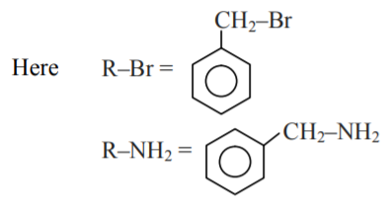
Hence, the answer is the option (1).
Question 3: Number of isomeric aromatic amines with molecular formula $\mathrm{C}_8 \mathrm{H}_{11} \mathrm{~N}_{, \text {, }}$ which can be synthesized by Gabriel Phthalimide synthesis is $\qquad$
Solution:
By Gabriel phthalimide synthesis $\rightarrow$ i-amine is prepared
$\mathrm{C}_8 \mathrm{H}_{11} \mathrm{~N} \rightarrow$ Should be aromatic & i-amine
$\begin{aligned} \text { Degree of unsaturation } & =\mathrm{C}+1-\frac{\mathrm{H}-\mathrm{N}}{2} \\ & =8+1-\frac{11-1}{2} \\ & =9-\frac{10}{2}=9-5=4\end{aligned}$
It means benzene ring
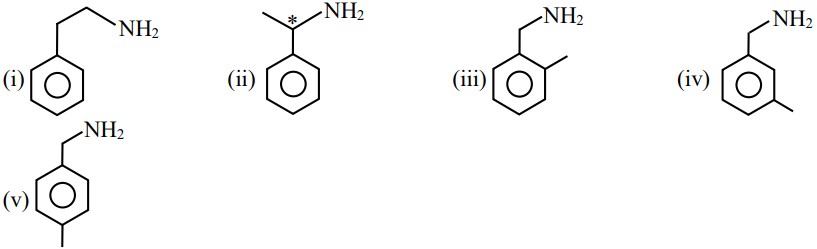
Hence, the correct answer is (6).
Question 4: Which of the following compounds cannot be prepared by Gabriel Phthalimide Synthesis?
A. $\mathrm{CH}_3 \mathrm{NH}_2$
B. $\mathrm{C}_2 \mathrm{H}_5 \mathrm{NH}_2$
C. $\mathrm{C}_6 \mathrm{H}_5 \mathrm{NH}_2$
D. $\mathrm{CH}_3 \mathrm{CH}_2 \mathrm{CH}_2 \mathrm{NH}_2$
Solution:
Gabriel synthesis proceeds through an SN2 mechanism.
For successful SN2 attack, the substrate must be an alkyl halide.
To prepare aniline $\left(\mathrm{C}_6 \mathrm{H}_5 \mathrm{NH}_2\right)$, one would require an aryl halide such as chlorobenzene. $\mathrm{C}_6 \mathrm{H}_5 \mathrm{Cl}$
Aryl halides do not undergo SN2 reactions because:
- The carbon attached to halogen is $\mathbf{s p}^{\mathbf{2}}$ hybridized.
- Backside attack is not possible.
- Partial double-bond character exists in the $\mathrm{C}-\mathrm{X}$ bond.
Therefore, aniline cannot be prepared by Gabriel synthesis.
Hence, the correct answer is option (C)
Question 5:
Practice More Questions With the Link Given Below
| Gabriel Phthalimide Synthesis practice questions and MCQs |
| Gabriel Phthalimide Synthesis practice questions and MCQs |
Frequently Asked Questions (FAQs)
Gabriel phthalimide synthesis is used for preparation of primary amines
Gabriel synthesis is used for the preparation of primary amines.
The Gabriel synthesis or Gabriel phthalimide synthesis is named after the German chemist Siegmund Gabriel. Gabriel phthalimide synthesis is a chemical reaction that converts primary alkyl halides into primary amines using alkyl halides. Conventionally, the Gabriel synthesis uses potassium phthalimide
Named after | Sigmund Gabriel |
Reaction type | Substitution reaction |
The main objective of Gabriel phthalimide synthesis is to form primary amine (RNH2). Gabriel synthesis involves reaction of potassium hydroxide with the phthalimide which forms an imide ion which is a good nucleophile. Nucleophilic substitution takes place from the imide ion on the alkyl halide. This leads to the formation of an intermediate named as N-alkyl phthalimide. Phthalimide then undergoes hydrolysis which yields a primary alkyl amine. However, aryl halides do not undergo simple nucleophilic substitution and thus aryl amines cannot be prepared through Gabriel synthesis. Gabriel synthesis has an advantage of eluding the possibility of over alkylation.
The method by which aniline cannot be prepared is Gabriel phthalimide synthesis. – Aniline is produced by degradation of benzamide with bromine in alkaline solution. This reaction is called Hoffmann bromamide degradation.
N ethyl phthalimide on hydrolysis gives ethyl amine. N-alkyl phthalimide on hydrolysis gives primary amines via nucleophilic substitution reaction mechanism.
Methylamine can be prepared by Hoffmann bromamide reaction which involves reaction of ammonia with methanol in the presence of an aluminosilicate catalyst.
