


Incenter of a Triangle: Formula, Properties and Examples
Among the many special points in a triangle, the incenter holds a unique position because it is the point where all three angle bisectors intersect. It is also the center of the circle inscribed inside a triangle, known as the incircle. The concept of the incenter is widely used in mathematics: coordinate geometry, mensuration, construction problems, and higher geometry. Understanding the incenter of a triangle is essential for solving questions related to angle bisectors, incircles, and geometric properties. In this article, we will explore the definition of the incenter, its formula, properties, construction, solved examples, and real-life applications.
This Story also Contains
- What is the Incenter of a Triangle?
- Incenter of a Triangle Formula
- Properties of the Incenter of a Triangle
- Incenter and Incircle
- How to Find the Incenter of a Triangle?
- Difference Between Incenter, Centroid, Circumcenter, and Orthocenter
- How to Construct the Incenter of a Triangle?
- Best Books for Incenter of a Triangle
- Shortcut Tips and Tricks for Incenter Problems
- Important Formula Table
- Solved Examples Based on Incentre of a Triangle
- NCERT Resources
- List of Topics related to Straight Lines
.png)
What is the Incenter of a Triangle?
The incenter of a triangle is one of the most important triangle centers in geometry. It is the point where the three internal angle bisectors of a triangle intersect. The incenter is always located inside the triangle and serves as the center of the inscribed circle (incircle), which touches all three sides of the triangle.
Incenter Meaning in Simple Words
In simple words, the incenter is the point inside a triangle that is equally distant from all three sides.
It can be thought of as the "center" of the triangle's largest possible circle that fits perfectly inside the triangle.
Definition of Incenter
The incenter of a triangle is the point of intersection of the three internal angle bisectors of the triangle.
If the angle bisectors of $\angle A$, $\angle B$, and $\angle C$ intersect at point $I$, then $I$ is called the incenter of the triangle.
Why the Incenter is Important
The incenter is an important geometric point because it possesses several unique properties.
Importance of the Incenter
- It is the center of the incircle.
- It is equidistant from all three sides of a triangle.
- It helps in solving geometry and mensuration problems.
- It is useful in coordinate geometry calculations.
- It is frequently used in engineering and architectural designs.
- It appears in board exams and competitive examinations.
Real-Life Applications of the Incenter
The concept of the incenter is used whenever an object must be placed at an equal distance from all sides of a triangular region.
| Application | Use of Incenter |
|---|---|
| Architecture | Designing triangular structures |
| Engineering | Optimal placement within triangular regions |
| Surveying | Distance calculations |
| Computer Graphics | Geometric modelling |
| Construction | Circular fitting inside triangular boundaries |
Incenter of a Triangle Formula
The coordinates of the incenter can be calculated using the vertices and side lengths of a triangle.
Coordinate Formula for Incenter
For a triangle with vertices:
$A(x_1,y_1)$
$B(x_2,y_2)$
$C(x_3,y_3)$ and side lengths: $a$, $b$, and $c$ the coordinates of the incenter are: $\left(\frac{ax_1+bx_2+cx_3}{a+b+c},\frac{ay_1+by_2+cy_3}{a+b+c}\right)$
This is the standard incenter formula used in coordinate geometry.
Incenter Using Side Lengths
The incenter is determined by taking a weighted average of the vertex coordinates, where the weights are the lengths of the sides opposite those vertices.
For triangle $ABC$:
- $a = BC$
- $b = AC$
- $c = AB$
The side lengths act as weights in the coordinate formula.
Meaning of Variables in the Formula
| Symbol | Meaning |
|---|---|
| $a$ | Length of side $BC$ |
| $b$ | Length of side $AC$ |
| $c$ | Length of side $AB$ |
| $(x_1,y_1)$ | Coordinates of vertex $A$ |
| $(x_2,y_2)$ | Coordinates of vertex $B$ |
| $(x_3,y_3)$ | Coordinates of vertex $C$ |
| $I$ | Incenter of the triangle |

NOTE:
If ΔABC is an equilateral triangle, then a = b = c
Coordinates of Incentre (I) = Coordinates of Centroid (G) = $\left(\frac{\mathrm{x}_1+\mathrm{x}_2+\mathrm{x}_3}{3}, \frac{\mathrm{y}_1+\mathrm{y}_2+\mathrm{y}_3}{3}\right)$
Derivation of the Incenter Formula
The incenter lies at the intersection of the three angle bisectors.
According to the Angle Bisector Theorem, an angle bisector divides the opposite side in the ratio of the adjacent sides.
Using the equations of two angle bisectors and solving them simultaneously leads to the coordinate formula:
$\left(\frac{ax_1+bx_2+cx_3}{a+b+c},\frac{ay_1+by_2+cy_3}{a+b+c}\right)$
This formula gives the exact location of the incenter in the coordinate plane.
Angle Bisector Method
The simplest method for locating the incenter is to draw the internal angle bisectors of any two angles of the triangle.
The point where they intersect is the incenter.
Geometrical Construction
The geometric construction uses only:
- Ruler
- Compass
- Pencil
No coordinate calculations are required.
The procedure is based entirely on angle bisector construction.
Diagram of Incenter Construction
For triangle $ABC$:
- Draw angle bisector of $\angle A$.
- Draw angle bisector of $\angle B$.
- Let them intersect at $I$.
Point $I$ is the incenter.
A circle drawn with center $I$ and radius equal to the perpendicular distance from $I$ to any side will touch all three sides of the triangle.
Properties of the Incenter of a Triangle
The incenter possesses several important geometric properties.
Intersection of Angle Bisectors
The incenter is formed by the intersection of the three internal angle bisectors.
Every triangle has exactly one incenter.
Equidistant from All Sides
The incenter is equally distant from all three sides of the triangle.
If the perpendicular distances from the incenter to the sides are:
$d_1$, $d_2$, and $d_3$
then: $d_1=d_2=d_3$
This common distance is called the inradius.
Center of the Incircle
The incenter serves as the center of the incircle.
The incircle touches all three sides of the triangle exactly once.
Position of the Incenter in Different Triangles
Unlike some other triangle centers, the incenter is always located inside the triangle.
| Triangle Type | Position of Incenter |
|---|---|
| Acute Triangle | Inside |
| Right Triangle | Inside |
| Obtuse Triangle | Inside |
| Equilateral Triangle | At the common center |
Incenter and Incircle
The incenter and incircle are closely related geometric concepts.
Relationship Between Incenter and Incircle
The incenter is the center of the unique circle that can be drawn inside a triangle touching all three sides.
This circle is called the incircle.
Radius of the Incircle
The radius of the incircle is called the inradius.
It is the perpendicular distance from the incenter to any side of the triangle.
Area Formula Using Inradius
The area of a triangle can be calculated using the inradius.
If: $r$ = inradius
$s$ = semiperimeter
then:
A=rsA=rsA=rs
where:
$s=\frac{a+b+c}{2}$
Applications of the Incircle
The incircle is useful in:
- Geometry constructions
- Engineering design
- Surveying
- Architecture
- Computer graphics
- Optimization problems
How to Find the Incenter of a Triangle?
There are multiple methods to locate the incenter.
Using Coordinate Geometry
When the coordinates of the vertices are known, use:
$\left(\frac{ax_1+bx_2+cx_3}{a+b+c},\frac{ay_1+by_2+cy_3}{a+b+c}\right)$
Using Angle Bisectors
Construct any two internal angle bisectors.
Their point of intersection is the incenter.
Step-by-Step Method
- Find the side lengths.
- Apply the coordinate formula.
- Calculate the weighted average of coordinates.
- Obtain the incenter coordinates.
Solved Examples
Example
Find the incenter of an equilateral triangle.
Since all sides are equal:
$a=b=c$
The formula simplifies to:
$x=\frac{x_1+x_2+x_3}{3}$
$y=\frac{y_1+y_2+y_3}{3}$
Thus, the incenter coincides with the centroid, circumcenter, and orthocenter.
Difference Between Incenter, Centroid, Circumcenter, and Orthocenter
A triangle has four important centers, each obtained differently.
Incenter vs Centroid
| Incenter | Centroid |
|---|---|
| Intersection of angle bisectors | Intersection of medians |
| Center of incircle | Center of mass |
| Always inside triangle | Always inside triangle |
Incenter vs Circumcenter
| Incenter | Circumcenter |
|---|---|
| Equidistant from sides | Equidistant from vertices |
| Center of incircle | Center of circumcircle |
| Always inside triangle | May lie inside or outside |
Incenter vs Orthocenter
| Incenter | Orthocenter |
|---|---|
| Formed by angle bisectors | Formed by altitudes |
| Always inside triangle | May lie inside or outside |
| Center of incircle | No associated circle |
Comparison Table of Triangle Centers
| Triangle Center | Formed By | Main Property |
|---|---|---|
| Incenter | Angle Bisectors | Equidistant from sides |
| Centroid | Medians | Center of mass |
| Circumcenter | Perpendicular Bisectors | Equidistant from vertices |
| Orthocenter | Altitudes | Intersection of altitudes |
Understanding these triangle centers is essential for mastering geometry, coordinate geometry, mensuration, and competitive examination mathematics.
How to Construct the Incenter of a Triangle?
The construction of the incenter of a triangle is possible with the help of a compass.
Steps to construct the incenter of a triangle:
Step 1: Place one of the compass's ends at one of the triangle vertices. The other side of the compass is on one side of the triangle.
Step 2: Draw two arcs on two sides of the triangle using the compass.
Step 3: By using the same width as before, draw two arcs inside the triangle so that they cross each other from the point where each arc crosses the side.
Step 4: Draw a line from the vertex of the triangle to where the two arcs inside the triangle cross.
Step 5: Repeat the same process from the other vertex of the triangle.
Step 6: The point at which the two lines meet or intersect is the incenter of a triangle
Learn more in detail about Straight Lines - Definition, Equations, Properties
Best Books for Incenter of a Triangle
The incenter is an important concept in geometry, coordinate geometry, and mensuration. These books help develop a strong understanding of triangle centers and geometric constructions.
| Book Name | Best For | Why It Helps |
|---|---|---|
| NCERT Mathematics | School & Board Exams | Strong geometry fundamentals |
| R.D. Sharma Geometry | School & Competitive Exams | Extensive geometry coverage |
| Plane Geometry – S.L. Loney | Advanced Geometry | Detailed theoretical concepts |
| Coordinate Geometry – S.L. Loney | Higher Mathematics | Triangle center applications |
| Objective Mathematics – Arihant | Entrance Exams | Geometry practice questions |
Shortcut Tips and Tricks for Incenter Problems
Many geometry questions involving the incenter can be solved faster by remembering its fundamental properties and formulas.
| Trick | Explanation |
|---|---|
| Incenter is the intersection of angle bisectors | Most important property |
| Incenter always lies inside the triangle | True for all triangles |
| Incenter is equidistant from all sides | Key exam fact |
| Incenter is the center of the incircle | Frequently asked concept |
| Use side lengths for coordinate formula | Simplifies calculations |
| Inradius touches all three sides | Important geometry property |
| Distinguish from centroid and circumcenter | Common source of confusion |
Important Formula Table
The following formulas are essential for solving incenter and incircle-related questions in geometry.
| Concept | Formula |
|---|---|
| Incenter Coordinates | $\left(\frac{ax_1+bx_2+cx_3}{a+b+c},\frac{ay_1+by_2+cy_3}{a+b+c}\right)$ |
| Semi-Perimeter | $s=\frac{a+b+c}{2}$ |
| Area Using Inradius | $\Delta=rs$ |
| Inradius Formula | $r=\frac{\Delta}{s}$ |
| Perimeter of Triangle | $a+b+c$ |
| Semi-Perimeter and Inradius Relation | $r=\frac{\Delta}{s}$ |
Solved Examples Based on Incentre of a Triangle
Example 1. Let $A(0,1)$, $B(1,1)$, and $C(1,0)$ be the midpoints of the sides of a triangle whose incenter is $D$. If the focus of the parabola $y^2=4ax$ passing through $D$ is $(\alpha+\beta\sqrt{3},0)$, where $\alpha$ and $\beta$ are rational numbers, find the value of $\frac{\alpha}{\beta^2}$.
Solution:
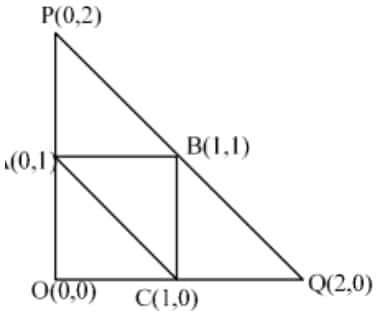
The given midpoints correspond to a triangle with vertices:
$P(0,0),\ Q(0,2),\ R(2,0)$
Side lengths are:
$a=QR=2\sqrt2$
$b=PR=2$
$c=PQ=2$
Using the incenter formula,
$I\left(\frac{ax_1+bx_2+cx_3}{a+b+c},\frac{ay_1+by_2+cy_3}{a+b+c}\right)$
Substituting the coordinates,
$D=\left(\frac{4}{2+2+2\sqrt2},\frac{4}{2+2+2\sqrt2}\right)$
$=\left(\frac{2}{2+\sqrt2},\frac{2}{2+\sqrt2}\right)$
Since $D$ lies on the parabola,
$y^2=4ax$
Substituting the coordinates of $D$,
$\left(\frac{2}{2+\sqrt2}\right)^2=4a\left(\frac{2}{2+\sqrt2}\right)$
$\Rightarrow 4a=\frac{2}{2+\sqrt2}$
$\Rightarrow a=\frac{1}{4}(2-\sqrt2)$
Therefore,
$\alpha=\frac12,\quad \beta=-\frac14$
Hence,
$\frac{\alpha}{\beta^2}$
$=\frac{\frac12}{\left(-\frac14\right)^2}$
$=\frac{\frac12}{\frac1{16}}$
$=8$
Correct Answer: $8$
Example 2. The coordinates of the midpoints of the sides of a triangle are $(0,1)$, $(1,1)$, and $(1,0)$. Find the $x$-coordinate of the incenter of the triangle.
Solution:
The triangle corresponding to these midpoints has vertices:
$(0,0),\ (0,2),\ (2,0)$
$I\left(\frac{a x_1+b x_2+c x_3}{a+b+c}, \frac{a y_1+b y_2+c y_3}{a+b+c}\right)$
- wherein
a,b,c is the length of the sides of ∆ ABC, and $A(x_1,y_1) B(x_2,y_2)$ and $C(x_3,y_3)$ are the vertices.
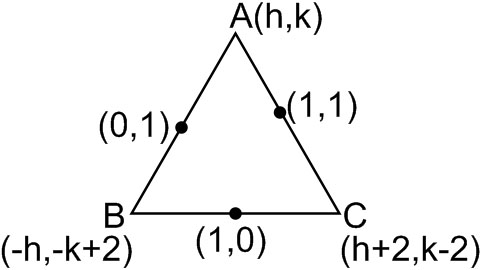
On solving h=0, k=2
Triangle becomes
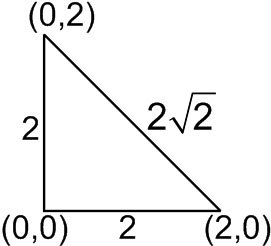
The side lengths are:
$a=2\sqrt2$
$b=2$
$c=2$
Using the incenter formula,
$x=\frac{ax_1+bx_2+cx_3}{a+b+c}$
Substituting values,
$x=\frac{(2\sqrt2)(0)+(2)(0)+(2)(2)}{2\sqrt2+2+2}$
$=\frac{4}{4+2\sqrt2}$
Rationalizing,
$x=\frac{4(4-2\sqrt2)}{16-8}$
$=2-\sqrt2$
Correct Answer: $2-\sqrt2$
Example 3. Let the tangent to the circle $x^2+y^2=25$ at the point $R(3,4)$ meet the coordinate axes at points $P$ and $Q$. If $r$ is the radius of the circle passing through the origin and centered at the incenter of triangle $OPQ$, find $r^2$.
Solution:
The tangent to
$x^2+y^2=25$
at $(3,4)$ is
$3x+4y=25$
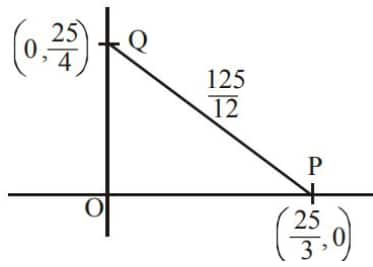
The intercepts are:
$P\left(\frac{25}{3},0\right)$
$Q\left(0,\frac{25}{4}\right)$
and
$O(0,0)$
Using the incenter formula, the incenter is
$I=\left(\frac{25}{12},\frac{25}{12}\right)$
Since the circle passes through the origin,
$r=OI$
Therefore,
$r^2=\left(\frac{25}{12}\right)^2+\left(\frac{25}{12}\right)^2$
$=\frac{625}{144}+\frac{625}{144}$
$=\frac{1250}{144}$
$=\frac{625}{72}$
Correct Answer: $\frac{625}{72}$
Example 4. Find the incenter of the triangle formed by the lines
$y=15,\quad 12y=5x,\quad 3x+4y=0$
Solution:
The vertices of the triangle are:
$(36,15),\ (0,0),\ (-20,15)$
The lengths of the opposite sides are:
$25,\ 56,\ 39$
Using the incenter formula,
$I=\left(\frac{25(36)+56(0)+39(-20)}{25+56+39},\frac{25(15)+56(0)+39(15)}{25+56+39}\right)$
$=\left(\frac{900-780}{120},\frac{375+585}{120}\right)$
$=\left(\frac{120}{120},\frac{960}{120}\right)$
$=(1,8)$
Correct Answer: $(1,8)$
Example 5. Find the incenter of the triangle with vertices
$(1,\sqrt3),\ (0,0),\ (2,0)$
Solution:
Let the vertices be:
$A(1,\sqrt3)$
$B(0,0)$
$C(2,0)$
Using the distance formula,
$AB=\sqrt{(1-0)^2+(\sqrt3-0)^2}$
$=\sqrt{1+3}$
$=2$
Similarly,
$AC=2$
and
$BC=2$
Therefore,
$AB=BC=CA$
Hence, the triangle is equilateral.
For an equilateral triangle:
Incenter = Centroid
Therefore,
$\left(\frac{1+0+2}{3},\frac{\sqrt3+0+0}{3}\right)$
$=\left(1,\frac{\sqrt3}{3}\right)$
$=\left(1,\frac1{\sqrt3}\right)$
Correct Answer: $\left(1,\frac1{\sqrt3}\right)$

NCERT Resources
Students preparing for Class 11 Mathematics can strengthen their understanding of straight lines through NCERT solutions, revision notes, and exemplar problems. These resources help build conceptual clarity, improve problem-solving skills, and provide effective exam preparation support.
NCERT Solutions for Class 11 Maths Chapter 10 Straight Lines
NCERT Class 11 Maths Chapter 10 Notes: Straight Lines
NCERT Exemplar Class 11 Maths Solutions Chapter 10 Straight Lines
List of Topics related to Straight Lines
To develop a strong understanding of coordinate geometry and straight lines, it is important to study related mathematical concepts. These topics help build a solid foundation for solving problems involving slopes, equations of lines, distances, angles, and geometric relationships in two-dimensional coordinate systems.
Frequently Asked Questions (FAQs)
The incenter is the point where the three internal angle bisectors of a triangle intersect.
The incenter is equidistant from all three sides of the triangle.
Yes. The incenter always lies inside the triangle regardless of the type of triangle.
The incenter is the center of the incircle, which is the circle touching all three sides of the triangle.
For a triangle with vertices $(x_1,y_1)$, $(x_2,y_2)$, and $(x_3,y_3)$:
$\left(\frac{ax_1+bx_2+cx_3}{a+b+c},\frac{ay_1+by_2+cy_3}{a+b+c}\right)$
where $a$, $b$, and $c$ are the side lengths opposite the corresponding vertices.
