


Section Formula - Definition, Formulas, Proof and Examples
Imagine you and your friend are holding the two ends of a rope, and you place a small clip somewhere in between to mark a point that divides the rope in a certain ratio. Without even realizing it, you are using the idea behind the Section Formula. In real life, we constantly divide things into parts sharing food, measuring distances, placing objects at equal gaps, or finding the midpoint between two locations on a map. Suppose you know the coordinates of two points on a line and need to find the exact coordinates of a point that divides the line in a specific ratio. Instead of measuring distances manually, mathematics provides a powerful shortcut known as the section formula. One of the most important concepts in coordinate geometry, the section formula helps determine the position of a point dividing a line segment internally or externally. It is widely used in geometry, vectors, engineering, computer graphics, and navigation systems. In this article, we will discuss the section formula, its derivation, internal and external division formulas, solved examples, and real-world applications.
This Story also Contains
- Section Formula in Coordinate Geometry – Definition, Formula and Applications
- Basics of Coordinate Geometry
- Types of Section Formula in Coordinate Geometry
- Internal Division in Section Formula
- External Division in Section Formula
- Section Formula for Midpoint
- Derivation of Section Formula
- Important Results and Shortcuts in Section Formula
- Best Books for Section Formula
- Shortcut Tips and Tricks for Section Formula
- Important Formula Table
- Solved Examples Based on Section Formula
.png)
Section Formula in Coordinate Geometry – Definition, Formula and Applications
The Section Formula is a fundamental concept in coordinate geometry and vector algebra. It is used to find the exact coordinates of a point that divides a line segment in a given ratio. This formula not only helps in calculating the ratio in which a point divides a line but also helps in finding the coordinates of that point accurately. One of its most common applications is finding the midpoint of a line segment, where the ratio is 1:1. The Section Formula plays a vital role in geometry, physics, and engineering problems involving straight-line division and positioning of points.
Definition of Section Formula
When a point lies on a line segment and divides it into two parts in a given ratio, the formula used to find the coordinates of that point is called the Section Formula.
Let a point $P(x, y)$ divide the line segment joining
$A(x_1, y_1)$ and $B(x_2, y_2)$
in the ratio $m:n$. Then the coordinates of point $P$ are given by:
$x=\frac{m x_2+n x_1}{m+n}, \quad y=\frac{m y_2+n y_1}{m+n}$
This formula is mainly used to find the position of a point that divides a line internally or externally in a given ratio.
Basics of Coordinate Geometry
Coordinate geometry, also known as analytical geometry, is a branch of mathematics that combines algebra and geometry to study points, lines, curves, and geometric figures using coordinates. It provides a systematic way to locate positions on a plane and calculate distances, slopes, areas, and other geometric properties. The concepts of coordinate geometry form the foundation for topics such as the section formula, distance formula, midpoint formula, straight lines, circles, conic sections, vectors, and three-dimensional geometry.
Cartesian Coordinate System
The Cartesian Coordinate System is a coordinate plane developed by the French mathematician René Descartes. It consists of two perpendicular number lines called axes that intersect at a common point known as the origin.
Components of the Cartesian Coordinate System
- Horizontal axis: x-axis
- Vertical axis: y-axis
- Intersection point: Origin $(0,0)$
The coordinate plane is divided into four regions called quadrants.
| Quadrant | Sign of x | Sign of y |
|---|---|---|
| First Quadrant | Positive | Positive |
| Second Quadrant | Negative | Positive |
| Third Quadrant | Negative | Negative |
| Fourth Quadrant | Positive | Negative |
Importance of the Cartesian Coordinate System
- Helps locate points precisely.
- Forms the basis of coordinate geometry.
- Used in engineering, physics, navigation, and computer graphics.
- Simplifies geometric calculations using algebraic methods.
For example, the point $(4,3)$ lies 4 units to the right of the origin and 3 units above the x-axis.
Coordinates of a Point
The coordinates of a point describe its exact position on the coordinate plane.
A point is represented as: $(x,y)$
where:
- $x$ is the x-coordinate (abscissa)
- $y$ is the y-coordinate (ordinate)
Understanding Coordinates
For the point $(5,2)$:
- Move 5 units along the x-axis.
- Move 2 units upward along the y-axis.
The resulting location is the point $(5,2)$.
Examples of Coordinates
| Point | Position |
|---|---|
| $(2,3)$ | First Quadrant |
| $(-4,5)$ | Second Quadrant |
| $(-3,-2)$ | Third Quadrant |
| $(6,-1)$ | Fourth Quadrant |
| $(0,0)$ | Origin |
Applications of Coordinates
Coordinates are used to:
- Plot graphs.
- Locate objects on maps.
- Represent positions in navigation systems.
- Model real-world problems mathematically.
Distance Between Two Points
One of the most important concepts in coordinate geometry is finding the distance between two points.
Suppose two points are: $A(x_1,y_1)$ and $B(x_2,y_2)$
The distance between them is calculated using the Distance Formula. $d=\sqrt{(x_1-x_2)^2+(y_1-y_2)^2}$
This formula is derived from the Pythagorean Theorem.
Why Distance Formula is Important
The distance formula helps:
- Measure line segment lengths.
- Verify geometric properties.
- Calculate perimeters and dimensions.
- Solve coordinate geometry problems.
Example
Find the distance between $(1,2)$ and $(4,6)$.
Using the formula:
$d=\sqrt{(4-1)^2+(6-2)^2}$
$d=\sqrt{3^2+4^2}$
$d=\sqrt{9+16}$
$d=\sqrt{25}$
$d=5$
Therefore, the distance between the two points is 5 units.
Line Segment and Ratio Division
A line segment is the shortest path connecting two points in a coordinate plane.
Consider two points:
$A(x_1,y_1)$ and $B(x_2,y_2)$
A point $P$ may divide the line segment $AB$ in a specific ratio.
Internal Division
If point $P$ lies between points $A$ and $B$, it divides the line internally.
For ratio: $AP:PB=m:n$
the coordinates of $P$ are obtained using the section formula.
Internal division is the most common application of the section formula.
External Division
If point $P$ lies outside the line segment but on the same line, it divides the segment externally.
External division is useful in advanced coordinate geometry and vector applications.
Importance of Ratio Division
Ratio division helps in:
- Finding coordinates of unknown points.
- Determining midpoints and centroids.
- Solving geometric constructions.
- Applying section formula concepts.
- Working with vectors and analytical geometry.
Real-Life Applications
The concept of ratio division is widely used in:
- Architecture and design
- Computer graphics
- Navigation systems
- Surveying and mapping
- Engineering drawings
Understanding line segments and ratio division is essential before learning the section formula because the section formula is fundamentally based on dividing a line segment into a given ratio.
Types of Section Formula in Coordinate Geometry
The Section Formula is broadly divided into two important types:
1) Internal Section Formula
When a point divides the line segment internally between two given points in the ratio $m:n$, we use the internal section formula. It means the point lies between points $A$ and $B$. This is the most commonly used form of the section formula in mathematics.
2) External Section Formula
When a point divides the line segment externally in the ratio $m:n$, the point lies outside the line segment joining the two given points. This form is useful when the dividing point is beyond either endpoint of the line.
Let us describe each in detail:
Internal Division in Section Formula
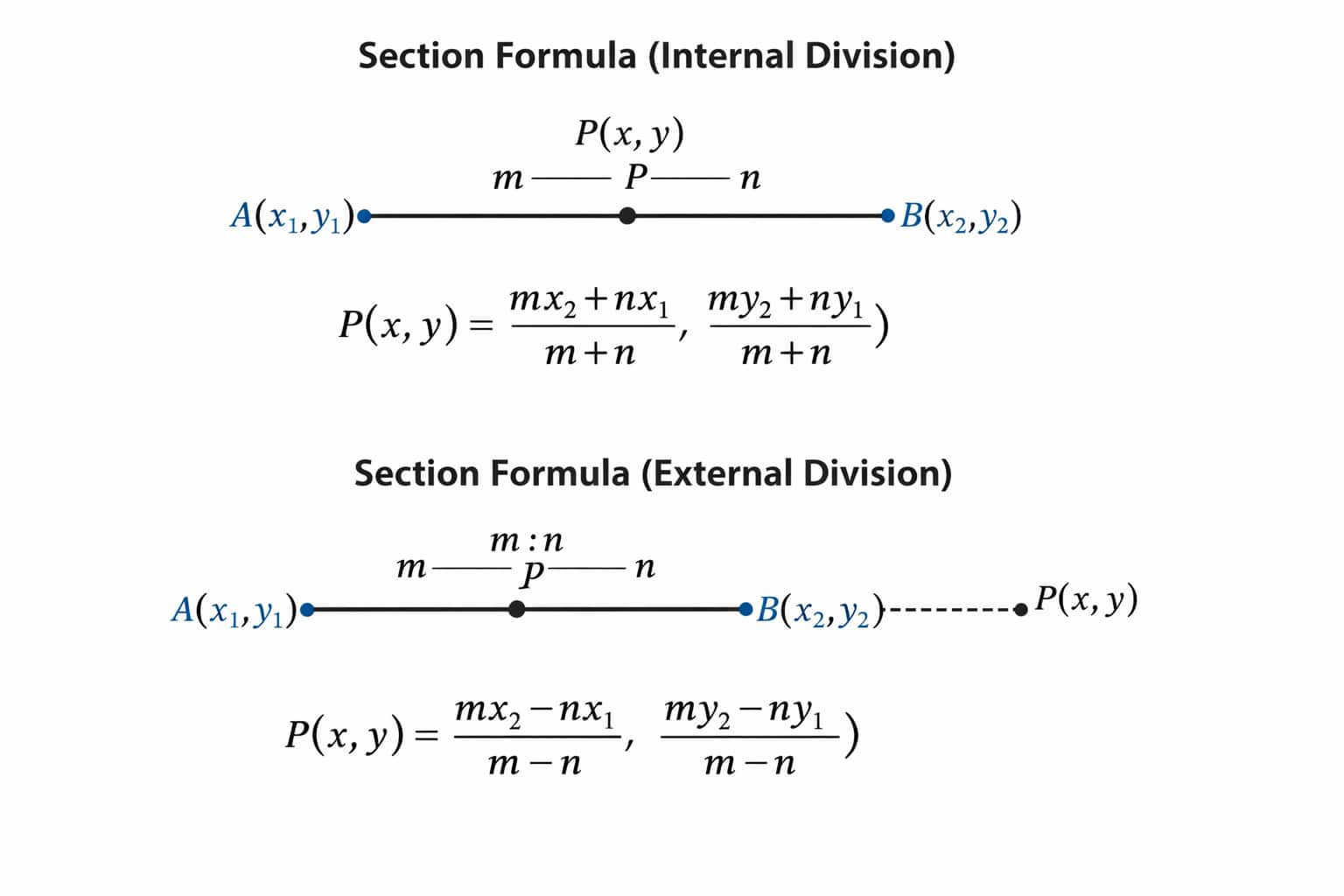
When a point divides a line segment internally, we use the Internal Section Formula. This formula helps us find the coordinates of a point that lies between two given points on a line and divides the line segment in a given ratio. In Vector Algebra, this idea is used to express a point as a weighted combination of two position vectors.
Consider two points $A(x_1, y_1)$ and $B(x_2, y_2)$ in a plane.
If a point $P(x, y)$ lies on the line segment $AB$ and is located somewhere between $A$ and $B$, then $P$ is said to divide $AB$ internally.
If $AP:PB = m:n$, then point $P$ divides $AB$ internally in the ratio $m:n$.
The coordinates of point $P(x, y)$ are given by the Internal Section Formula:
$x=\frac{m x_2+n x_1}{m+n}, \quad y=\frac{m y_2+n y_1}{m+n}$
This formula is one of the most important results in Vector Algebra and Coordinate Geometry, especially for finding midpoints, trisection points, and proportional division of vectors.
External Division in Section Formula
When a point divides a line segment externally, we use the External Section Formula. In this case, the point does not lie between the two given points but lies on the extension of the line beyond either end.
If point $P$ lies on the line joining $A$ and $B$ but not between them, and $AP:BP = m:n$, then $P$ is said to divide $AB$ externally in the ratio $m:n$.
The coordinates of point $P(x, y)$ are given by:
$x=\frac{m x_2-n x_1}{m-n}, \quad y=\frac{m y_2-n y_1}{m-n}$
This form is very useful in vector problems where the dividing point lies outside the given segment.
Section Formula for Midpoint
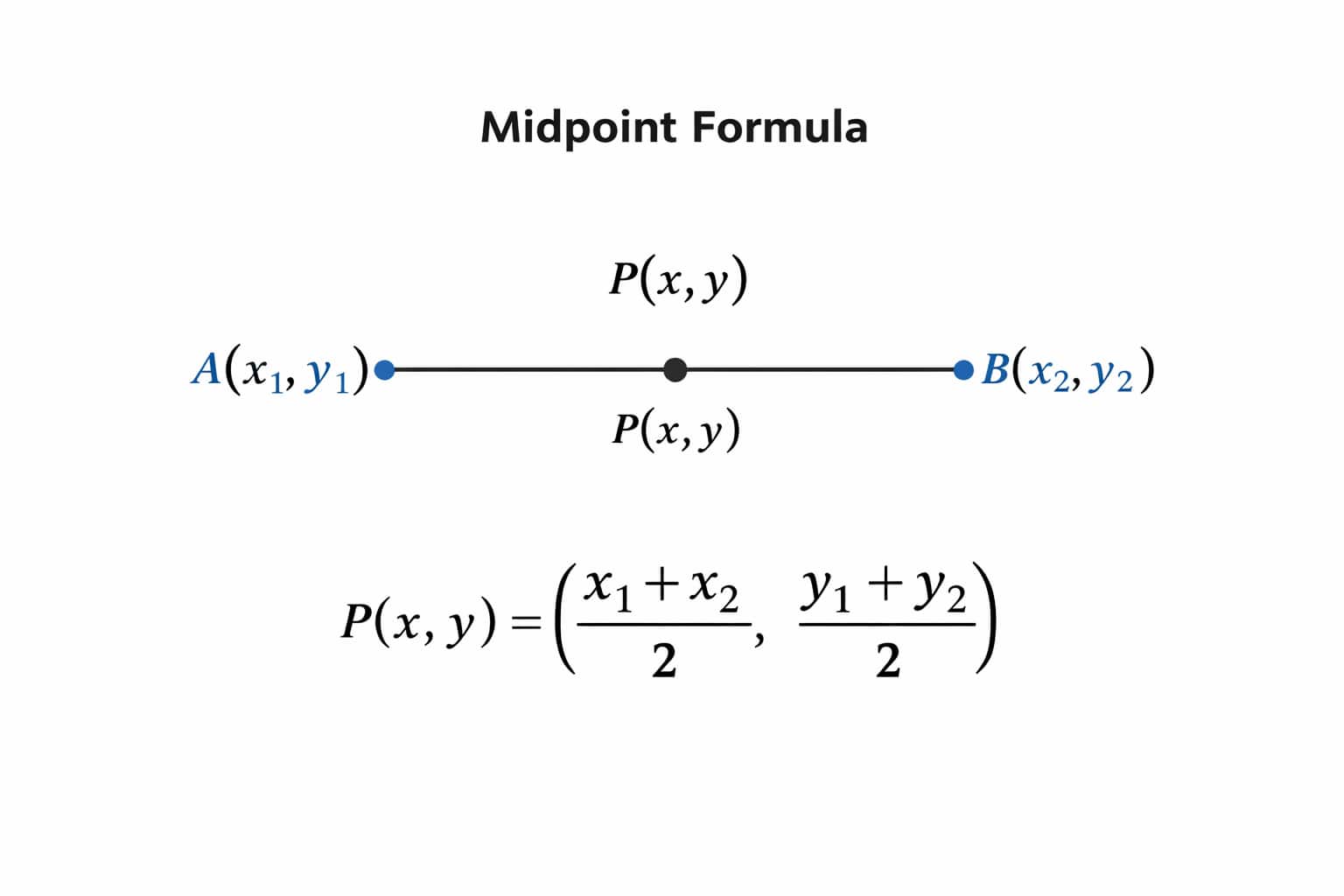
The Midpoint Formula is a special case of the internal division formula where the ratio is $1:1$. A midpoint is the point that lies exactly halfway between two points.
If $P$ is the midpoint of the line segment joining
$A(x_1, y_1)$ and $B(x_2, y_2)$, then:
$x=\frac{x_1+x_2}{2}, \quad y=\frac{y_1+y_2}{2}$
This is one of the most commonly used formulas in Vector Algebra and Coordinate Geometry.
Derivation of Section Formula
The Section Formula can be proved using the concept of similar triangles.
Let point $P(x, y)$ divide the line segment $AB$ internally in the ratio $m:n$.
Draw perpendiculars from points $A$, $P$, and $B$ to form two right-angled triangles $AQP$ and $PRB$.
In triangles $AQP$ and $PRB$:
∠PAQ = ∠BPR (corresponding angles)
∠PQA = ∠BRP = $90^\circ$
Hence, the triangles are similar by AA similarity.
So, $\frac{AP}{PB}=\frac{AQ}{PR}=\frac{PQ}{BR}=\frac{m}{n}$ ...(1)
Using coordinates:
$AQ = x - x_1$ ...(2)
$PR = x_2 - x$ ...(3)
From (1), (2), and (3):
$\frac{x - x_1}{x_2 - x}=\frac{m}{n}$
Solving for $x$:
$x=\frac{m x_2+n x_1}{m+n}$ ...(A)
Similarly, for the $y$-coordinate:
$PQ = y - y_1$ ...(4)
$BR = y_2 - y$ ...(5)
$\frac{y - y_1}{y_2 - y}=\frac{m}{n}$
Solving for $y$:
$y=\frac{m y_2+n y_1}{m+n}$ ...(B)
From (A) and (B), the coordinates of point $P$ are:
$P(x, y)=\left(\frac{m x_2+n x_1}{m+n}, \frac{m y_2+n y_1}{m+n}\right)$
This proves the Internal Section Formula.
Important Results and Shortcuts in Section Formula
Sometimes, instead of using the ratio $m:n$, we use $\lambda:1$ for simplicity.
The internal division formula becomes:
$\left(\frac{\lambda x_2+x_1}{\lambda+1}, \frac{\lambda y_2+y_1}{\lambda+1}\right)$If $\lambda > 0$, the division is internal.
If $\lambda < 0$, the division is external.The coordinates of the points that trisect the line segment $AB$ are:
$\left(\frac{x_1+2x_2}{3}, \frac{y_1+2y_2}{3}\right)$
and
$\left(\frac{2x_1+x_2}{3}, \frac{2y_1+y_2}{3}\right)$
Best Books for Section Formula
The section formula is a fundamental topic in coordinate geometry and forms the basis for advanced concepts such as vectors and analytical geometry. These books provide strong conceptual understanding and practice.
| Book Name | Best For | Why It Helps |
|---|---|---|
| NCERT Mathematics Class 10 & 11 | School Students | Strong foundation in coordinate geometry |
| Coordinate Geometry – S.L. Loney | Advanced Geometry | Comprehensive theory and examples |
| Mathematics – R.D. Sharma | Board Exams | Step-by-step solutions |
| Skills in Mathematics Coordinate Geometry – Arihant | Entrance Exams | Exam-oriented practice |
| Cengage Coordinate Geometry | JEE Preparation | Advanced-level questions |
Shortcut Tips and Tricks for Section Formula
Understanding ratios and coordinate calculations can make section formula problems much easier to solve.
| Trick | Explanation |
|---|---|
| Memorize Internal Division Formula | Most commonly used formula |
| Midpoint is a Special Case | Ratio = $1:1$ |
| Calculate Coordinates Separately | Solve x and y coordinates independently |
| Check Ratio Order | Incorrect ratio placement changes the answer |
| Use Symmetry | Helpful in midpoint problems |
| Simplify Fractions Early | Makes calculations easier |
| Verify Position of Point | Internal division point lies between endpoints |
Important Formula Table
This formula table contains the key formulas used in section formula problems.
| Concept | Formula |
|---|---|
| Internal Division | $\left(\frac{mx_2+nx_1}{m+n},\frac{my_2+ny_1}{m+n}\right)$ |
| External Division | $\left(\frac{mx_2-nx_1}{m-n},\frac{my_2-ny_1}{m-n}\right)$ |
| Midpoint Formula | $\left(\frac{x_1+x_2}{2},\frac{y_1+y_2}{2}\right)$ |
| Distance Formula | $\sqrt{(x_2-x_1)^2+(y_2-y_1)^2}$ |
| Centroid Formula | $\left(\frac{x_1+x_2+x_3}{3},\frac{y_1+y_2+y_3}{3}\right)$ |
Solved Examples Based on Section Formula
Example 1: Let a triangle be bounded by the lines $\mathrm{L}_1: 2 x+5 y=10 ; \mathrm{L}_2:-4 x+3 y=12$ and the line $L_3$, which passes through the point $\mathrm{P}(2,3)$ intersects $\mathrm{L}_2$ at $A$ and $L_1$ at $B$ . If the point P divides the line-segment AB , internally in the ratio $1: 3$,then the area of the triangle is equal to [JEE MAINS 2022]
Solution

Let A be $\left(\mathrm{a}, 4+\frac{4 \mathrm{a}}{3}\right) \quad\left(\because \mathrm{A}\right.$ lies on $\left.\mathrm{L}_2\right)$
and B be $\left(\mathrm{b}, 2-\frac{2}{5} \mathrm{~b}\right) \quad\left(\because \mathrm{B}\right.$ lies on $\left.\mathrm{L}_1\right)$
Using the section formula for point P
$2=\frac{3 \mathrm{a}+\mathrm{b}}{4}$ and $3=\frac{3\left(4+\frac{4 \mathrm{a}}{3}\right)+\left(2-\frac{2 \mathrm{~b}}{5}\right)}{4}$
$\Rightarrow 3 \mathrm{a}+\mathrm{b}=8$ and $4 \mathrm{a}-\frac{2 \mathrm{~b}}{5}=-2$
$\Rightarrow \quad \mathrm{a}=\frac{3}{13}, \mathrm{~b}=\frac{95}{13}$
$\therefore \quad \mathrm{A}$ is $\left(\frac{3}{13}, \frac{56}{13}\right), \mathrm{B}$ is $\left(\frac{95}{13}, \frac{-12}{13}\right)$
$\therefore$ Area of $\triangle \mathrm{ABC}=\frac{1}{2}\left|\begin{array}{ccc}\frac{3}{13} & \frac{56}{13} & 1 \\ \frac{95}{13} & \frac{-12}{13} & 1 \\ \frac{-15}{13} & \frac{32}{13} & 1\end{array}\right|$
$=\frac{132}{13}$
Hence, the correct answer is $\frac{132}{13}$.
Example 2: The locus of a point that divides the line segment joining the point $(0,-1)$ and a point on the parabola,$x^2=4 y$ internally in the ratio $1: 2$ is : [JEE MAINS 2020]
Solution : Let point $P$ be $\left(2 t, t^2\right)$ and $Q$ be $(h, k)$
$
h=\frac{2 t}{3}, k=\frac{-2+t^2}{3}
$
Hence locus is $3 k+2=\left(\frac{3 h}{2}\right)^2 \Rightarrow 9 x^2=12 y+8$
Hence, the answer is 9 x^2-12 y=8
Example 3: Two sides of a parallelogram are along the lines, $x+y=3$ and $x-y+3=0$ . If its diagonals intersect at $(2,4)$ , then one of its vertex is: [JEE MAINS 2019]
Solution: Mid-point formula is given by
$\begin{aligned} & x=\frac{x_1+x_2}{2} \\ & y=\frac{y_1+y_2}{2}\end{aligned}$
If the point P(x,y) is the midpoint of the line joining $\mathrm{A}\left(\mathrm{x}_1, \mathrm{y}_1\right)$ and $\mathrm{B}\left(\mathrm{x}_2, \mathrm{y}_2\right)$.
Two lines
$x+y=3$ and $x-y=-3$ intersects at A (0,3)
Point C is $\left(x_1, y_1\right)$
So,
$\frac{x_1+0}{2}=2 \quad \frac{y_1+4}{2}=4$
$=>C\left(x_1, y_1\right)=C(4,5)$
So, the Equation of BC is $x-y=-1$
and the equation of CD is $x+y=9$
Solve $x+y=9$ and $x-y=-3$
$D(3,6)$
Hence, the answer is $(3,6)$.
Example 4: If in a parallelogram ABDC, the coordinates of A, B, and C are respectively $(1,2),(3,4)$ and $(2,5)$. then the equation of the diagonal AD is: [JEE MAINS 2019]
Solution: Mid-point formula is given by
$\begin{aligned} & x=\frac{x_1+x_2}{2} \\ & y=\frac{y_1+y_2}{2}\end{aligned}$
If the point $P(x, y)$ is the midpoint of the line joining $\mathrm{A}\left(\mathrm{x}_1, \mathrm{y}_1\right)$ and $B\left(x_2, y_2\right)$.
Two–point form of a straight line -
$y-y_1=\left(\frac{y_2-y_1}{x_2-x_1}\right)\left(x-x_1\right)$
The lines pass through $\left(x_1 y_1\right)$ and $\left(x_2 y_2\right)$.
As BD and AC are parallel
$\frac{n-4}{m-3}=\frac{5-2}{2-1}$
$n-4=3(m-3)$..............................(1)
As AB and CD are parallel
$\frac{n-5}{m-2}=\frac{4-2}{3-1}=\frac{2}{2}=1$
$n-5=(m-2)$..............................(2)
Solving (1) and (2)
m=4 and n=7
$\overrightarrow{D A}$ is $(y-2)=\left(\frac{7-2}{4-1}\right)(x-1)$
$=>5 x-3 y+1=0$
Hence, the answer is $5 x-3 y+1=0$.
Example 5: If a circle C, whose radius is 3, touches externally the circle, $x^2+y^2+2 x-4 y-4=0$ at the point $(2,2)$, then the length of the intercept cut by this circle C, on the x-axis, is equal to [JEE MAINS 2018]
Solution: The general form of a circle - $x^2+y^2+2 g x+2 f y+c=0$
centre = $(-g,-f)$
radius = $\sqrt{g^2+f^2-c}$
$S=x^2+y^2+2 g x+2 f y+c=0$
equation of
$C_1 i s(x-5)^2+(y-2)^2=3^2$
$x^2+y^2-10 x-4 y+20=0$
X- intercept = $\left.2 \sqrt{(} g^2-c\right)=2 \sqrt{(25-20)}$
$=2 \sqrt{5}$
Hence, the answer is $2 \sqrt{5}$.
List of Topics Related to Section Formula
This section gives a quick overview of all the important topics covered in Straight Lines: section formula, so you can clearly see what concepts you need to study and how they are connected with each other.
NCERT Resources
This section includes useful NCERT-based materials such as notes, solutions, exemplar solutions that are directly aligned with the syllabus and help in building strong fundamentals.
NCERT Maths Class 11th Notes for Chapter 10 - Straight Lines
NCERT Maths Class 11th Solutions for Chapter 10 - Straight Lines
NCERT Maths Class 11th Exemplar Solutions for Chapter 10 - Straight Lines
Practice Questions based on the Section Formula
This section contains carefully selected questions to help you apply concepts, improve problem-solving skills, and gain confidence through regular practice.
Section Formula- Practice Question MCQ
We have provided below the practice questions based on the topics related to the section formula:
Frequently Asked Questions (FAQs)
The formula used to calculate the ratio in which a point divides the line segment is called the section formula. It is also used to calculate the coordinate of the point which divides the line into two parts.
Yes, the section formula is a key concept in both Vector Algebra and Coordinate Geometry and is often expressed using position vectors.
The coordinates of the point which trisects AB are $\left(\frac{x_1+2 x_2}{3}\right),\left(\frac{y_1+2 y_2}{3}\right)$ or $\left(\frac{2 x_1+x_2}{3}\right),\left(\frac{2 y_1+y_2}{3}\right)$
The internal section formula is used when a point divides a line segment between two points in the ratio $m:n$.
$x=\frac{m x_2+n x_1}{m+n}, ; y=\frac{m y_2+n y_1}{m+n}$
The midpoint formula is a special case of the section formula when the ratio is $1:1$.
$x=\frac{x_1+x_2}{2}, ; y=\frac{y_1+y_2}{2}$