
Search Colleges, Exams, Schools & more


Login
Transformation of Quadratic Equations
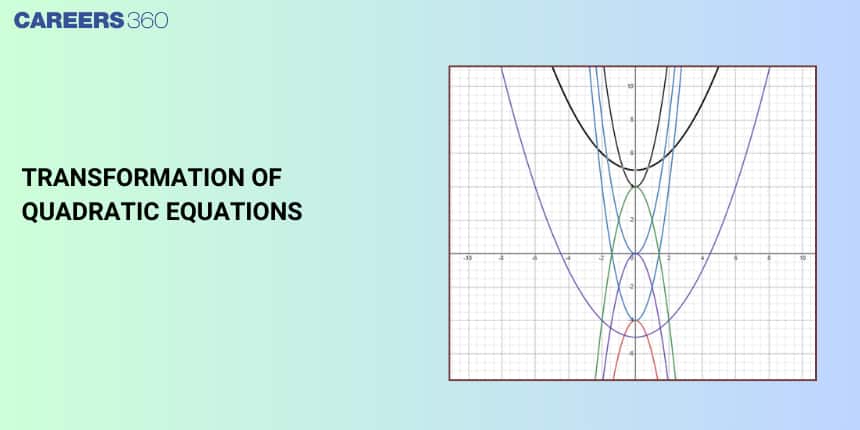
Quadratic Equation plays an important role in mathematics due to their parabolic graphs and numerous applications. Transformation of these equations can help analysts to analyze different insights. The transformation of the parabolic equation includes shape, size, etc. It is useful in real-life applications.
This Story also Contains
- Quadratic Equation:
- Transformation of roots
- Solved Examples Based on Transformation of Quadratic Function:
Quadratic Equation:
A polynomial equation in which the highest degree of a variable term is 2 is called a quadratic equation.
Standard form of quadratic equation is $a x^2+b x+c=0$
Where $\mathrm{a}, \mathrm{b}$, and c are constants (they may be real or imaginary) and called the coefficients of the equation and $a \neq 0$ ( a is also called the leading coefficient).
$
\text { Eg, }-5 x^2-3 x+2=0, x^2=0,(1+i) x^2-3 x+2 i=0
$
As the degree of the quadratic polynomial is 2 , so it always has 2 roots (number of real roots + number of imaginary roots $=2$ )
Roots of quadratic equation
The root of the quadratic equation is given by the formula:
$
\begin{aligned}
& \mathrm{x}=\frac{-\mathrm{b} \pm \sqrt{\mathrm{D}}}{2 \mathrm{a}} \\
& \text { or } \\
& \mathrm{x}=\frac{-\mathrm{b} \pm \sqrt{\mathrm{b}^2-4 \mathrm{ac}}}{2 \mathrm{a}}
\end{aligned}
$
Where $D$ is called the discriminant of the quadratic equation, given by $D=b^2-4 a c$, The discriminant of a quadratic equation reveals the nature of roots.
Equation from roots
A quadratic equation with $\alpha$ and $\beta$ as its roots is $(\mathrm{x}-\alpha)(\mathrm{x}-\beta)=0$
$
\mathrm{x}^2-(\alpha+\beta) \mathrm{x}+\alpha \beta=0
$
So, the equation with given roots can be written as $x^2-$ (sum of roots) $x+($ Product of roots) $=0$
Transformation of roots
Let $\alpha$ and $\beta$ be the roots of quadratic equation $\mathrm{ax}^2+\mathrm{bx}+\mathrm{c}=0$, then
i) the equation with root $\alpha+\mathrm{k}$ and $\beta+\mathrm{k}$ will be
$
a(x-k)^2+b(x-k)+c=0, \quad(\text { replace } \mathrm{x} \text { by } \mathrm{x}-\mathrm{k})
$
ii) the equation with root $\alpha-k$ and $\beta-k$ will be
$
\left.a(x+k)^2+b(x+k)+c=0, \text { (replace } \mathrm{x} \text { by } \mathrm{x}+\mathrm{k}\right)
$
iii) the equation with root $\alpha$ k and $\beta \mathrm{k}$ will be
$
a x^2+k b x+k^2 c=0\left(\text { replace } x \text { by } \frac{x}{k}\right)
$
iv) the equation with root $\frac{\alpha}{k}$ and $\frac{\beta}{k}$ will be $a x^2 k^2+b k x+c=0$ (replace x by kx )
v) the equation with root $\alpha$ and $-\beta$ will be $a x^2-b x+c=0 \quad$ (replace x by -x )
vi) the equation with root $\frac{1}{\alpha}$ and $\frac{1}{\beta}$ will be
$
c x^2+b x+a=0\left(\text { replace } \times \text { by } \frac{1}{x}\right)
$
vii) the equation with root $-\frac{1}{\alpha}$ and $-\frac{1}{\beta}$ will be $c x^2-b x+a=0\left(\right.$ replace $\times$ by $\left.-\frac{1}{x}\right)$
viii) the equation with root $\frac{k}{\alpha}$ and $\frac{k}{\beta}$ will be
$
c x^2+k b x+k^2 a=0\left(\text { replace } \times \text { by } \frac{k}{x}\right)
$
Recommend Video Based on Transformation of Quadratic Equations:
Solved Examples Based on Transformation of Quadratic Function:
Example 1: Let $\alpha, \beta, \gamma$ are roots of $x^3-x^2+1=0$ then the equation whose roots are $\frac{1}{\alpha}, \frac{1}{\beta}, \frac{1}{\gamma}$ is
1) $x^3+x-1=0$
2) $x^3-x+1=0$
3) $x^3+x+1=0$
4) $x^3-x-1=0$
Solution
As we learned in
Transformation of the equation -
To find an equation whose roots are symmetrical functions of $\alpha$ and $\beta$, Where $\alpha \& \beta$ are roots of some other equation.
- wherein
Take any of the roots to be equal to $y$ \& calculate $\alpha$ or $\beta$ accordingly in terms of $y$ \& satisfy the given equation to get required equation.
Let $\frac{1}{\alpha}=y \Rightarrow \alpha=\frac{1}{y}$
Now, $\alpha$ being the root of a given equation will satisfy it, So
$
\begin{aligned}
& \left(\frac{1}{y}\right)^3-\left(\frac{1}{y}\right)^2+1=0 \Rightarrow 1-y+y^3=0 \\
& \Rightarrow y^3-y+1=0
\end{aligned}
$
$\therefore$ equation is $x^3-x+1=0$
Hence, the answer is the option (2).
Example 2: Let $\alpha, \beta, \gamma$ are roots of $x^3+x+1=0$ then the equation with roots $\alpha-1, \beta-1, \gamma-1$ is :
1) $x^3+3 x^2+4 x+3=0$
2) $x^3-3 x^2+4 x+3=0$
3) $x^3-3 x^2-4 x+3=0$
4) $x^3-3 x^2+4 x-3=0$
Solution
As we have learned
Transformation of the equation -
To find an equation whose roots are symmetrical functions of $\alpha$ and $\beta$, Where $\alpha \& \beta$ are roots of some other equation.
- wherein
Take any of the roots to be equal to $y \&$ calculate $\alpha$ or $\beta$ accordingly in terms of $y$ \& satisfy the given equation to get the required equation.
Let $\alpha-1=y \Rightarrow \alpha=y+1$, Now put in the given equation we get -
$
(y+1)^3+(y+1)+1=0 \Rightarrow y^3+3 y^2+4 y+3=0
$
$\therefore$ Equation is $\rightarrow x^3+3 x^2+4 x+3=0$
Hence, the answer is the option (1).
Example 3: If $\alpha, \beta, \gamma$ are roots of $x^3-x+2=0$ then the equation whose roots are $\alpha+\beta+2 \gamma, \beta+\gamma+2 \alpha \& \gamma+\alpha+2 \beta$ will be:
1) $x^3+x-2=0$
2) $x^3+x+2=0$
3) $x^3-x+2=0$
4) $x^3-x-2=0$
Solution
As we learned in
Transformation of the equation -
To find an equation whose roots are symmetrical functions of $\alpha$ and $\beta$, Where $\alpha \& \beta$ are roots of some other equation.
- wherein
Let $y=\alpha+\beta+2 \gamma=\alpha+\beta+\gamma+\gamma=0+\gamma$
$\Rightarrow \gamma=y$
now, $\gamma$ will satisfy the given equation so $y^3-y+2=0$
$\therefore$ equation is $x^3-x+2=0$
Hence, the answer is the option (3).
Example 4: If $\alpha$ and $\beta$ are the roots of the equation $x^2+p x+2=0$ and $\frac{1}{\alpha}$ and $\frac{1}{\beta}$ are the roots of the equation $2 x^2+2 p x+1=0$, then $\left(\alpha-\frac{1}{\alpha}\right)\left(\beta-\frac{1}{\beta}\right)\left(\alpha+\frac{1}{\beta}\right)\left(\beta+\frac{1}{\alpha}\right)$ is equal to:
1) $\frac{9}{4}\left(9+q^2\right)$
2) $\frac{9}{4}\left(9-q^2\right)$
3) $\frac{9}{4}\left(9+p^2\right)$
4) $\frac{9}{4}\left(9-p^2\right)$
Solution
$
\begin{aligned}
& x^2+p x+2=0 \quad \alpha, \beta \\
& 2 x^2+2 p x+1=0 \quad \frac{1}{\alpha}, \frac{1}{\beta}
\end{aligned}
$
$
\begin{aligned}
& \alpha+\beta=-p, \alpha \beta=2 \\
& \frac{1}{\alpha}+\frac{1}{\beta}=-q, \frac{1}{\alpha \beta}=\frac{1}{2} \\
& \left(\alpha-\frac{1}{\alpha}\right)\left(\beta-\frac{1}{\beta}\right)\left(\alpha+\frac{1}{\beta}\right)\left(\beta+\frac{1}{\alpha}\right) \\
& =\left(\alpha \beta-\frac{\alpha}{\beta}-\frac{\beta}{\alpha}+\frac{1}{\alpha \beta}\right)\left(\alpha \beta+2+\frac{1}{\alpha \beta}\right) \\
& =\left(\frac{5}{2}-\frac{\alpha^2+\beta^2}{\alpha \beta}\right)\left(\frac{9}{2}\right) \\
& =\left(\frac{5}{2}-\frac{p^2-4^{-1}}{2}\right)\left(\frac{9}{2}\right) \\
& =\frac{9}{4}\left(9-p^2\right)
\end{aligned}
$
Hence, the answer is the option 4.
Example 5: The number of roots of the equation, $(81)^{\sin ^2 x}+(81)^{\cos ^2 x}=30$ in the interval $[0, \pi]$ is equal to :
1) $4$
2) $2$
3) $8$
4) $3$
Solution
$
\begin{aligned}
& (81)^{\sin ^2 x}+(81)^{\cos ^2 x}=30 \\
& (81)^{\sin ^2 x}+\frac{(81)^1}{(18)^{\sin ^2 x}}=30 \\
& (81)^{\sin ^2 x}=t \\
& t+\frac{81}{t}=30 \\
& t^2-30 t+81=0 \\
& (t-3)(t-27)=0 \\
& (81)^{\sin ^2 x}=3^1 \quad \text { or } \quad(81)^{\sin ^2 x}=3^3 \\
& 3^{4 \sin ^2 x}=3^1 \quad \text { or } \quad 3^{4 \sin ^2 x}=3^3 \\
& \sin ^2 x=\frac{1}{4} \quad \text { or } \quad \sin ^2 x=\frac{3}{4}
\end{aligned}
$

Articles
Upcoming Exams

Study Resources, Applications and Opportunities
Law Admissions 2026 Open | Avail Merit-Based Scholarships
Global Institute of Business Studies, Bengaluru
ApplyBBA/MBA/PGDM Early Bird Applications Deadline 06th Nov'26. Apply now using coupon code CAREER250 and get ₹250 off the application fee
School of Business, UPES, Dehradun
ApplyRanked #36 amongst institutions in Management by NIRF | 100% Placement
Great Lakes Institute of Management, Chennai
ApplyGlobally Recognized by AACSB (US) & AMBA (UK) | 18 LPA Avg. CTC for PGPM 2026
NEET PG College Predictor
ExploreNEET PG All India & State College Predictor with Admission Process Guide
Management Development Institute, Gurgaon
ApplyTop B-School: Ranked #9 in NIRF Management Rankings 2025.