ATIT
Ranked 1 st among Top Law Schools of super Excellence in India - GHRDC | NAAC A+ Accredited | #36 by NIRF


Computers have become an essential part of modern life, influencing almost all aspects of our daily routines; from communication and education to entertainment and healthcare. This article explores the evolution of computers, shedding light on their historical milestones, technological development, and the profound impact generations of computers have had in the field of computer science.
This Story also Contains
Also Read:
Computer history and evolution spans millennia, beginning with the abacus in 2400 BC, advancing through mechanical calculators like Pascal’s PAscaline and Leibniz’s Step Reckoner in the 17th century, and culminating in Charles Babbage;s Analytical Engine in the 1830s. These milestones set the stage for modern programmable computers, revolutionizing mathematical computation and technological innovation.
Abacus and Early Calculating Devices: The abacus, invented around the 2400 BC, is one of the earliest known computing tools. It allowed the users to perform basic mathematics calculations. This laid the foundation for future computing devices by introducing the concepts of representing numerical values and manipulating them efficiently.
Development of Mechanical Calculators in the 17th Century: Notable inventions include Blaise PAscal’s PAscaline and Gottfried Wilhelm Leibniz’s Step Reckoner. Pascal’s Pascaline, created in 1642, was designed to assist with tax calculations. It used gears and wheels to perform addition and subtraction. Leibniz’s Step Reckoner, developed in 1673, could perform all four arithmetic operations, including multiplication and division, using a stepped drum mechanism.
These early devices demonstrated the potential of mechanical solutions for complex calculations.
Analytical Engine: Charles Babbage, an English mathematician and inventor, is often regarded as the ‘Father of the Computer’. In the 1830s, he coneptualized the Analytical Engine, a mechanical general-purpose computer. The Analytical Engine was designed to be programmable, capable of performing any calculation given the appropriate instructions.
It featured components analogous to modern computers, such as an arithmetic logic unit (ALU), control flow through conditional branching and loops, and memory storage.
Concept of a Programmable Computer: The Analytical Engine introduced the groundbreaking idea of a programmable computer. Unlike previous mechanical calculators, which were limited to specific tasks, the Analytical Engine could be reprogrammed to solve various problems. This concept laid the groundwork for modern computing, emphasizing the importance of flexibility and versatility in computational devices.
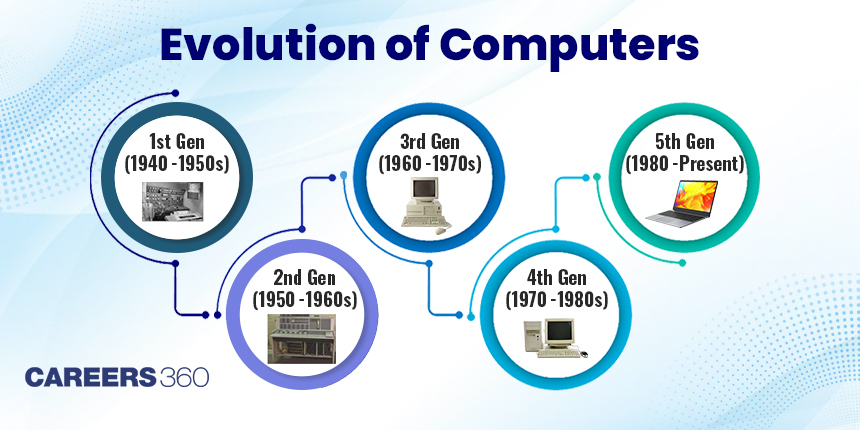
The first generation of computers, emerging in the 1940s, transformed technology with vacuum tube-based circuitry and magnetic drum memory. Examples like ENIAC and UNIVAC pioneered large-scale computation despite size and reliability challenges, setting the stage for modern computing advancements. These advances accelerated the evolution of computers dramatically.
Description and Functionality: The first generation of computers, spanning from the 1940s to the 1950s, relied on vacuum tubes for circuitry and magnetic drums for memory. These tubes are electronic devices that control the flow of electric current in a high vacuum between electrodes to which an electric potential difference has been applied.
These tubes acted as the primary technology for amplifying, switching, and Modifying electrical signals. They were crucial in performing complex calculations, making these early computers capable of handling large-scale computational tasks.
Examples: ENIAC, UNIVAC: Two prominent examples of first-generation computers are the Electronic Numerical Integrator and Computer (ENIAC) and the Universal Automatic Computer (UNIVAC).
ENIAC: Completed in 1945, the ENIAC was one of the earliest electronic general-purpose computers. It was designed to calculate artillery firing tables for the United States Army's Ballistic Research Laboratory.
UNIVAC: The UNIVAC I (Universal Automatic Computer I), completed in 1951, was the first commercially produced computer in the United States. It was designed for business and administrative applications, marking the beginning of the use of computers in commercial industries.
Size: First-generation computers were massive in size, often filling entire rooms. The ENIAC, for instance, weighed about 30 tons and occupied roughly 1,800 square feet.
Heat Production: The reliance on vacuum tubes made these machines very power-hungry and prone to generating significant amounts of heat. This necessitated elaborate cooling systems to manage the heat.
Reliability Issues: This heat production often led to frequent breakdowns and maintenance issues, as the vacuum tubes were not highly reliable and had a relatively short lifespan.
Impact: Despite these limitations, first-generation computers were unique in their ability to perform automated computations, laying the foundation for the future evolution of computer technology.
The second generation of computers emerged in the 1950s and lasted till the mid 1960s. These computers were characterized by the use of transistors instead of vacuum tubes, marking a notable advancement in computer technology. Of all the generations of computers, this was the one that had a profound effect on the development of computers.
Transistors were a key invention that replaced the bulkier and less reliable vacuum tubes. A transistor is a semiconductor device used to amplify or switch electronic signals and electrical power. Compared to vacuum tubes, transistors were smaller, more reliable, and generated less heat, which made them ideal for use in computers. This transition significantly improved the overall performance and efficiency of computers.
The primary advantages of transistors over vacuum tubes are as follows:
Smaller Size: Transistors were much smaller than vacuum tubes, which allowed for the construction of more compact and portable computers.
Increased Reliability: Transistors were more reliable and had a longer lifespan than vacuum tubes, reducing the frequency of maintenance and repairs.
Lower Power Consumption: Transistors consumed less power and generated less heat, which improved the energy efficiency of computers and reduced cooling requirements.
Faster Operation: Transistors could switch on and off much faster than vacuum tubes, resulting in increased processing speeds.
Integrated Circuits (ICs) revolutionized computing in the third generation. These miniature semiconductor devices replaced older technologies, enhancing computer speed, reliability, and affordability. This development, exemplified by IBM's System/360, laid the foundation for smaller, more powerful computers and widespread technological integration.
An Integrated Circuits (ICs) is a small electronic device made out of a semiconductor material, typically silicon, on which thousands of tiny resistors, capacitors, and transistors are fabricated. This miniaturization allowed for the creation of more powerful and reliable computers while reducing their size and cost. Development of ICs was a key moment in the evolution of computers.
The development of ICs revolutionized the computing industry. They replaced the bulkier and less reliable transistors used in second-generation computers, leading to a dramatic increase in processing power and efficiency. ICs enabled computers to become smaller, faster, and more efficient, making them more accessible to businesses and paving the way for the widespread use of computers in various industries.
One of the most notable examples of third-generation computers is the IBM System/360, introduced in 1964. The System/360 series was revolutionary for its use of ICs and for introducing a standardized architecture that could be used across a family of computers. This meant that businesses could upgrade to more powerful systems without needing to rewrite their software, a significant improvement in terms of cost and convenience.
The third generation saw significant advancements in computer technology:
Miniaturization: The use of ICs allowed for the creation of smaller and more compact computer systems. This was a critical step towards the development of personal computers.
Increased Power: ICs enabled computers to perform more complex calculations at faster speeds, enhancing their capabilities and expanding their potential applications.
Cost Efficiency: The production of ICs reduced the manufacturing costs of computers, making them more affordable and accelerating their adoption across various sectors.
Reliability: Computers built with ICs were more reliable and required less maintenance compared to their predecessors, making them more practical for everyday use.
The third generation of computers, powered by integrated circuits, brought about notable improvements in size, speed, efficiency, and cost, setting the stage for the modern computing era.
The fourth generation of computers, marked by the advent of microprocessors. A microprocessor is a single chip containing millions of transistors, integrating the CPU, memory, and input/output controls. The Intel 4004, developed in 1971, was the first microprocessor, leading to significant advancements in computing power and efficiency.
Microcomputers, also known as personal computers (PCs), revolutionized computing by bringing affordable computing power to individuals and small businesses. They include desktops, laptops, and handheld devices like smartphones and tablets. Microcomputers are versatile, handling a wide range of tasks from basic word processing to complex multimedia editing and gaming.
Minicomputers are larger and more powerful than microcomputers but smaller than mainframes. They were popular in the 1970s and 1980s, serving medium-sized businesses and scientific institutions. Minicomputers offered substantial processing power and storage capacity, making them suitable for tasks requiring moderate computational resources, such as database management and scientific research.
Mainframes are robust, high-performance computers used by large organizations like banks, government agencies, and corporations for handling vast amounts of data and supporting critical applications. They excel in reliability, scalability, and security, managing large-scale transaction processing, bulk data processing, and enterprise resource planning (ERP) systems.
Supercomputers represent the highest-level of computational power, designed for solving complex problems requiring massive calculations and simulations. Found in research institutions, universities, and government labs, supercomputers tackle tasks like weather forecasting, molecular modeling, and nuclear simulations. They feature thousands of processors working in parallel to achieve unparalleled performance.
Each type of fourth-generation computer plays a distinct role in computer evolution history, contributing to advancements in technology and expanding the capabilities of modern computing.
Related
The fifth generation of computers mark the integration of artificial intelligence (AI) and machine learning (ML) into modern computing. Unlike previous generations, which focused on hardware advancements, this era focuses on the development of intelligent systems capable of learning, reasoning, and self-improvement. These technologies are driving innovations across various sectors, including healthcare, finance, and education and going forward will significantly impact the evolution of computers.
From the first generation of computers in the 1940s, characterized by bulky vacuum tubes, to the second generation in the 1950s that introduced transistors, each Computer Generation has significantly advanced our computational capabilities. The third generation brought integrated circuits, while the fourth generation saw the advent of microprocessors, making computers more accessible and efficient. The fifth generation emphasizes artificial intelligence and quantum computing, pushing the boundaries of what computers can achieve.

On Question asked by student community
Hello student!
You can check the Karnataka PUC Computer Science Mid-Term Question Papers for 1st PUC and 2nd PUC from the links below. You can also refer to the 2nd PUC Computer Science blueprint to understand the question paper pattern and marks distribution.
Given below are the links to access:
Hello Students,
The Karnataka 2nd PUC Computer Science Mid-Term Exam 2026-27 blueprint is available here. You can check the paper pattern and marks distribution for preparation.
https://school.careers360.com/download/ebooks/karnataka-2nd-puc-computer-science-blue-print-2026-27
Hi!
Stay updated on the below page, the computer science link will be made given as soon it is available:
Hello student!
Given below are the link for Class 11 Tamil Nadu Quarterly Question Paper and Answer Key for Computer Science:
Hello Ayush,
For the WBCHSE Class 12 Semester 3 Computer Science Question Paper 2025, you can access the Careers360 resource below. The Semester 3 exams were conducted in September 2025, and the Computer Science paper is available for download.

Ranked 1 st among Top Law Schools of super Excellence in India - GHRDC | NAAC A+ Accredited | #36 by NIRF
Law Admissions 2026 Open | Avail Merit-Based Scholarships
Get Job Ready in Healthcare | Employability-Focused Programs
Highest CTC: 24 LPA | Average CTC: 12.32 LPA | 85 Placement Partners
Attend 9-Hour Masterclass on 10th October 2026 to help you score 99+ percentile in CAT 2026
Registration Start: 3 August 2026 | Last Date to Apply: 15 September 2026 (till 5 PM)