School of Business, UPES, Dehradun
Ranked #36 amongst institutions in Management by NIRF | 100% Placement


Here's something many students don't hear early enough: there is no single best course for government jobs. What matters most is the exam you prepare for, and the course you pick should help you do that well.
This Story also Contains
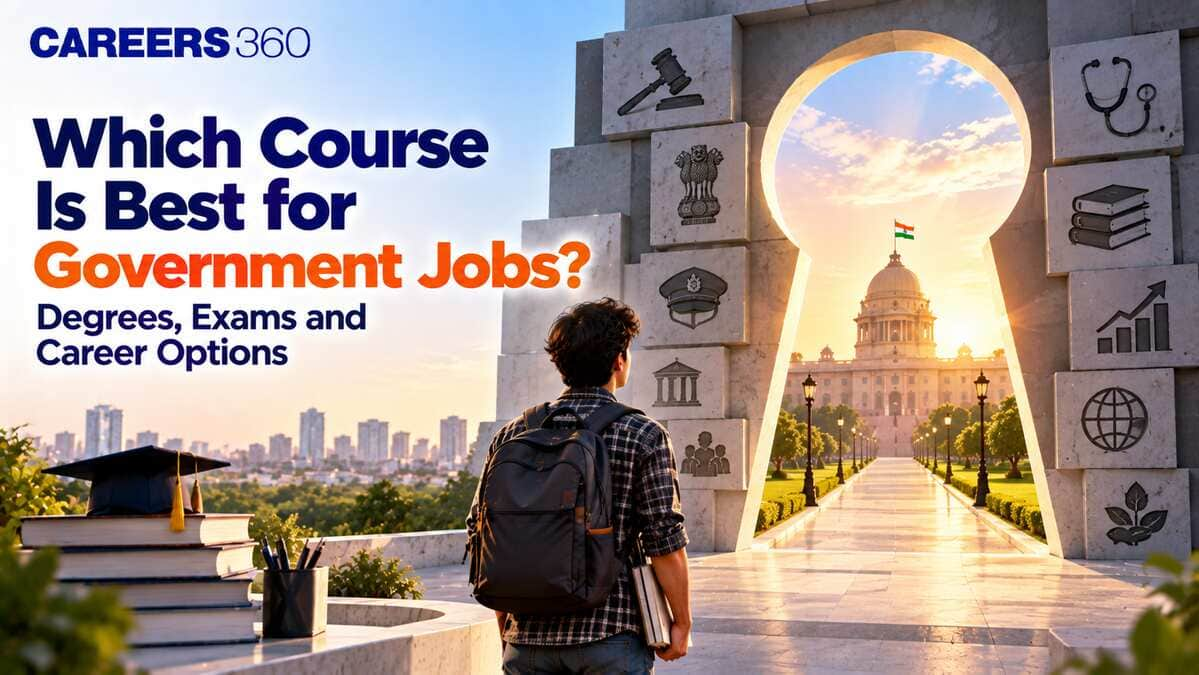
That's actually good news. Most big government exams only ask for a graduation degree, so you can choose a subject you enjoy and still aim for a government job. Let's look at the options.
Government jobs open up at three stages:
Government Jobs After 10th: Some state and railway posts
Government Jobs After 12th: Exams like SSC CHSL, SSC MTS, SSC Stenographer, RRB Group D and NDA can lead to the way of 12th pass government jobs.
Government Jobs After graduation: UPSC, SSC CGL, banking, insurance and many officer-level jobs
You can also read: Best courses after 12th for government jobs
Government job exams like UPSC, SSC CGL, SBI and IBPS PO/Clerk, and insurance exams such as LIC, GIC and NIACL ask only for a graduation degree in any discipline from a recognised university. So your degree doesn't lock you in.
Even so, some degree courses for government jobs fit certain exams better. Let us have a look at the best degree for government jobs:
| Degree | Works Well For | Why |
|---|---|---|
BA (Political Science, History, Economics, Geography) | UPSC, State PSC, SSC | Subjects overlap with exam syllabus |
Banking exams, SSC accounts and clerical posts | Helps with finance, maths and reasoning | |
Banking, management posts | Business and numbers focus | |
B.Ed (after graduation) | Teaching jobs in government schools | Needed along with TET |
Law (LLB, BA LLB) | Legal posts in SEBI, IOCL, public sector banks, courts | Direct subject fit |
Agriculture degrees | Agriculture departments, FCI, NABARD | Subject-specific roles |
Armed forces, technical posts | Many technical and defence entries |
A Simple Tip for Students: Pick the course whose subjects are closest to your exam syllabus. That makes preparation much easier.
A BA for civil services is a popular choice for those who want to do civil services preparation. You can pick subjects like Political Science, History, Economics or Geography, and these show up often in competitive exams.
These suit students who want banking or accounting jobs. B.Com helps you build comfort with numbers and reasoning, which banking exams test heavily.
If you already know you want to teach, this four-year course combines graduation and teacher training in one go and saves you a year. A regular B.Ed is taken after graduation. Teaching posts in places like Kendriya Vidyalayas and Navodaya Vidyalayas also require the Teacher Eligibility Test (TET).
| Exam | Basic Qualification |
|---|---|
UPSC (Civil Services) | Graduation in any discipline |
SSC CGL | Graduation in any discipline |
SBI / IBPS PO and Clerk | Graduation in any discipline |
LIC, GIC, NIACL (Assistant, AAO) | Graduation in any discipline |
NABARD Grade B | Graduation with 50% aggregate |
RBI Assistant | Graduation with 50% aggregate |
RBI Grade B Officer | 60% in 10th, 12th and graduation |
SSC CHSL, MTS, RRB Group D | Class 12 or lower, depending on the post |
CDS | Any degree for IMA and OTA, other posts vary |
Always read the official notification before you apply, because rules change each year.
Civil Services: Choose a BA or any graduation you like, and start UPSC preparation alongside it.
Bank job: Aiming for a bank job? B.Com or BBA gives you a head start, but you can apply with any graduation. What matters more is being comfortable with maths and reasoning, because that's where most of the exam marks come from.
Teaching: Teaching is a clear path. You can take BA B.Ed straight after 12th, or finish a regular degree and add a B.Ed later. Either way, you'll need to clear the TET before applying for government school posts.
Armed forces: For the armed forces, many students go for B.Tech, while others take the NDA route right after Class 12. Pick whichever fits your timeline.
Getting a job quickly: Want to start earning sooner? Look at exams you can give after 12th, like SSC CHSL, SSC MTS or RRB Group D. You can keep studying for your degree while you prepare.
Here is the list of six main paths for government job seekers: Railways, Defence, SSC, Police, Banking and state-level jobs.
Some posts you can aim for:
IAS, IPS, IFS and other civil services
Bank PO and clerk
SSC inspector, auditor and assistant
Insurance officer
Railway officer and clerk
Government school teacher
Agriculture officer
Legal officer in government bodies
Defence officer
Subject-specific roles in banks and financial bodies also exist for IT, law, commerce and language graduates.
A degree is only half the work. Build these habits too:
Read the newspaper daily for current affairs
Practise reasoning and quantitative aptitude
Improve your English and typing speed for clerical posts
Solve previous year papers
Learn basic computer skills like MS Office
Short skill courses in typing and basic computer skills are also helpful to improve your chances for clerical and office jobs.
Ask yourself:
Which exam do I actually want to prepare for?
Which subjects do I enjoy enough to study for three years?
Does this degree match the exam syllabus?
Will I be able to study for the exam alongside my degree classes?
Do I have a backup plan if the exam doesn't work out?
That last one matters. Government job preparation and government job exams are competitive, so a degree you like gives you options either way.
There's no magic course that guarantees a government job. Different degrees open different doors. A BA works well if you're eyeing the civil services; B.Com or BBA can help you in banking exams, B.Ed takes you toward teaching, and a law degree gets you into legal roles. Whatever you pick, start preparing early and read the official exam notification for the latest eligibility rules. It's also smart to keep a backup plan in mind, since these exams are tough to crack. Before you finalise anything, compare your options on Careers360's course pages.

On Question asked by student community
Hello, you can consider RV University, Mysuru. It offers B.Com (Hons.) in International Accounting, integrated with ACCA, as well as B.Tech (Hons.) programmes in Computer Science & Engineering and Electronics & Communication.
Hello, admission on 29 September 2026 may still be possible at some colleges, but it will depend on vacant seats, the college's admission deadline and the admission process. Since you prefer Ahmedabad, please tell me whether you want a regular B.Com course and your Class 12 percentage.
Hey there
Yes, you are eligible for the SSC CGL Junior Statistical Officer (JSO) post if you have studied Statistics as one of the subjects at degree level.
The SSC CGL 2026 notification gives two routes:
60% in Mathematics in Class 12, OR
Statistics as one of the subjects at
Hello, NPTEL offers courses in areas such as Accounting, Finance and Banking that can be useful for B.Com students. You can check the available NPTEL courses here: NPTEL Courses
For Accounting and Finance specifically, check this link: NPTEL Accounting and Financial Analysis Courses

Ranked #36 amongst institutions in Management by NIRF | 100% Placement
Law Admissions 2026 Open | Avail Merit-Based Scholarships
NAAC A Grade | 27+ Years of Excellence in Education | Affiliated to BNU | AICTE & GoK Approved | Scholarships upto 100%
Application Free of Cost for Limited Time || NAAC A++ Accredited | Highest CTC 52 LPA | #11 in University Category by NIRF
B.Com Application Open 2027 | #51-100 in Innovation Category by NIRF | Highest CTC: 11.75 LPA | UGC Approved | 100,000+ Alumni Globally
B. Com, B. Com (H), (7 Specializations) | M. Com, M. Com (H), (4 Specializations) | Highest CTC 18 LPA | 5.5 LPA Average CTC | Sem3 Summer Internship | 200+ Top Brands as Recruiter