University Institute of Engineering, Chandigarh University, Chandigarh
Among top 1% Universities in India (QS World University Rankings 2027)


Walk down any Indian street today and you will spot an e-scooter, an electric auto or a charging point outside a mall. EVs are no longer a “future” thing. Someone has to design the batteries, motors and chargers behind them, and that is where BTech in Electric Vehicle Technology comes in. It is a four-year engineering course built around electric vehicles (EVs). This article covers admission, colleges, eligibility, fees and career scope, and also points out a few things that no one tells you. If you are still comparing branches, look at BTech colleges in India and the top engineering colleges first.
This Story also Contains
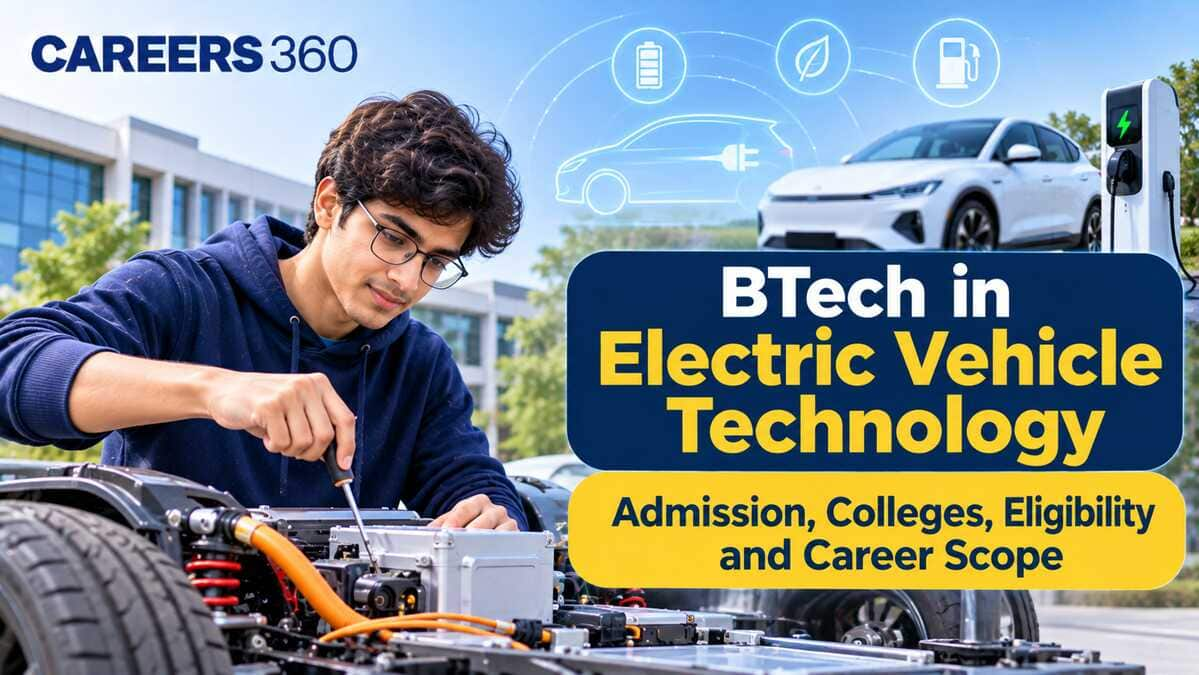
It is an undergraduate engineering degree that mixes electrical, mechanical and electronics topics, with the EV as the main subject. You learn how an EV is designed, how its battery is managed, how the motor is controlled and how charging works. Many colleges end the course with a capstone project, where students build a working prototype.
A confusing point: most colleges do not offer a plain “BTech EV” degree. You will see three versions.
Version | Colleges |
|---|---|
Full EV degree | SRM, VIT |
Electrical branch with EV specialisation | |
Mechanical branch with EV specialisation | GD Goenka |
Always check what name will be printed on your degree certificate. It matters for jobs and for higher studies.
Particulars | Details |
|---|---|
Course level | Undergraduate (UG) |
Duration | 4 years (8 semesters) |
Mode | Full time, on campus |
Basic eligibility | Class 12 with Physics and Maths |
Entrance exams | JEE Main, SRMJEEE, VITEEE, state and university tests |
Approx. total fees | Rs. 7.8 lakh to Rs. 11 lakh in private colleges |
Top job roles | EV design engineer, battery engineer, charging infrastructure engineer |
The eligibility rules change from college to college. Here is what some colleges ask for.
Colleges | Eligibility |
|---|---|
SRM | Class 12 with Physics, Maths and one more science or technical subject; minimum 50% in PCM |
VIT | Class 12 with Physics and Maths plus Chemistry, Biology, Computer Science or similar |
Sharda | 60% in Class 10, Class 12 and in PCM |
RGIPT Amethi | JEE Advanced or JEE Main, with 80% aggregate in Class 12 |
So Chemistry is not always compulsory, but Physics and Maths almost always are. Students with a diploma can also look at lateral entry. GLA lists a three-year lateral entry EV programme for diploma holders with at least 50 per cent marks.
Admission is mostly through entrance exams, and the process depends on the college type.
Central or government institutes: Here, JEE Main is the way in. Go through the JEE Main eligibility criteria before you fill the form, because age and attempt rules trip up many students. After the result, keep an eye on the JEE Main counselling schedule.
Private universities: Most of them run their own tests, like SRMJEEE and VITEEE. Some also take your JEE Main score or Class 12 marks. Apply to more than one, since their dates are different.
State colleges: Many accept state entrance exams.
Applications for private universities open early, often in November and close by March or April. Don’t wait for results to start your forms. Use the JEE Main college predictor to see where your rank can take you, and check the JEE Main cutoff for recent trends. Exact dates will appear on each college page, so check them again before you apply.
The fees below are total course fees. They may change every year, so confirm with the college.
College | Programme | Exam | Total Fees |
|---|---|---|---|
SRM | BTech Electric Vehicle Technology (30 seats) | SRMJEEE | Rs. 11.00 lakh |
BTech Electric Vehicles | VITEEE | Rs. 7.80 lakh | |
BTech Mechanical with Electric Vehicles | College criteria | Rs. 8.50 lakh | |
BTech Electrical with EV Technology | GLAET | Rs. 8.19 lakh | |
BTech Electrical, Major in E-Vehicle Technology | JEE Advanced / JEE Main | Rs. 9.70 lakh |
More options include Gautam Buddha University, Sanjay Ghodawat University and Jain University.
Tip: RGIPT is a government institute, so the fee is usually lower than at private universities. Check its page for the latest numbers.
Subjects differ by college, but most follow this pattern.
Year | Common topics |
|---|---|
1st | Maths, Physics, basic electrical and mechanical engineering, programming |
2nd | Electrical machines, power electronics, thermodynamics, control systems |
3rd | Battery technology, battery management systems, electric propulsion, charging infrastructure |
4th | Vehicle dynamics, hybrid vehicles, EV testing, project or prototype |
SRM, for example, says its course covers electric propulsion, battery management systems, charging infrastructure and vehicle dynamics.
Technical: MATLAB and Simulink, CAD, embedded systems, basics of Python
EV topics: battery pack design, motor control, thermal management, charging standards
Soft skills: teamwork, report writing, problem solving in labs
The scope of electric vehicle technology is growing because carmakers, battery makers and charging companies all need trained people.
Sector | Example roles |
|---|---|
EV manufacturers | Design engineer, testing engineer |
Battery companies | Battery pack engineer, BMS engineer |
Charging networks | Charging infrastructure engineer |
Auto component makers | Powertrain engineer, quality engineer |
Research labs and startups | R&D engineer, prototype developer |
Government and PSUs | Engineer posts through exams like GATE |
Salary depends on your college, projects and internships. Avoid trusting a single “highest package” line from a college ad. Check the placement page for how many students from your own branch got jobs.
MTech in EV or power electronics: Prepare for GATE. See the list of MTech colleges.
MBA: Good for roles in EV business, operations or supply chain.
Extra skills: Free online certification courses in battery technology, MATLAB or Python can make your profile stronger.
NAAC A++ Accredited | Avail up to 100% scholarship via MRNAT-Manav Rachna National Aptitude Test
Diploma (17 Specializations), B.Tech / B.Tech (Hons.) / IE-B.Tech - 4 years - 25+ specializations | M. Tech - 14+ specializations | Highest CTC – 60 LPA
Many students miss these points.
Degree name: Is it a full EV degree or a specialisation?
EV subjects: Ask for the semester-wise syllabus. How many papers are really about EVs?
Labs and tools: Does the college have battery, motor and charging labs?
Industry links: Ask the college which EV or auto companies take its students for internships. Names matter here. “Strong industry ties” on a brochure means nothing without them.
Full four-year cost: Add hostel, mess and exam fees.
Placement record for this branch, not the whole college.
Branch | Best for | Limit |
|---|---|---|
BTech EV Technology | Students sure about EVs | Few colleges, narrow focus |
Electrical Engineering | Wide options, including EVs and power | Less EV depth |
Mechanical Engineering | Vehicle body and mechanical design | Needs extra EV learning |
If you are not fully sure, an electrical or mechanical branch with an EV specialisation keeps more doors open.
BTech in Electric Vehicle Technology suits students who want to work on the future of transport. There are not many colleges, so start your research early and compare the syllabus, labs, full fee and placements. If you want a safer path, an electrical or mechanical branch with an EV specialisation works too.

On Question asked by student community
Hello, pursuing an M.Tech in Artificial Intelligence and Machine Learning after B.E. in AI and ML can help you gain advanced knowledge and specialise in the field. You can explore M.Tech AI and ML colleges and fees details here: https://engineering.careers360.com/colleges/list-of-artificial-intelligence-and-machine-learning-colleges-in-india?degree=6&stream=1&branch=588
You can pursue B.Tech in Robotics, Automation or Mechatronics after Class 12 with PCM. Admission depends on the university and may be through JEE Main or merit.
For example, Galgotias University offers B.Tech in Robotics and Mechatronics, so these can be good options to explore if you're interested in automation
Hi,
Yes, you can still join BE/BTech through KCET counselling. Since you officially discontinued your B.Sc Agriculture seat, submitted the discontinuation letter, and got your TC/documents back without penalty, you are generally eligible to participate in KCET counselling again.
KEA mainly creates issues when students block seats and do not
If you're specifically looking for B.E./ B. Tech in Aerospace Engineering (not Aeronautical Engineering) , it's worth considering LPU as well. Aerospace Engineering is a broader field that covers the design, development, testing, and maintenance of both aircraft and spacecraft , including satellites, rockets, and space exploration systems, whereas Aeronautical
Hello
If you are looking for the BE/B.Tech in Aerospace Engineering in Karnataka or Tamil Nadu States. There are some reputed colleges which offer this course with good academics and the best placement records.
Here are some colleges that offer BE/B.Tech in Aerospace Engineering -

India’s only private university to be ranked for Graduate Employability | 6000+ Placements | 800+ Recruiters | 75 LPA-Highest Salary
Ranked #43 among Engineering colleges in India by NIRF | Get Upto 100% Scholarships
NAAC A++ Accredited | Avail up to 100% scholarship via MRNAT-Manav Rachna National Aptitude Test
Diploma (17 Specializations), B.Tech / B.Tech (Hons.) / IE-B.Tech - 4 years - 25+ specializations | M. Tech - 14+ specializations | Highest CTC – 60 LPA
60+ Years of Education Legacy | UGC & AICTE Approved | Prestigious Scholarship Worth 6 Crores
UG Scholar's Round Deadline: 1st Dec'26 | Earn upto 50% merit Scholarship + 10% for top performers | Highest CTC 18 LPA