ATIT
Merit Scholarships | NAAC A+ Accredited | Top Recruiters : E&Y, CYENT, Nvidia, CISCO, Genpact, Amazon & many more


The full form of BTech EEE is Bachelor of Technology in Electrical and Electronics Engineering. It is a four-year undergraduate course that blends electrical and electronics engineering concepts. The BTech EEE course includes subjects such as digital and analogue electronics, microprocessors, embedded systems, communication systems, and signal processing.
This Story also Contains
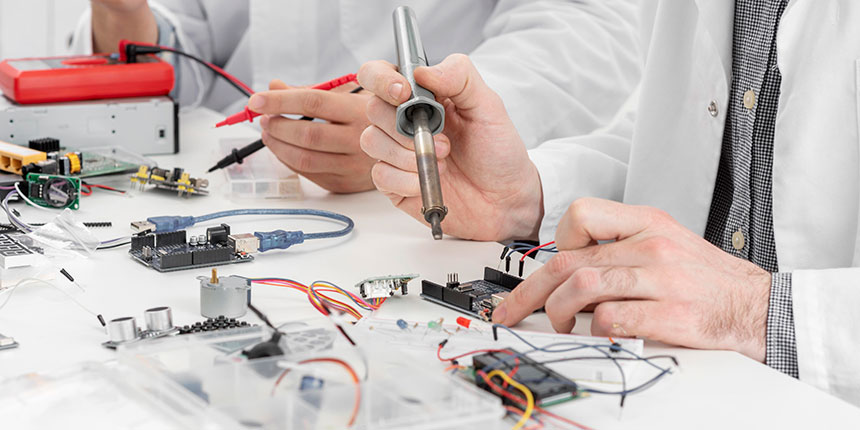
More than 1900 colleges in India offer the BTech Electrical and Electronics Engineering course. Placement opportunities are promising in top institutes. Data from VCE Hyderabad for the academic year 2021–22 shows that out of 101 students registered for placements, 91 received job offers, indicating strong placement potential in this field.
Students must complete their 10+2 in the Science stream and qualify for entrance exams like JEE Main, JEE Advanced, BITSAT, or SRMJEE. Some of the career options include roles such as Electrical Engineer, Electronics Engineer, and Instrumentation Engineer. The average BTech EEE salary is approximately Rs. 4.5 LPA.
BTech in Electrical and Electronics Engineering is a four-year undergraduate course focusing on both electrical and electronic systems. This programme prepares candidates for various engineering roles in the power, automation, and electronics industries. Here are the key highlights of the BTech EEE course, including duration, eligibility, average fees, salary, and career options.
| Particulars | Values |
|---|---|
Course Name | BTech in Electrical and Electronics Engineering |
BTech EEE Course Duration | 4 Years |
BTech EEE Examination Type | Semester system |
BTech EEE Eligibility Criteria | 10+2 (with Physics, Chemistry, and Mathematics with a minimum of 50 per cent marks) |
BTech EEE Admission Process | Entrance Exam/Merit-based |
Entrance Exam | JEE Main, JEE Advanced, BITSAT, and SRMJEE |
BTech EEE Fees | Rs. 6 lakhs |
BTech EEE Average Salary | Rs. 4.5 LPA |
Top Recruiters | Wipro Lighting Corporate, Schneider Electric, Bharat Heavy Electrical Ltd., Havells India Limited, HBM Power System, Tata Electric Companies |
BTech EEE Career Options | Electronics Engineer, Electrical Engineer, Instrumentation Engineer |
To apply for the BTech in Electrical and Electronics Engineering course, candidates must meet specific academic and entrance exam requirements. Eligibility may vary across institutions. Below are the essential BTech EEE eligibility criteria, including subject requirements, qualifying marks, and entrance exams accepted by engineering colleges across India.
| Particular | Values |
|---|---|
Eligibility Criteria | 10+2 in the Science stream (PCM) from a recognised board in India |
Minimum aggregate score | Minimum 50 per cent marks |
Subjects required | Physics, Maths, Chemistry, Computer Science |
Entrance Exam | JEE Main, JEE Advanced, BITSAT, SRMJEE, VITEEE, WBJEE, KEAM Exam, MHT CET |
The BTech in Electrical and Electronics Engineering admission process may vary across colleges. Most institutions accept candidates based on national or state-level entrance exams. Selection is generally merit-based, and those with higher ranks in entrance tests are given preference during the counselling and seat allotment process. Here are some general steps:
Admission to the BTech in Electrical and Electronics Engineering course is primarily entrance-based and may vary across colleges. Most institutes shortlist candidates based on national or state-level exam scores. Below are some of the top entrance exams accepted for BTech EEE admissions:
| Exam Name | Conducting Body | Exam Date |
|---|---|---|
NTA | ||
Karnataka Examinations Authority | ||
JNTU Kakinada | ||
Consortium of Medical Engineering and Dental Colleges of Karnataka | ||
West Bengal Joint Entrance Examinations Board | ||
BITS | ||
SRM University | ||
Anna University | ||
State Common Entrance Test Cell - Maharashtra State | ||
NTA |
The BTech in Electrical and Electronics Engineering cutoff score is used to evaluate merit based on entrance exams. Most colleges consider the JEE cutoff for admission. The cutoff depends on factors like exam difficulty, number of applicants, and available seats, and it differs across institutions.
Also Read: JEE Advanced Preparation Tips 2025
BTech Electrical and Electronics Engineering covers a comprehensive curriculum that equips students with knowledge in electrical systems, electronics, circuit design, control systems, and power systems. The course also includes practical applications in fields like communication and signal processing. The syllabus is from the AVV, Coimbatore.
The first-year syllabus of BTech Electrical and Electronics Engineering covers fundamental concepts in mathematics, science, and engineering. Topics include calculus, differential equations, basic electronics, and programming. Students also participate in lab sessions and workshops to develop practical skills. This structured curriculum sets the groundwork for more advanced subjects in upcoming years.
| Semester 1 | Semester 2 |
|---|---|
Technical Communication | Multivariable Calculus |
Single Variable Calculus | Laplace Transform |
Ordinary Differential Equation | Engineering Physics – A/ Engineering Chemistry – B |
Matrix Algebra | Engineering Physics Lab – A / Engineering Chemistry Lab – B |
Problem Solving and Algorithmic Thinking | Computer Programming |
Engineering Physics – A/ Engineering Chemistry – B | Electrical Engineering Practice |
Engineering Physics Lab – A / Engineering Chemistry Lab – B | Electric Circuits |
Manufacturing Practice | Electronic Circuits |
Engineering Graphics – CAD | Cultural Education – II |
Cultural Education – I | - |
The second-year BTech Electrical and Electronics Engineering syllabus introduces more specialised subjects. It focuses on electrical machines, control systems, signal processing, and digital systems. Students gain deeper insights into circuit design, energy systems, and engineering materials. This year helps develop a stronger technical foundation through both theory and practical applications.
| Semester 3 | Semester 4 |
|---|---|
Fourier Transforms and Complex Analysis | Probability and Statistics |
Fundamentals of Mechanical Engineering | Electrical Machines I |
Material Science for Electrical Engineering | Signals and Systems |
Analogue Integrated Circuits | Electrical Energy Systems I |
Electrical Measurements | Control Systems |
Digital Systems | Soft Skills I |
Electromagnetic Theory | - |
In the third year of the BTech EEE course, the syllabus includes advanced topics such as power electronics, electric drives, and microcontrollers. It also introduces Python programming and optimisation techniques. The curriculum aims to improve practical skills and software knowledge relevant to electrical engineering applications in modern industry.
| Semester 5 | Semester 6 |
|---|---|
Electrical Energy Systems II | Electric Drives and Control |
Power Electronics | Microcontrollers and Applications |
Digital Signal Processing | Optimization Techniques |
Electrical Machines II | Introduction to Python programming |
Soft Skills II | Software-Based Solutions for Electrical Engineering |
- | Open Lab |
- | Soft Skills III |
- | Indian Constitution |
In the final year of the BTech Electrical and Electronics Engineering course, the syllabus focuses on project-based learning and subjects like power system protection, disaster management, and environmental science. These topics help students build practical knowledge, technical skills, and a strong foundation for careers in the electrical and electronics engineering field.
| Semester 7 | Semester 8 |
|---|---|
Power System Protection and Switch Gear | Project Phase II |
Environmental Science | - |
Disaster Management | - |
Project Phase I | - |
The BTech Electrical and Electronics Engineering fee structure depends on the college type and its location. Government colleges charge lower fees, while private institutes may have higher costs. The fee ranges from Rs. 10,000 to Rs. 14.0 lakhs, with the average BTech EEE course fee being around Rs. 6 lakhs.
BTech in Electrical and Electronics Engineering graduates can explore career opportunities in various sectors such as telecommunications, information technology, aviation, transportation, and the electrical industry. They can work in roles related to product design, system management, control systems, power generation, and technical sales, depending on their skills and specialisation.
After completing the BTech EEE course, graduates can choose to enter the teaching profession. They may work as lecturers at reputed colleges and universities. Additionally, those interested in research can pursue postgraduate degrees like MTech and PhD to build a career in academics and scientific research.
After completing a BTech in Electrical and Electronics Engineering, graduates have various career opportunities across industries. These roles involve working with cutting-edge technologies, designing electrical systems, and contributing to advancements in electronics and instrumentation. Here are some of the job roles with their average salary in BTech EEE.
| Job Roles | Description | Average Salary (LPA) |
|---|---|---|
Electronics Engineers are engineers who have completed a bachelor's degree in electronics engineering or a similar field. Electronic components, circuits, and systems are designed, developed, adapted, installed, tested, and maintained by them. | Rs. 4.1 LPA | |
Electrical Engineers create and test innovative electrical systems, as well as find answers to electrical issues and devices. They work with large-scale electrical systems, including motor control and power transfer, daily. | Rs. 4.7 LPA | |
Instrumentation Engineer | Instrumentation Engineers work with pressure, temperature, and flow measurement instruments to configure them. Their main task is to work on design specifications and packages for individual devices. They frequently perform the installation as well. | Rs. 6.3 LPA |
Control Systems Engineer | Control Systems Engineers design and maintain systems that regulate machinery and processes, ensuring smooth operation through automation. They use their expertise in electrical circuits, programming, and system dynamics to optimise performance, reliability, and safety across industries like manufacturing and energy. | Rs. 9.1 LPA |
Source: Ambition Box
BTech in Electrical and Electronics Engineering graduates have vast career opportunities in fields like electrical, electronics, and information technology. With continuous advancements in the digital and electronics sectors, engineers specialising in this domain are always evolving their skills. They gain deeper insights into electrical and electronics concepts while enhancing their expertise.
Around 1800 private Indian institutes offer a Bachelor of Technology in Electrical and Electronics Engineering. These private BTech EEE colleges are significantly more expensive than public universities. Some of the best private BTech EEE colleges in India are listed below:
| Top Colleges | NIRF Ranking | Fees |
|---|---|---|
56 | Rs. 16.84 lakhs | |
19 | Rs. 6.92 lakhs | |
21 | Rs. 11 lakhs | |
201-300 | Rs. 15.02 lakhs | |
99 | - | |
101-150 | Rs. 2.20 lakhs | |
45 | Rs. 11.20 lakhs | |
101-150 | Rs. 4.49 lakhs | |
151-200 | Rs. 18 lakhs | |
85 | - |
Attending a government-run college is less expensive than attending a private college. These colleges are well known for their high academic standards in India. The following table contains some of the best government BTech EEE colleges in India:
| Top Colleges | NIRF Ranking | Fees |
|---|---|---|
90 | - | |
151-200 | Rs. 41,320 | |
101-150 | - | |
NA | Rs. 4.64 lakhs | |
31 | Rs. 6.30 lakhs | |
NA | Rs. 2.10 lakhs | |
NA | - | |
77 | Rs. 10.95 lakhs | |
46 | Rs. 5.76 lakhs | |
University College of Engineering, Osmania University, Hyderabad | 101-150 | Rs. 2 lakhs |
BTech in Electrical and Electronics Engineering offers diverse career opportunities in fields like product development, wireless communication, and system engineering. Graduates can work with top companies or pursue higher education to further improve their skills and expertise in electrical and electronics engineering.
Frequently Asked Questions (FAQs)
The BTech EEE full form is Bachelor of Technology in Electrical and Electronics Engineering. BTech in EEE is a four-year degree programme, which is divided into eight semesters. The BTech EEE course is considered a skill-oriented program that is pursued after completing class 12th with science stream.
Many top recruitment companies are hiring electrical and electronics engineering candidates such as BHEL, NSPCL, SAIL, NTPC, ISRO, L&T, TATA Motors, and GAIL.
For BTech Electrical and Electronics Engineering graduates, there is a wide range of BTech EEE career options available in the public as well as private sector companies dealing with the designing, manufacturing, and application of electronic devices and equipment, communication systems, radio & television, radar, hardware & software, and more.
To meet the BTech EEE eligibility criteria, candidates should have completed their 10+2 with physics, chemistry, mathematics, and biology, with a minimum of 50 per cent marks.

On Question asked by student community
Hello, pursuing an M.Tech in Artificial Intelligence and Machine Learning after B.E. in AI and ML can help you gain advanced knowledge and specialise in the field. You can explore M.Tech AI and ML colleges and fees details here: https://engineering.careers360.com/colleges/list-of-artificial-intelligence-and-machine-learning-colleges-in-india?degree=6&stream=1&branch=588
You can pursue B.Tech in Robotics, Automation or Mechatronics after Class 12 with PCM. Admission depends on the university and may be through JEE Main or merit.
For example, Galgotias University offers B.Tech in Robotics and Mechatronics, so these can be good options to explore if you're interested in automation
Hi,
Yes, you can still join BE/BTech through KCET counselling. Since you officially discontinued your B.Sc Agriculture seat, submitted the discontinuation letter, and got your TC/documents back without penalty, you are generally eligible to participate in KCET counselling again.
KEA mainly creates issues when students block seats and do not
If you're specifically looking for B.E./ B. Tech in Aerospace Engineering (not Aeronautical Engineering) , it's worth considering LPU as well. Aerospace Engineering is a broader field that covers the design, development, testing, and maintenance of both aircraft and spacecraft , including satellites, rockets, and space exploration systems, whereas Aeronautical
Hello
If you are looking for the BE/B.Tech in Aerospace Engineering in Karnataka or Tamil Nadu States. There are some reputed colleges which offer this course with good academics and the best placement records.
Here are some colleges that offer BE/B.Tech in Aerospace Engineering -

Merit Scholarships | NAAC A+ Accredited | Top Recruiters : E&Y, CYENT, Nvidia, CISCO, Genpact, Amazon & many more
AICTE Approved | Affiliated to AKTU | Grade "A" college of GGSIPU | Highest CTC 14.2 LPA
Ranked #43 among Engineering colleges in India by NIRF | Get Upto 100% Scholarships
100% Placement Support | State-of-the-art Infrastructure
Affiliated to Anna University | Highest CTC 44 LPA | Top Recruiters : JP Morgan Chase & Co, Nielson IQ, QUBE, META, GOOGLE, AMAZON & many more.
Application Free of Cost for Limited Time || NAAC A++ Accredited | Highest CTC 52 LPA | #11 in University Category by NIRF