Symbiosis Online Programs
Online PG programs from Symbiosis Centre for Distance Learning


B.Tech in Electronics Engineering is a four-year undergraduate course like all other undergraduate engineering degrees. It is a branch of electrical engineering in which students are taught the effects and application of electrons to build components, electrical circuits, devices, systems, or equipment. Students with PCM subjects in 10+2 can gain admission to BTech in Electronics Engineering.
This Story also Contains
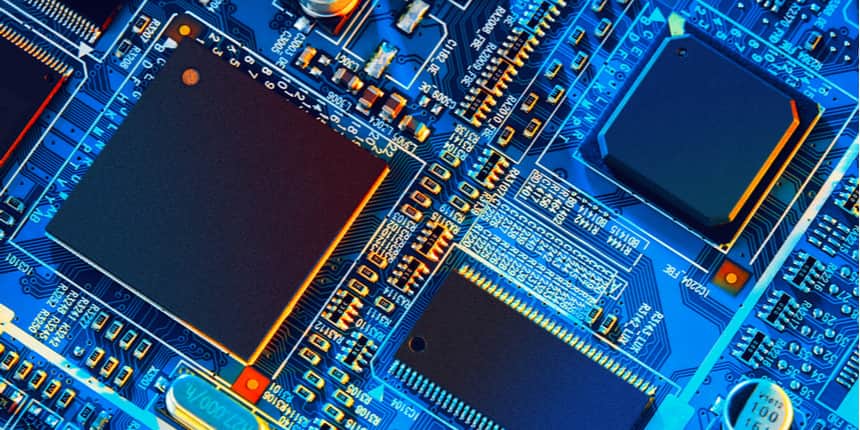
Subjects studied in the B.Tech in Electronics Engineering programme are electrical circuits and systems, electromagnetic fields, electronic devices & components, signals & systems, and numerical methods. Apart from these, other subjects that are a part of the curriculum are network analysis, analog circuits & systems, digital communication systems, microwave engineering, and micro-processing engineering.
BTech ECE, BTech EEE, and B.Tech in Applied Electronics Engineering are closely related to this course. More than 150 colleges in India offer B.Tech in Electronics Engineering courses. The fees of this degree start from Rs. 13,000 and end at Rs. 21.0 lakhs. Graduates can work in IT, transportation networks, air-plane manufacturing, production, and power distribution.
Particulars | Values |
|---|---|
Course Name | B.Tech Electronics Engineering |
Course Duration | Four years |
Examination Type | Semester system |
Course Eligibility | 10+2 with PCM |
Admission Process | Entrance Exam/Merit-based |
Entrance Exam | JEE Main, MHT CET, UPCET, AP EAMCET, KCET |
Course Fees | Rs. 13,000 to Rs. 21.0 lakhs |
Average Salary | Rs. 4.0 LPA |
Top Companies | Research and Development Laboratories, Bharat Heavy Electricals Limited, Defence Organisations, National Thermal Power Corporation, Texas Industries, CISCO, IBM |
Job Position | Electronics Engineer, Design Engineer, Test Engineer, Project Engineer, Product Designer |
Meeting the eligibility criteria is a must step for admission, and it is not static and can vary across institutions, depending on the affiliation or governing body. A general B Tech Electronics Engineering eligibility criteria for aspirants are mentioned below:
The admission process for B.Tech in electronics engineering is identical to any other undergraduate programme in the engineering domain. Numerous stages need to be completed to get admitted.
Candidates need to qualify for engineering entrance exams conducted at national, state, and university levels for admission to top colleges. Mentioned below are some exams that aspirants should prefer to attend.
Exam Name | Level | Conducting Body | Exam Schedule |
|---|---|---|---|
National | NTA | ||
State | Karnataka Examinations Authority | ||
State | JNTU Kakinada | ||
State | Consortium of Medical Engineering and Dental Colleges of Karnataka | ||
State | West Bengal Joint Entrance Examinations Board | ||
University | SRM University | ||
State | State Common Entrance Test Cell - Maharashtra State | ||
State | JNTU Hyderabad | ||
State | Odisha Joint Entrance Examinations Board | - | |
State | Commissioner for Entrance Examinations |
The cutoff is the minimum mark candidates need to score to go further in the admission process. It is determined based on the entrance examination scorecard. The difficulty level of the exam, total seat intake, and the number of applicants collectively decide the cutoff. The BTech in Electronics Engineering cutoff is published by the government authority on their official website.
Here, in this section, we have mentioned all the skills required for B.Tech in Electronics Engineering course. These skills are not mandatory, but having them on your side will be beneficial for sure.
The curriculum of B Tech in Electronics Engineering is divided into eight semesters encompassing theoretical and practical subjects. The B Tech in Electronics Engineering subjects given below are taught at RGIPT Amethi.
Semester 1 | Semester 2 |
Classical Physics | Modern Physics |
Inorganic & Physical Chemistry | Differential Equations |
Real Analysis & Calculus | Fundamentals of Electronics Engineering |
Computer Programing | Thermodynamics |
Electronics Engineering Work Practices | Engineering Graphics |
Workshop Practices | Biology |
Semester 3 | Semester 4 |
Linear Algebra & Complex Analysis | Fundamentals of Mechanical Engineering |
Fundamentals of Electrical Engineering | Signals and Systems |
Materials Science | Statistical Methods and Data Analysis |
Network Analysis & Synthesis | Numerical Methods |
Solid State Electronic Devices | Analogue Circuits and Systems |
Data Structure and Algorithm | Digital Circuits and Systems |
Semester 5 | Semester 6 |
Analogue Communication Systems | Digital Signal Processing |
Microelectronics | Digital Communication |
Electromagnetic Fields and Transmission Lines | Department Elective - 2 |
Department Elective – 1 | Control Systems |
Microprocessor Engineering | Instrumentation Engineering |
B.Tech. Project | B.Tech. Project |
- | Industrial Training/Summer Project |
Semester 7 | Semester 8 |
Basic VLSI Design | Antennas and Propagation |
Microwave Engineering | Optical Communication |
Department Elective-3 | Department Elective - 4 |
Open Elective – 1 | Open Elective-2 |
Language & Management Courses L/M-1 | Language & Management Courses L/M-2 |
B.Tech. Project | Advances in Electronics Engineering |
The B Tech in Electronics Engineering fees have to be paid by the student every semester. The fee structure includes tuition fees, facilities charges, session charges, library, and a one-time admission fee as well.
There are no fixed BTech Electronics Engineering fees, as the governing body of the college holds all the right to alter it. Generally, public colleges and universities have lower fees compared to private colleges. The average B Tech in Electronics Engineering fees range from Rs. 13,000 to Rs. 21.0 lakhs.
B.Tech in electronics engineering course offers an innovative approach to the career. The number of graduates in electronics engineering is increasing every year. An electronics engineering graduate works in numerous fields such as the electronics industry, communication, electromedical industry, IT industry, power generation industry, manufacturing industry, and hardware industry.
Graduates with a B.Tech in Electronics Engineering can also pursue MTech or MBA as it also opens numerous new opportunities to pursue doctoral studies. If graduates are inclined toward research work, a PhD in a related field is also a good option for them.
The career prospects in B Tech in Electronics Engineering are great both nationally and internationally. Many major companies recruit skilled and capable electronic engineers who contribute to the further growth of their company. Mentioned below are some of the job profiles that candidates might land in after completing their graduation.
Electronics Engineer: Electronics engineers design and develop electrical equipment, systems, and devices. They create electronic systems for manufacturing companies focusing on engineering and technology.
Design Engineer: Design engineers in the electronics domain create prototypes of electrical products. They research and work on already existing products and try to optimise and make them more efficient.
Project Engineer: Project engineers are responsible for overseeing the process of a new product. They ensure that the product meets all the technical specifications as required by the client.
Telecom Engineer: Telecom engineers are professionals who are responsible for the maintenance of telecommunication systems. They install and repair all kinds of telecommunication systems.
Electronics engineering deals with the studies of electromagnetism & its uses in a broad way and is associated with the application of electronic devices such as integrated circuits, electrical circuits, and transistors. Knowledge gained during the course will help candidates get a job right after graduation.
Graduates can find employment in the private and public sectors. PSUs and various other government departments recruit BTech Electronics Engineering graduates, offering lucrative salaries and other perks. It signifies a never-ending field of opportunities for a bachelor's in electronics engineering.
The remuneration for the job profiles in the electronics engineering domain alters from individual to individual depending upon their capabilities and tenure. The salary also differs for every job profile.
The more skilled and experienced professionals are in their domain, the higher earnings they are paid. Mentioned below are some BTech Electronics Engineering salary figures for reference purposes, please treat them as such.
| Job Position | Average Salary |
|---|---|
Electronics Engineer | Rs. 3.9 LPA |
Test Engineer | Rs. 5.6 LPA |
Project Engineer | Rs. 5.3 LPA |
Design Engineer | Rs. 4.1 LPA |
Telecom Engineer | Rs. 4.0 LPA |
Source: Ambition Box
Numerous colleges offer B.Tech in electronics engineering, however, selecting a good college is the most important step for your career. Mentioned below are some of the top colleges in India that offer this electronics engineering course:
| Colleges | Total Fees |
|---|---|
Rs. 8.58 lakhs | |
Rs. 17.21 lakhs | |
Rs. 11.0 lakhs | |
Rs. 14.91 lakhs | |
RGIPT Amethi | Rs. 11.07 lakhs |
Rs. 3.32 lakhs | |
Rs. 33,360 | |
Rs. 6.81 lakhs | |
- | |
- |
More than 140 private colleges in India offer B Tech in Electronics Engineering. Listed below are the top colleges along with their fee structure.
Colleges | Total Fees |
|---|---|
Montessori Siva Sivani Institute of Science and Technology, Vijayawada | - |
Rs. 5.0 lakhs | |
Rs. 3.58 lakhs | |
Rs. 2.56 lakhs | |
Rs. 3.0 lakhs | |
- | |
Rs. 3.60 lakhs | |
Rs. 12.0 lakhs | |
Rs. 5.03 lakhs |
In India, government colleges are the first choice for many candidates because of their low fees and highly qualified teachers. Listed below are the top government BTech in Electronics Engineering colleges in India.
| Colleges | Total Fees |
|---|---|
Rs. 1.72 lakhs | |
- | |
Rs. 4.68 lakhs | |
- | |
- | |
Rs. 1.34 lakhs | |
Rs. 51,750 | |
Rs. 1.21 lakhs | |
Rs. 2.33 lakhs | |
Rs. 13,940 |
B Tech in Electronics Engineering comprises subjects such as the design and application of circuitry and equipment that are used for power generation and distribution, machine control, and communications. Pursuing this course can be a perfect choice for interested candidates.
Research about potential colleges and institutes where an aspirant is planning to apply will be very beneficial before getting into the tedious process of admissions.
Frequently Asked Questions (FAQs)
B. Tech in Electronics Engineering is a 4-year undergraduate course in the engineering domain. It is a branch of electrical engineering that teaches the effects & application of electrons to build components, electrical circuits, devices, systems, or equipment.
The career prospects in this field are great at both national and international. Many major companies are recruiting skilled and capable electronic engineers who will contribute to the further growth of their company.
IIT BHU, Thapar University, SRM University Chennai, and KIIT University are the top B Tech in Electronics Engineering providers in India.
Candidates are required to have passed Class 12 with PCM subjects from any recognised board in India.

On Question asked by student community
Hello, pursuing an M.Tech in Artificial Intelligence and Machine Learning after B.E. in AI and ML can help you gain advanced knowledge and specialise in the field. You can explore M.Tech AI and ML colleges and fees details here: https://engineering.careers360.com/colleges/list-of-artificial-intelligence-and-machine-learning-colleges-in-india?degree=6&stream=1&branch=588
You can pursue B.Tech in Robotics, Automation or Mechatronics after Class 12 with PCM. Admission depends on the university and may be through JEE Main or merit.
For example, Galgotias University offers B.Tech in Robotics and Mechatronics, so these can be good options to explore if you're interested in automation
Hi,
Yes, you can still join BE/BTech through KCET counselling. Since you officially discontinued your B.Sc Agriculture seat, submitted the discontinuation letter, and got your TC/documents back without penalty, you are generally eligible to participate in KCET counselling again.
KEA mainly creates issues when students block seats and do not
If you're specifically looking for B.E./ B. Tech in Aerospace Engineering (not Aeronautical Engineering) , it's worth considering LPU as well. Aerospace Engineering is a broader field that covers the design, development, testing, and maintenance of both aircraft and spacecraft , including satellites, rockets, and space exploration systems, whereas Aeronautical
Hello
If you are looking for the BE/B.Tech in Aerospace Engineering in Karnataka or Tamil Nadu States. There are some reputed colleges which offer this course with good academics and the best placement records.
Here are some colleges that offer BE/B.Tech in Aerospace Engineering -

Ranked #43 among Engineering colleges in India by NIRF | Get Upto 100% Scholarships
Apply for B.E at East Point College of Engineering and Technology | Affiliated to VTU | AICTE Approved | NBA Accredited | Highest CTC 33 LPA
100+ Recruiters | 100+ Placements of 2026 Batch | NBA & NAAC Accredited | Highest CTC 37 LPA
NBA Accredited | AICTE Approved | Affiliated to AKTU | Highest CTC 14.2 LPA | Accepts CUET Score
Ranked #45 Among Universities in India by NIRF | 1950+ Students Placed 91% Placement, 800+ Recruiters
Merit Scholarships | NAAC A+ Accredited | Top Recruiters : E&Y, CYENT, Nvidia, CISCO, Genpact, Amazon & many more